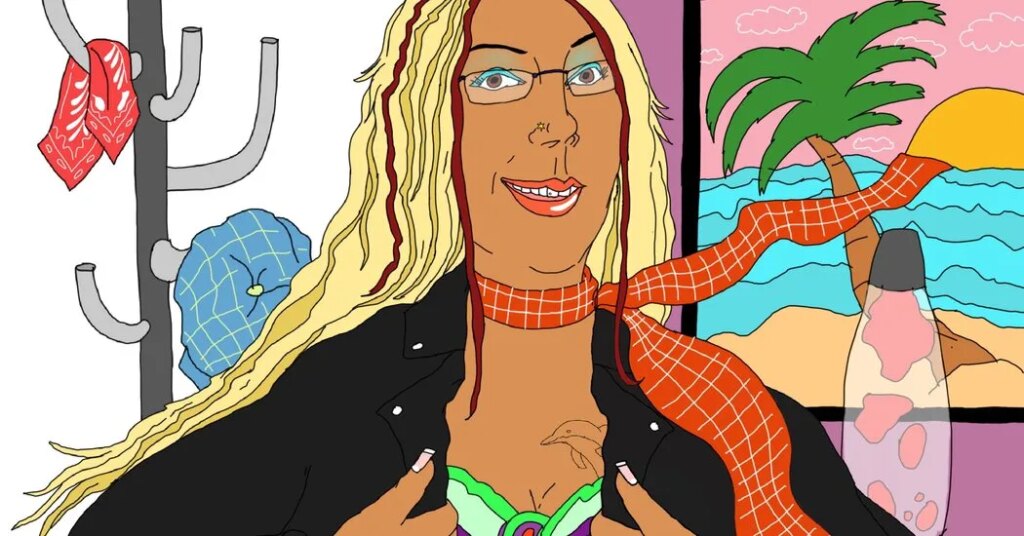
I’ve been obsessing over this year’s return to relevance of a fashion brand that I wore 20 years ago: 7 for All Mankind. It’s once again selling the low-rise jeans that made it famous, now alongside the rest of the 2006 uniform: hip-hugger belts, tiny jackets with princess shoulders and giant, comically impractical platform heels. In a runway show during New York Fashion Week last month, it doubled down on hyping a self-consciously 2006 tousled party girl.
These deliberately messy clothes feel deeply familiar to me. I wore them all the first time around. My friends and I mixed vintage with repurposed clothing: shrunken leather jackets off the racks at Buffalo Exchange, plus a skinny scarf stolen from rail-thin rock boys who bought their jeans from the Gap’s girls department. So it’s been equal parts hilarious and destabilizing to watch the look of my early 20s reappear, to rapturous praise, on the Instagram feeds of very stylish friends who are actually in their early 20s.
I understand this is an established-to-the-point-of-cliché pattern. Isn’t there some adage about living long enough to see the music and the clothes of your youth repackaged and sold back to you? Fine. But skinny jeans and white belts? Really?
In an era when even teenagers are plumping, smoothing, nipping and tucking their way into uniformity, it suddenly feels luxurious to look undone, to be able to afford that kind of recklessness, sartorially and emotionally. Quiet luxury, the dominant fashion philosophy of the past few years, was never about restraint so much as erasure: the expensive, exhausting work of looking as if you have no visible seams, no history, no night before.
When I was 22 and living on the Lower East Side, my roommate, Sarah, and I scoured Rainbow on Canal Street for Day-Glo clothes in fabrics that felt (and probably were) flammable. We wore them with thrifted ’50s lingerie and vintage rock T-shirts Sarah cut apart and safety-pinned back together, dressing from an ever-shifting pile of shared clothes on the floor, then painting our lips with drugstore Wet n Wild red lipstick.
Nobody wanted to look bad, obviously. We were as vain and as preening as any other set of young people. But it was possible to look terrible and still be cool. Joe Strummer famously said about punk that “if you were ugly, you were in.” Karen O once put it this way: “Every photo you’d see would be basically the most unattractive, ugly moment of every show, but it’s pretty awesome that that’s what they wanted to showcase. The real. The gritty, visceral — bleh — real.” Beauty had value in the early 2000s, as it always does and always will. It just wasn’t the only currency. And more to the point, it would have seemed gauche to have beauty and not spend it: not live in it, not see how far it could get you.
Is that what is missing today? We live in an era of mass market Botox and filler (and now on-demand GLP-1s) and wellness coaches and self-improvement book clubs and ketamine shamans, and all the other self-management products that are meant to fix our faces, bodies and souls are merely the market responding to our need to curate ourselves, 24/7, for life online. In the end, what are we really getting out of that? Where is the carnal payoff?
When I asked one of my 20-something friends why she loves 7 she sent me multiple screenshots of Ashton Kutcher in cargo shorts, part of a trove of Y2K inspiration she apparently keeps handy on her phone. Looking at these, I was reminded that the 2000s were not, by any reasonable measure, a great fashion era. Message T-shirts, trucker hats, asymmetrical striped dresses from Forever 21 that look like dish towels. So much of what we wore was so very bad. And yet, in those images she’d collected of the era’s celebrities, with their disheveled frosted-tip fashion sense, I could see an appealing idea of early 2000s life. It was an experience of youth that was messier, smaller, more D.I.Y., more insouciant and private — and that now feels mostly unavailable, even to people who are actually young.
Look again at my friend’s Y2K party pic collection and you’ll see people who were completely absorbed in the actual living of their actual lives — even the Olsen twins, even the C-listers with the bad self-tans that, in hindsight, my friend pointed out, just made everyone look young.
It’s appropriate that the 7 relaunch would be fronted by Chloë Sevigny, who at 51 remains the reigning archetype of the girl the brand is appealing to, and who has, for years, been lamenting the blandification of fashion and culture. Two years ago, asked where she would never want to live, Ms. Sevigny landed on Los Angeles, drolly rattling off a list of critiques that included the hard water and “monotonous” sunshine, before more thoughtfully describing the as a place that makes her feel “self-conscious” and “uncomfortable” because it’s so specifically constructed around the entertainment business. So many places feel like that now — virtually every street corner on every city block is just another anonymous stage for influencers with indistinguishable faces and bodies shooting indistinguishable content to sell products that will make us look more like them.
These new 7 clothes feel like an attempt to sell you a different option. Instead of looking like someone styled for a repressive fantasy of perfection, perhaps you might like to look like someone caught in the middle of her imperfect life. There’s a risk associated with this approach: that you’ll look bad, wear the wrong thing, say the wrong thing, be seen as unfinished. But for the cost of a moment of messiness, you can reclaim a little lived-in disorder. That may be why wearing a pair of cheap-looking but not actually cheap low-rise jeans can suddenly feel like a deliberate act of freedom.
Back in the day I owned a pair of 7s. They were probably the most expensive thing in my wardrobe then. Stiff, dusty blue with a little stretch — novel, at the time — something like a denim scuba suit, with a crease built permanently into the fade. They were great. They were ridiculous. They’ve been in storage for the last 20 years. This fall, they’re going back into rotation.
Lizzy Goodman, a contributing writer at The New York Times Magazine, is the author of “Meet Me in the Bathroom: Rebirth and Rock and Roll in New York City 2001-2011.”
The Times is committed to publishing a diversity of letters to the editor. We’d like to hear what you think about this or any of our articles. Here are some tips. And here’s our email: [email protected].
Follow the New York Times Opinion section on Facebook, Instagram, TikTok, Bluesky, WhatsApp and Threads.
The post The Luxury of Looking a Mess appeared first on New York Times.