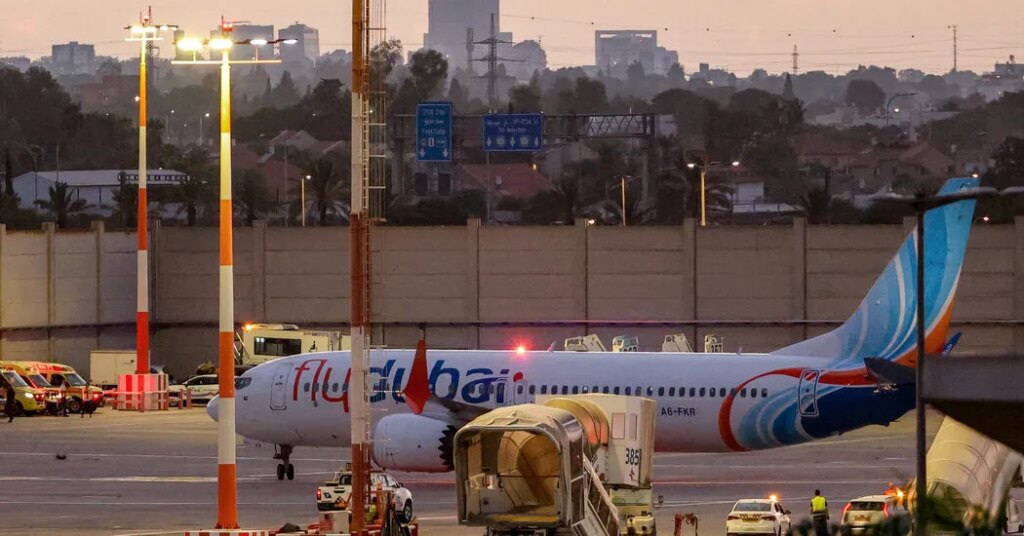
The co-pilot who violently attacked the captain of a flight from Dubai to Tel Aviv and then tried to crash the airliner had embraced extreme Islamist views, prompting security officials in Oman to scrutinize him earlier, according to two people briefed on the matter.
The co-pilot was identified as an Omani man named Hamam al-Hamami, who was the first officer on FlyDubai Flight 1073, the two people said. They spoke on the condition of anonymity because they were not authorized to publicly discuss the investigation into the attack.
The investigation so far indicated that he had acted alone and had no known ties with Iran, which has long sought to target Israelis abroad, two U.S. officials said. Lone wolves can be hard for counterterrorism officials to detect.
A recent social media post attributed to Mr. al-Hamami showed a photo of a former Qaeda leader, CNN reported. Concerns about his radicalization raise questions about what background checks had been carried out before allowing him to fly. It is unclear whether the Omanis had shared their concerns with security officials in Israel, the United Arab Emirates — where the flight originated — or with the airline.
Mr. al-Hamami’s identity was first reported by Al Arabiya, a Saudi Arabian broadcaster, and The Wall Street Journal first reported Oman’s concerns about his radical ideological views.
More than 170 passengers, mostly Israelis, were on the FlyDubai flight on Wednesday when the co-pilot began stabbing the captain less than an hour before it was supposed to land. The plane plunged more than 17,000 feet in less than two minutes, flight tracking websites showed, as its pilot, Capt. Smit Machchhar, fought off the attack. Captain Machchhar managed to unlock the cockpit door, and passengers intervened, averting a crash.
Much remains unclear about the motive for the attack, which is the subject of an international investigation. Prime Minister Benjamin Netanyahu of Israel told Fox News on Thursday that the co-pilot had undergone “Islamist radical indoctrination,” but he did not elaborate. The plane’s passengers were mostly Israeli, some of whom said the crisis evoked the feelings of dread they had last felt on Oct. 7, 2023, during the Hamas-led attack on Israel, in which about 1,200 people were killed.
A LinkedIn profile bearing Mr. al-Hamami’s name said he lived in Muscat and had worked at Oman Air for seven years, leaving in 2025. The profile said he had studied engineering at RMIT University in Australia, and, more recently, aviation at Buckinghamshire New University in Britain. The page made no mention of FlyDubai. The LinkedIn profile has been deleted.
After the failed attack on the plane, two posts appeared on the profile, CNN reported. One depicted a photo of Ayman al-Zawahri, who led Al Qaeda after Osama bin Laden’s death and was killed by the United States in 2022. It was not clear who made the posts or whether they had been scheduled in advance to be published.
The U.A.E. said on Thursday that it would take the lead in investigating whether the attack was linked to terrorism. Both Captain Machchhar, who was wounded in the attack but is in stable condition, and Mr. al-Hamami have been transferred to the Emirates from Saudi Arabia, where the plane made an emergency landing.
A group of passengers is credited with saving the aircraft by rushing into the cockpit and subduing the co-pilot after being alerted by a mother’s screams, before treating the wounded Captain Machchhar.
Adam Goldman contributed reporting.
The post Omani Co-Pilot on FlyDubai Flight Is Said to Have Extremist Views appeared first on New York Times.