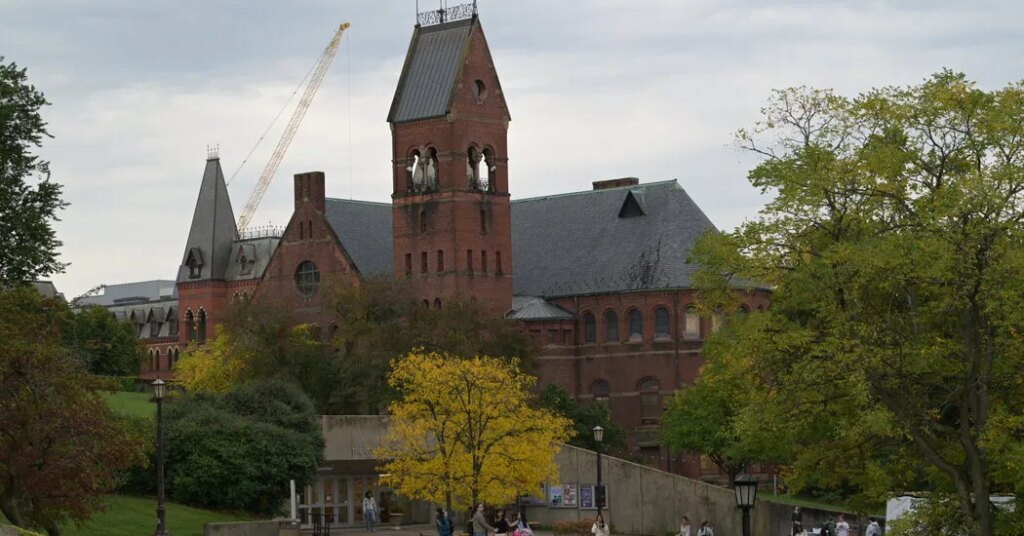
A lawsuit alleging rape at a Cornell fraternity house has set off a wave of anger among women on college campuses and beyond.
Campus sexual assault survivors and their supporters have published essays in school newspapers and inundated social media in solidarity with the complainant, known in court records only as Jane Doe.
Some are using the familiar #MeToo hashtag of an earlier movement to combat sexual abuse and harassment. Others have adopted a new one: #IAmJaneDoe.
In one opinion article in the University of Pennsylvania campus newspaper, students wrote that “sexual violence happens far too often on college campuses everywhere.”
“It’s time to face the fact that the ‘Cornell incident’ isn’t just born of Cornell problems, or limited to a Cornell issue,” the students wrote.
The outrage flooding social media and rising up on campuses follows similar waves of disgust about campus sexual violence that emerged more than a decade ago and then reignited after the broader #MeToo reckoning that began with Hollywood sexual assault revelations. Driving the campaign in support of Ms. Doe is a feeling that not enough changed after similar movements.
The Penn students wrote, for example, that past responses have been bureaucratic, and that universities “prioritize bolstering their own image” instead of making deeper changes that protect women from assault.
Celebrities have also joined the outcry. Mariska Hargitay and her Joyful Heart Foundation, which supports domestic violence survivors, posted: “Survivors deserve to be believed and kept informed. Silence protects no one. To her: we support you.”
During an appearance in Ithaca, N.Y., Representative Alexandria Ocasio-Cortez called the 2024 episode at Cornell’s Chi Phi fraternity house part of a “culture of rape” on college campuses.
In the lawsuit, the young woman says she was assaulted at the Chi Phi house on Cornell’s campus, names seven men who were involved and says the university and law enforcement agencies did not do enough to punish or pursue prosecution of the men.
The men involved have denied the allegations, while the university, the fraternity and prosecutors have said they responded appropriately given the information they had at the time.
Lawyers point out the difficulty of prosecuting such cases in court, particularly when many complainants, including Ms. Doe, change their accounts over time. Records obtained by The New York Times present a murky picture of what took place. The woman indicated in one text message to one of the men that “nothing illegal” had happened. But she also told police investigators that “I can say with 100 percent confidence I was raped.”
The widespread condemnation of accused men could create an unfair dynamic, according to Andrew T. Miltenberg, a lawyer for one of the Cornell men, Gillio Lopes. He said the “danger in a case like this is that an accusation, amplified often enough, can harden into a verdict before the evidence is ever tested.”
Mr. Miltenberg, known for representing students against sexual misconduct claims, said the attention was compounded by statements of public officials that seemed to side with Ms. Doe.
On Sept. 28, Attorney General Letitia James posted on X: “What this young woman has been forced to endure is horrific and unacceptable. I’m holding her in my heart and prayers.”
Several days later, Gov. Kathy Hochul appointed Ms. James to take over investigating the case.
Mr. Lopes has unequivocally denied the allegations, Mr. Miltenberg said.
The online outpouring in support of Ms. Doe has also led to a backlash, with some right-wing commentators condemning her and others trying to reveal her identity.
Federal data shows that nationally, there were 6,000 to 6,200 reports of rapes on campus a year from 2014 to 2019, or about eight to 11 per 10,000 on-campus students. But reports declined drastically during the pandemic years, when many students took classes remotely. Since then, they have begun to rise again.
The data does not show how many reports resulted in action or were substantiated.
But the available data suggests the problem has been widespread. Over a quarter of undergraduate women reported some form of nonconsensual sexual contact by physical force, or because they were unable to consent, according to a large survey of students conducted by the Association of American Universities in 2019.
That survey also found evidence of a growing awareness about rules and resources, as universities built out new policies and training.
At Cornell, a survey conducted by the university found that roughly one-third of undergraduate women said they had unwanted sexual experiences.
For some current Cornell students and recent graduates, reading Ms. Doe’s claims of assault has prompted them to share memories of their own experiences of sexual misconduct. Many said that the allegations weren’t entirely surprising because of how often they had heard about friends who said they had been assaulted at parties.
“To be honest, there are so many during my time there that it almost feels like it all blurs into one,” said Claire Ting, who graduated from Cornell last year and served in student government, referring to conversations with friends about upsetting sexual experiences.
“We would see posts and discussions talking about the sexual assaults that happened,” she added. “The buzz would die down and then it would happen again.”
The response, she said, was “hurdle after hurdle of bureaucracy.”
There have been other moments in recent decades when campus sexual assault has dominated the national conversation. When the documentary “The Hunting Ground” was released in 2015, for example, it galvanized a movement.
Lady Gaga sang the film’s theme song at the Oscars, where she was introduced by Joseph R. Biden Jr., then the vice president. At the time, statistics showed that one in four women on campus reported being sexual assault victims. Just months before the film’s release, the launch of a White House campaign to end campus sexual assault — “It’s On Us” — seemed to signal a changing tide.
More than a decade later, though, the allegations at Cornell prompted questions among survivors about whether anything has changed.
Kacey Lee, who graduated from Cornell in 2025, said she was both “shocked and not shocked” in the fall of 2024 when she heard about Ms. Doe’s reported assault.
“Being around frat culture and knowing how people can be there was a level of — not that I was expecting it, but I was not the most surprised,” Ms. Lee said.
While federal data shows that Cornell has reported as many as 28 campus rapes in some recent years, its on-campus undergraduate population is the largest of any Ivy League school. When adjusted for its size, Cornell mirrors many of its peer institutions.
Cornell officials have said they disciplined the men after investigating Ms. Doe’s allegations, but didn’t provide details. They have defended their response and cautioned against a “false narrative,” which they said could depress reports of sexual assault.
In a message on its website, the university said it had strengthened its policies around sexual assault in recent years. “Our goal is not simply to respond appropriately when sexual misconduct is reported,” the school said, “but to build a community in which sexual violence is prevented, people feel safe coming forward, those who do are supported, and individuals found responsible are held accountable.”
Elise Siemering, who has said she was raped 14 years ago by a fellow student at High Point University in North Carolina, said she found comfort in the social media outpouring.
“The women and men who say, ‘I am Jane Doe,’ it gives you a glimmer of hope that there are people in our nation who try to shield her as much as they can,” said Ms. Siemering, who was among more than 30 people who told their stories in the 2016 book “We Believe You.”
Annie E. Clark, whose allegations of sexual assault at the University of North Carolina at Chapel Hill served as the basis for “The Hunting Ground,” said this week that the growth of social media had, in some ways, helped women.
“With the advent of social media, more people are sharing their stories and know that they are not alone,” said Ms. Clark, co-founder of the organization End Rape on Campus.
Indeed, social media platforms are where the original #MeToo movement gained steam, a little less than a decade ago, spurred by disturbing disclosures about the film producer Harvey Weinstein.
Researchers at the University of Chicago documented the role of #MeToo on social media as a catalyst for social change, noting that the hashtag was used on Twitter, now X, 19 million times between 2017 and 2018, the first year of the movement, and in dozens of different languages.
The hashtag became “a sign of empowerment for victims who may have feared they were alone,” the researchers found.
But since then, a series of federal regulatory changes has created instability in the handling of campus sexual assault cases, according to Kenyora Johnson, chief executive of End Rape on Campus.
Referring to the release of “The Hunting Ground,” she said, “Eleven years later, we’re still talking about survivors struggling to be heard.”
The film was released shortly after a highly publicized incident at Florida State University, and featured a freshman who brought sexual assault claims against Jameis Winston, a Heisman Trophy winner who is now the starting quarterback of the New York Giants.
Before that accusation became public, a second woman had sought counseling after reporting a sexual encounter with Mr. Winston, saying that she felt violated by the incident.
Mr. Winston, who denied misconduct, was not prosecuted in the case, although a story in The New York Times raised questions about law enforcement handling of the inquiry. In 2016, both Florida State and Mr. Winston settled lawsuits filed by his accuser, according to reports at the time.
Although many of Cornell’s current students and recent graduates are too young to remember the #MeToo movement, they expressed frustration about the pervasiveness of sexual violence around them.
At a Cornell student government forum on Thursday afternoon, a junior, Jane Wang, came forward and said that she saw herself reflected in Ms. Doe’s experiences.
“I cannot speak on behalf of all survivors because the pain, hurts and trauma that each of us carries is our own,” Ms. Wang told the student government representatives.
Students warn one another about the risks of fraternity parties immediately when they get to Cornell, said Hannah Shvets, a senior who also serves on the Ithaca Common Council. Young women, she suggested, are largely left to fend for themselves.
“From the day we get to campus there’s awareness — be cautious, go in groups,” she said. “Students feel like often fraternities can partake in behavior that other clubs or organizations would get shut down if they did.”
The post Cornell Case Revives Anger About Handling of Campus Sexual Assault Cases appeared first on New York Times.