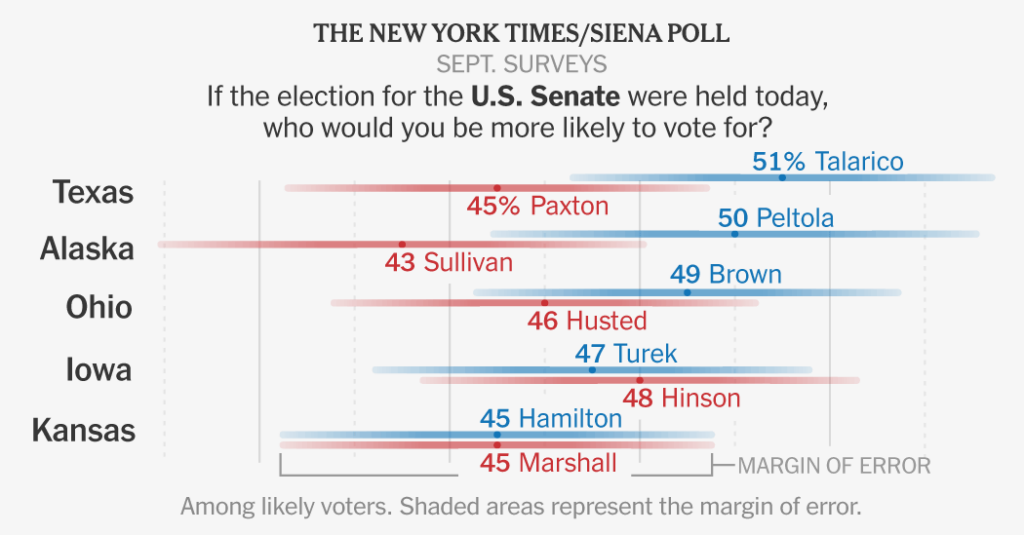
A month before the midterm elections, Democrats have opened leads or battled their way to ties or near-ties in five reliably Republican states where they are trying to flip Senate seats to win control of the chamber, according to new New York Times/Siena University polls.
Democrats lead among likely voters in the Senate races in Texas and Alaska, two states that consistently vote Republican, the polls found. They have an edge in Ohio, which has been tilting rightward for years. Republicans have a slim edge in Iowa, and Democrats are neck-and-neck with Republicans in Kansas, which has not voted for a Democratic senator since 1932.
President Trump’s deep unpopularity, disapproval of the Iran war and frustration over high gas prices and the cost of living are reshaping the electoral landscape, the polls found.
Taken together, the new polls suggest that the Democrats have multiple paths to retake the Senate majority, despite a challenging map that had favored Republicans going into the midterms. To win Senate control, Democrats need to flip four Republican-held seats while holding on to their current seats in three battleground states, a difficult task.
But there are signs that it is increasingly possible. On Friday, a top Republican super PAC pulled its money out of the Senate race in North Carolina, signaling that the party is not optimistic about being able to defend its seat there. The super PAC, called the Senate Leadership Fund, plans to redirect resources to Kansas, where Republicans have growing concerns about holding their seat.
The polling suggests Democrats are increasingly competitive in these Republican states.
[Follow all of the latest polls heading into November’s elections.]
In Texas, James Talarico, a Democratic state representative, has opened up a six-percentage-point lead in the race against Ken Paxton, the scandal-plagued attorney general and Republican nominee who has been strongly supported by Mr. Trump.
Austin Vaughn, 30, an independent voter who works for a nonprofit and lives in the Houston area, said he voted for Mr. Trump in 2024 but plans to support Mr. Talarico this fall.
“He’s the one actually listening and hearing that those are problems,” said Mr. Vaughn, referring to rising costs. “And the Republicans on the other side are gaslighting everyone and saying they aren’t real problems.”
In Alaska, former Representative Mary Peltola, a Democrat, is ahead of Senator Dan S. Sullivan, the Republican incumbent, by seven percentage points. The polling aligns with the results of the state’s nonpartisan primary in August, when Ms. Peltola and Mr. Sullivan appeared on the same ballot, and she won by eight points. A majority of voters there said that they viewed Ms. Peltola favorably; the poll was conducted after allegations of poor treatment toward her staff came to light.
In Ohio, former Senator Sherrod Brown, a Democrat, holds a narrow three-point edge in his comeback bid against Senator Jon Husted, the Republican incumbent, with voters saying they prefer the well-known Mr. Brown over Mr. Husted on nearly every issue in the poll. Mr. Brown has an 11-point advantage over Mr. Husted on the question of who would better handle the increasingly potent political issue of data centers, the poll found.
And in Iowa and Kansas, two Midwestern states that have been hit hard by the economic effects of Mr. Trump’s policies, the races are neck-and-neck. In Iowa, Representative Ashley Hinson, the Republican nominee, has a one-point edge over State Representative Josh Turek, the Democrat. In Kansas, the Rev. Adam Hamilton, the Democratic nominee, and Senator Roger Marshall are locked in a dead heat.
The polls suggest Democrats are performing well with independent voters, who often decide elections. Across the five states, Democrats hold a 24-point advantage with the group. On issue after issue, independent voters say they trust Democrats over Republicans — including a 30-point advantage on which party does what’s best for ordinary people in their state.
In all but one of the states, Democratic candidates are seen as less ideological than their Republican counterparts. In Ohio, voters were about equally concerned that the candidates were too ideological; 37 percent said they thought Mr. Brown was too far to the left, and 36 percent said Mr. Husted was too far to the right.
It is a striking transformation in five states Mr. Trump won every time he was on the ballot. In Ohio, which he carried with 55 percent of the vote in 2024, only 38 percent now approve of Mr. Trump’s job performance, down from 44 percent in June.
Soaring gas prices, which were driven above $4 a gallon by the Iran war, have continued to hurt the president’s popularity, particularly in the Midwest. About half of Republicans in Iowa and Ohio said that they disapproved of Mr. Trump’s handling of gas prices. Across all five states, Democrats are now more trusted than Republicans to handle the cost of living — reversing the advantage Mr. Trump had on the issue in those states just two years ago.
“You used to be able to get a house — a pretty good house — for under $200,000,” said Bethany Deines, a 58-year-old Democrat in Hamilton, Ohio, who supports Mr. Brown for Senate. Homes in her area now go for more than double that, she added: “I mean, it’s just not manageable for everyday people to be able to really even afford quality housing.”
Perhaps nowhere is Democrats’ advantage more remarkable than in Texas, where Mr. Talarico has been boosted by a growing share of voters — now 60 percent — who say that he has the right kind of moral values, up from 51 percent in June.
Many establishment Republicans, including Senator John Cornyn, whom Mr. Paxton defeated in a primary, warned this year that Mr. Paxton was a flawed candidate who could put what had been seen as a safe Senate seat at risk.
The poll suggests that may have proved true, with a majority of Texas voters saying Mr. Paxton does not have good character. And 45 percent say his past scandals, including his impeachment over corruption charges and a messy divorce from his wife, make them question supporting him — or mean they will not support him at all.
But Mr. Paxton will have a big financial advantage heading into November. Republican groups recently began spending large amounts of money to prop him up, reserving about $190 million in ads supporting him for the final two months of the race.
About half of voters across the five states — 49 percent — say they want a candidate who can provide a check on the president, according to the polls. Just 27 percent say they would prefer candidates who support Mr. Trump.
Nowhere is that more apparent than Iowa, where 53 percent of likely voters, including nearly 20 percent of Mr. Trump’s own supporters, say they want a candidate who can provide a check on the president.
Brayden Blocker, an 18-year-old Republican and college student in Iowa City, said Congress should be “less extreme.”
“With the new Congress coming in, I would say that I think it should just be more moderate members that aren’t necessarily, like, just what Trump wants to do,” he said. “It’s what their constituents want to do instead.”
The divide in voter concern about parties being too ideological is particularly stark in Kansas, where voters are more likely by a 10-point margin to say that the Republican is too far to the right than to say that Mr. Hamilton, the Democrat, is too far to the left.
Senator Marshall, the state’s Republican incumbent, is an obstetrician-gynecologist who filed lawsuits against hundreds of patients over outstanding bills, leading to the arrest of at least 81 patients, a New York Times investigation found. That has become an issue in the campaign.
Half of voters also say they worry that he will support Mr. Trump too much.
“You couldn’t pay me enough money to back Donald Trump or anybody that backs him,” said Alexis Price, 42, a travel adviser in Kansas City who said she does not align with either party. “I think what the Republican Party and a lot of the Republican nominees are doing is disgraceful and disgusting. And I have to vote to my conscience over any sort of party affiliation.”
Across the five polled states, Democrats hold an advantage on nearly every issue, including on the cost of living, which is the single most important issue to voters, along with the economy. Even Republicans’ edge on immigration is slipping. Republicans held just a three-point advantage on the issue across the five states.
Among the strongest measures for Democrats is that voters say that they trust them more to do what’s best for ordinary voters. In Alaska, Ms. Peltola has a eight-point advantage on that question.
Ms. Peltola is viewed very favorably by a majority of Alaskans, including 15 percent of Republicans, and has managed to grow her lead in a state that nonetheless favors Republicans continuing to hold control of the Senate.
“I see her out in the community,” said Jessica Romer, a 38-year-old Democrat in Anchorage. “And I just really like that she’s interacting with people, like getting to know them and what their needs and wants are.”
The post Senate Races in Republican States Tilt Toward Democrats, Polls Find appeared first on New York Times.