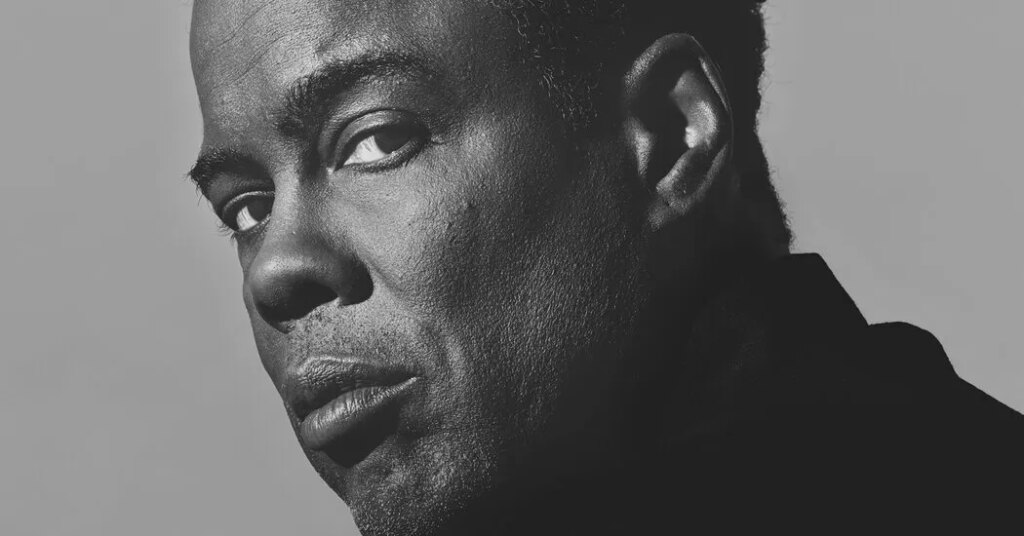
Chris Rock is inarguably one of the greatest stand-up comedians of all time. From specials like his 1996 breakout, “Bring the Pain,” to his most recent, “Selective Outrage” in 2023, he has established himself as not only scabrously funny but also fearless and insightful when tackling race, politics, relationships — you name it. Rock’s movie career, though, has been more variable. He’s been in plenty of hits, often alongside his friend Adam Sandler (two “Grown Ups” films; 2005’s “The Longest Yard”). And I’d point to the cult-classic hip-hop satire “CB4” (1993) as well as “Top Five” (2014), about a superstar comedian at a career crossroads, as film work that ably translated Rock’s intelligence and wit to the big screen. But there hasn’t quite been a cinematic statement on par with his stand-up. Until now. “Misty Green,” which opens Oct. 9, is an indisputable leap forward.
The film, the fourth that Rock has written, directed and acted in, is about a midcareer Hollywood actress named Misty, played in a riveting performance by Rosalind Eleazar (best known for the Apple TV show “Slow Horses”). Misty is at a moment of peak personal and professional crisis, and her story allows Rock to examine serious questions about social inequality, getting older in show business and compromise. I wanted to ask him about those subjects as well as his thoughts on comedy today, forgiveness and what his future holds.
Subscribe: Apple Podcasts | Spotify | YouTube | Amazon | iHeart
One of the themes of “Misty Green” is status: who has it and who loses it when it comes to success, money, relationships. I want to know: When do you feel insecure about your status? I’ve been doing a lot of therapy the last few years, post-Covid, and a lot of it is about not feeling insecure. A lot of it is about “you’re enough.” But I don’t ever really feel insecure about my “status,” per se. Occasionally I’ll meet people that are obviously working harder than me and that’ll make me feel insecure. Adam Sandler, Rick Rubin. You’re like, “How many things are you doing right now?” And some people are better with their kids than me. I think I’m a good dad.
You kept them off the pole. I kept them off the pole, but they’re on OnlyFans!
The movie makes Hollywood very appealing, because of the talent there and the love that people have for doing what they do, but it also makes Hollywood seem awful: racist, sexist, chipping away at your soul. Has that been your experience? You’re not going to get a “how bad Hollywood is” soliloquy from me. I always say every generation laughs at their children’s racism. So my kids are like, “This is racist,” and I’m like [Rolls eyes]. And what I would call racist, my mother would laugh at. Are there bad parts about Hollywood? Yes. But it’s still better than a normal job by a ton. I used to work at Red Lobster. I used to work at a home for severely autistic adults. I had the night shift, and sometimes you had to change the diaper of a grown man. So what if I can’t get a sketch on? So what if somebody doesn’t respond to my script? I used to wipe people’s asses!
But the question of compromises comes up throughout the film. There’s compromises in everything, man.
So what are the compromises that you’ve had to make in your career? I came up in cable television. I could say what I wanted. Honestly I don’t know if I could do “Bring the Pain” today. I’d have to compromise. But in ’96, I did pretty much whatever I wanted. Dude, I made “Pootie Tang.” I did a documentary about hair. So I’m the last guy to complain.
A second ago you said you didn’t know if you’d be able to make “Bring the Pain” today. That’s a sentiment I see a lot: comedians saying, “I don’t know if I’d be able to make that today.” But do you really think that’s true? You’re right. I’d be able to make it. As a matter of fact, I’ll go even further, “Bring the Pain” would be bigger today. You know why? Because you wouldn’t be able to report on it. The New York Times wouldn’t be able to say it was great. It wouldn’t be on Netflix. It would be like the Shane Gillis thing, which would actually elevate it. You know, The New York Times has got a weird thing with comedy.
What’s the weird thing? The Times, The Journal — they ignore the nuance. So it’s like, This is the manosphere-conservative thing, or, This is the wokey-woke thing. And all the people in the middle they kind of ignore. I remember five, 10 years ago, Bill Burr sold out Madison Square Garden. At that point, maybe eight comedians had sold out Madison Square Garden. I wake up the next day and I want to read the review. There’s no review, because Bill Burr is this guy that walks a crazy line. Is he conservative? Maybe. Wait a minute, he’s got a Black wife. Oh, he’s sexist. Wait a minute, there’s a lot of women here. You guys are not [expletive] with that middle. So anyway, “Bring the Pain” would be bigger today because it would be less lauded.
I think something has happened in comedy since Trump was first elected, where it seems like comedians feel as if they have to subtly or overtly signal their politics. Audiences are looking for that, and comedians are giving it to them. Maybe. I mean, I’m trying to decide if I’m gonna go back out now. Do I want to?
Why wouldn’t you? Do I want to jump in this bed? I don’t know. I am loving directing. Maybe I should do a run of pictures.
I have a question about Rosalind Eleazar and “Misty Green.” What did she bring to the part that wasn’t in the script initially? When I’m directing, I say, “It’s my movie, it’s your part.” And it was hers, man. Put it this way: I only met Rosalind about a month ago. For the months we were shooting, there was only Misty. She was Misty in the audition. She was Misty through the whole filming process. She never asked me one question that didn’t have to do with the character.
There’s a scene in the film where her character performs at a nightclub, and we see that she’s also an incredible singer. When I saw that, I was thinking about the amount of talent that’s out there — even people who are not household names. It’s staggering. Do you understand who makes it and who doesn’t? Talent must have so little to do with it. There’s a lot that goes into it. Right place, right time. What kind of friend are you? That goes a long, long way. Even now if I look over my career, probably half of my gigs are just somebody going, “Oh, he’s cool.” You have to be considerate. You have to ask people how they’re doing. A lot of artists, we’re so self-centered. So to answer your question, yes, there’s a lot of talent out there, and a lot is just right time, right place. Sometimes you’re on the subway and you see a guy playing the violin, and you’re like, They should be at the Met. Like, what the [expletive]?
Who’s someone you’ve worked with that you thought was incredibly talented, but they were self-destructive or they just never got a break? Ooh, I can’t say that. I wish I could. I’d say that off-camera. There’s a bunch of people. That self-destructive thing is a really sad thing. A self-destructive person is basically a person that makes six bad decisions a year. That’s 359 days of being fine. But those six bad decisions a year will [expletive] up your whole life.
How many bad decisions a year do you make? I don’t know. Show business is like the Olympics. And in the Olympics, the difference between first and last can be less than a second sometimes.
I want to ask another question about the movie. Were there ideas that you’d had about men and women that you then had to examine in order to credibly create the character of Misty? Because in a lot of your comedy, you make distinctions between men and women, but the distinctions are coming from the male point of view, and “Misty Green” is so much about a woman’s story. Did it take any excavation to be able to do what you wanted to do with her character? Saying there are stark differences between men and women is a perfect device for comedy. It doesn’t work in a drama. I’ll say this: Part of all this therapy is developing empathy and really being able to get inside of another character. So the last four or five years, I’m a way more empathetic person. It also helps that my daughters are like grown-ups, so I really watch women around my house. My daughters don’t forgive my sins, but they give me an education that I wouldn’t normally have.
I want to go back to directing. It was 12 years between you directing “Top Five” and “Misty Green.” What took so long? Life, Covid, I got divorced, which meant I had to make real money. Maybe I had some other scripts that the market didn’t respond to. It’s not like I was sitting around. But Covid was a time to be like, OK, what am I doing with my life? And other [expletive] I don’t feel like talking about. I had a lot of stuff going on the last 12 years.
Did you come up with answers to “What should I be doing with my life?” I should be directing small movies, character-driven pieces. Maybe I’m not in the movie as much as I used to be. So I’ve been writing a lot more. I’m actually working on a book of essays. We’ll see where that goes.
Could we talk about those things you don’t feel like talking about? I mean, I’m a big boy. I can answer stuff coolly, or not answer. Whatever. What do you want to know?
Is there more to say about the slap than what you said in your last special? I’m good, man. That was so long ago.
Not that long ago. I wish everyone well. I’ve moved on with my life.
Do you forgive what happened? I’m not going to get into clickbait things. I don’t think I’m in a beef. I’m done, dude. I’m done.
Let’s return to the movie. I was slightly surprised to hear that you don’t have anything that bad to say about Hollywood, given the content of the film, which to me was about how hard and hurtful to an artist’s soul Hollywood can be. So what were the themes that you were interested in exploring in “Misty Green?” I’m really into expiration dates. Everybody tells you that you can do art forever, and that’s just not true. In show business, you’ve got to reach certain plateaus by a certain time or else you’re going to be in trouble. So Misty is turning 40, and it’s a little bit of an expiration date happening. But, yeah, I wanted to do a movie about Hollywood. I wanted to do a movie about L.A. It’s this tale of two cities. Sunshine and palm trees, but we’re constantly walking over homeless people — the most liberal people in the world. Rodeo Drive and Skid Row are in the same city, probably eight, 10 miles apart. In a lot of ways, America’s like that: very rich, very poor. We live in a world where either you order [expletive] or you deliver [expletive], and you really don’t want to deliver [expletive], you know?
What should your response to that disparity be? So, the running title of the book that I’m writing right now is “When the Homeless Know Your Name.” Because when the homeless know your name, you feel that. Somebody asks you for money on the street, they just ask you for the money. When they ask me, they say, “Yo, Chris!” I don’t know what I should do. First of all, who the hell carries cash anymore? You give what you can.
I want to dig into that feeling a bit more. When the homeless know your name, what do you feel? Put it this way: I get up around 7. I get coffee by about 7:15. I go to my supermarket, get some fruit, and inevitably there’s always a bunch of guys setting up for the day. Did you ever see “12 Years a Slave” or any slave movie with a free slave? The slaves look at Chiwetel [Ejiofor]. He’s dressed all cool and he got his hat and they’re just looking at him like: “How the [expletive] did this happen? We’re the same.” That’s me at the supermarket in the morning. They’re looking at me, not even as a famous person, just like, “Who’s this brother buying mango at 7:25 in the morning?” Because there are no Black dudes living in SoHo. Am I answering your question?
Yeah. You’ve seen behind the veil. Yeah, and it’s like, they’re looking at me, and I’m looking at them, because I know I could be that. I know if I don’t walk into a comedy club in ’84 or ’83, I’d probably have a normal job. I’d have a lovely life, by the way. I’m not one of these guys who thinks that if I didn’t find comedy, I’d be in jail. No, I’d work for Amazon and I’d have a wife and some kids and I’d be OK. I’d be the funny guy on the Amazon route.
It’s interesting that you’re writing a book because I remember, before the pandemic, there was an announcement that you were working on a book about interracial relationships. What happened there? The book never showed up. I’m not trying to be like a gangster or anything. When you’re writing something about race, especially in this era of everybody taking everything out of context — I just didn’t feel like everything I was saying to the publisher, they were listening. I was like, I don’t trust these people. So I gave the money back.
How much was it that you gave back? It was a significant sum. More than I’m making today.
I’ll make a check out to you later. Do you think that taking things out of context is an ongoing problem for artists and comedians? There’s so much discussion about whether somebody said something offensive or who’s allowed to say what, and I never know how real that is. I hate to say, it’s just B.S. It’s just nerd bullies. Do you know how easy it is to go, “What did you mean by that?” before you elect to be angry at something? It is so easy to ask somebody: “Hey, man, could you not say that thing? I just felt a certain way when you said that.” Then if you’re ignored, yes, reply with anger. But it is so easy to pause and just go, “Hey, what did you mean?” I don’t know who I was having this argument with, but they said, “People are so sensitive.” I’m like: “No, they’re not sensitive. They’re mean. And they can’t stop being mean.”
You think it’s all about meanness? I’m just saying, meanness is the new kale. It’s on the platter, OK? It’s like, “Oh, do you got any mean here?”
When is offense justified? People are entitled to their feelings. Don’t get me wrong. We’re all entitled to be offended. Don’t take me out of context. Context does matter, though. A lot of people are ignoring context because it prevents them from being mean.
This morning when you came in, you said, “I don’t think I’ve been here since I filmed ‘Top Five’ with the canceled all-stars, Scott Rudin and Charlie Rose.” And I listened to a podcast interview you did with David Spade and Dana Carvey earlier this year, and you also used the phrase “the canceled all-stars” to talk about Louis C.K. and Kanye. How do you think about questions of forgiveness and who gets forgiven and why? Hey, man, I’m Black. When you’re Black, white people believe every accusation is a conviction. I grew up at 619 Decatur Street, between Howard and Saratoga. A guy named Roger Logan, who I grew up with and was one of my best friends’ brothers, went to jail for years for a murder he didn’t commit. And here’s the weird thing: His brother used to plead with me to pay for a lawyer for Roger, and I never did it. I always had a no-lawyer thing. I’ll pay your mortgage; there’s a bunch I’ve paid for — education and all sorts of [expletive]. I always stay out of lawyers because it’s so open-ended. And it still [expletives] with me. I had the means to help him and I didn’t. I don’t know if we could’ve got him out or not, but still. So all that to say, Black men get accused of [expletive] they didn’t do all the time, every day. We let Black men out of jail and go: “Whoops! That Black guy just did 30 years — too bad.” So to answer your question, hopefully I don’t get accused of anything, but it’s real when people get accused of things, and you better be real sure they did it. Am I making sense?
You’re making sense. I think you’re describing a kind of lived empathy that —— I’ll go even further. My grandfather, Allen Rock, killed a man. Legend has it, he thought the guy was sleeping with my grandmother. The guy lived next door. He told the guy, “If you take another step in my yard, I’m going to shoot you.” The guy took one step and my grandfather blew him away. My grandfather went to jail. He was a preacher. He gets out of jail on a Wednesday, and by Friday he was picking us up from school. Within a year or two, he was the reverend of that church again. My brother Charles shot a guy. I say all that to say, my grandfather went to jail. He did his time. So a) if you’re going to accuse somebody, make sure they did it. And b) when people do things, there’s a time limit in the real world. In your world, you just shun people. But in the real world, we have to live with each other. It’s up to the victims to forgive, and two things can be true: My brother shot a guy. I love my brother. Because I love my brother, does that mean I think the person should have gotten shot? No. The last thing I’ll say: When I was a kid, I was in police lineups two, three times. Stay away from Howard Avenue. Howard and Decatur.
In Bed-Stuy? In Bed-Stuy, and you’re minding your business and you get swooped up. And now you’re in a police lineup. And you’ve seen enough cop movies to know that behind that window is a person — could be a man, but probably a woman — and if she points at you, your whole life’s over. If she points at me, she’s wrong, but she’s not lying. She’s traumatized, and when you’re traumatized you try to wrap [expletive] up. My dad drove a newspaper truck, and I’ve been reading the paper since I was a kid. The news has taken all the nuance out of it. Everything’s black and white.
I want to go back to what you said about becoming a more empathetic person. How does one consciously learn to be more empathetic? And is being more empathetic good for a comedian? It better be, or I’m in trouble. I don’t know if I’ve learned to be empathetic. A friend of mine told me I had Asperger’s a few years back, and I got it checked out. It wasn’t Asperger’s, but it was a thing called NVLD, nonverbal learning disorder. It requires its own level of therapy.
What are the effects of that? The effects are that I’m really bad at reading nonverbal signals. I catastrophize, I have black-and-white thinking — both things that are great for being a comedian but bad in personal life and real relationships. So I’ve been learning. I have to see a woman once a week. “Misty Green” would be the first piece of art that I’ve done since my diagnosis.
You said earlier that part of what you were talking about in therapy is feeling like you’re “enough.” When do you have self-esteem questions? All artists have self-esteem questions, especially the good ones. An artist is an egomaniac with an inferiority complex. I would absolutely fall into that. “I am great. I hope they notice.” So, yeah, I can feel that way. Eddie Murphy makes me feel like that. In the presence of Eddie Murphy, I can get a little insecure.
Of course. Also, not to name-drop, but one of my biggest regrets in life is I could never relax around Prince. He wanted to be friends. Hanging out, I couldn’t not be like, “Oh [expletive], Prince is drinking ice tea!”
Did you and he ever get to a place where he was normal? I mean, a normal rock star. Those degrees of normal are so different than yours. I remember, I was at Prince’s house. I’m in Minneapolis. I’d just done some shows, and he had a party for me at Paisley Park. I am literally in the vault, and he’s playing me new music, and there’s lots of people there, and his wife called. I think he was married to Mayte at the time. And he was like: “Everybody be quiet! Be quiet!” It’s like 200 people. Mayte called, he’s picking up the phone, and he goes: “Hey. Nothing. Nah, I’m just chillin’. Yeah, I’ll probably go to bed in a couple of hours. Love you, too.” And then the party started again. [Sings] “Gett Off”! Right away!
Even Prince has to take that call. Even Prince had the check-in.
You said that you want to direct more films, but you also talked about the idea of an expiration date, and it can be hard for comedians to get older. It can definitely be hard for comedians to get older.
It’s hard to stay edgy. Well, nobody stays edgy. You become the establishment. Early in your career, it’s your performance, but it’s also the promise of who you are. So the public is investing in this thing, this stock. But later on you’re like LeBron. It’s all results and we’ll give you a one-year deal — as long as you play like LeBron. I mean, I’ve seen careers and people change. Steve Martin’s the king of reinvention.
If you listen to a Steve Martin album, because of the style of comedy he’s doing — absurdist and whimsical — you’re never asking yourself, Does he really believe that? But now audiences are asking, Does the comedian believe what they’re saying? So when you’re telling jokes about real-life things, are we supposed to understand that you believe what you’re saying, or that you’re just saying what you need to say to make the bit work? Jokes tend to work better when there’s some truth in them, when you’re not just making up stuff. I think the audience can tell who’s fake. They can tell if you’re married, they can tell if you’ve got kids, they can tell if you worked. You can’t fake anything. The thing about comedians is, there’s no mystique. There’s no Ziggy Stardust of comedians. You are who you are, and they’re rolling with you or not.
Do you think you are who you are in your film work? I think “Misty” is a good barometer of me right now. I’m like every character in the movie on some level.
Hopefully not the Adam Driver character, a guy who procures prostitutes for Saudi princes. There is nothing different between the Adam Driver character in my movie and the Jack Lemmon character in “The Apartment.” It’s just an outfit and some hairstyle.
And the drugs. Alcohol is the biggest drug in the world. What are you talking about? See, you are leaving out your nuance. You literally are making my point in front of me. You conveniently made yourself stupid to make a point.
I never conveniently make myself stupid. You’re so much smarter than that!
If people are like, David left out the nuance of what drug Jack Lemmon was using in “The Apartment”! — I’ll die on that hill. It hurt you that Jack Lemmon was basically the same character. And you have this love for “The Apartment,” which is deserved. It’s one of the best movies ever. But that’s what he was. He was a pimp.
I guess you’re right. I don’t know where to go from that. Jack Lemmon is a pimp. In “The Apartment” he’s a lovable pimp, but a pimp nonetheless.
In so many ways, we all are. Or hoes! Mostly hoes.
You know, before we spoke initially, I had asked if you could send over the names of some films that were influential on “Misty Green.” You sent a list that included Bob Fosse’s “Cabaret,” “Bad Lieutenant,” “Klute.” Can you tell me how they helped shape your vision for your movie? There’s a great line in “Husbands and Wives,” the Woody Allen film. He’s playing a professor, and the line is something to do with, You can’t teach people to write; all you can do is expose them to great writing and hope they pick up on it. It’s kind of the same thing with film. You can’t teach a person really to make a good movie. You just gotta show them some good movies and hope that they run with it. All of those movies, especially the Fosse stuff — there’s a lot of “Lenny” in “Misty Green.” I love those movies. My mother would always say, “If you feed a kid long enough, he starts to look like you.” If you love movies hard enough, you’ll eventually make that kind of movie.
Wait, did Fosse also direct “Star 80”? Yeah! “Star 80” is my go-to. How could I forget “Star 80”? “Misty Green” is so “Star 80.” The Fosse stuff more than anything has been an influence.
There’s a line in your movie that I wanted to ask about. The character that you play in the film says to Misty, “True love starts at forgiveness.” Is that your experience of forgiveness? Yeah. You don’t really realize if you love somebody until you have to forgive them. I can enjoy myself with just about anybody. It’s when somebody tests you, when somebody betrays you, when somebody lets you down and you still want to be around them — that’s love. I have a friend that’s going to be nameless that might have gotten canceled. Another friend of mine was like, “How can you be friends with that person?” I was like, “If you’re only friends with your friends when they’re good, they’re not your friends.” If you’ve got a bunch of people that are only going to be there when you’re good, you have no friends. That doesn’t mean condoning abusive behavior; you can reprimand your friends. That’s also part of friendship.
But we all have a line, right? You and I live in different worlds. I’ve got friends that are in jail. I’ve got friends that are drugged out. I don’t live like you.
You don’t know that. I can tell.
I mean, you happen to be right. And by the way, I’m not being dismissive of you. I’m just saying that my friends have tested me more than yours, and maybe I’ve tested them. I’m not religious, but I’m a Christian, and God forgives. That’s what it’s all about. The problem with quote, unquote, wokeness — and don’t get me wrong, it is great that marginalized people have a voice; it is great to advocate for anybody that feels marginalized — but the problem is we’re in the Old Testament right now, and the Old Testament has no forgiveness. The Old Testament didn’t work, so they had to write a remix called the New Testament.
There’s been discussion lately about how the Woke 1.0 era, which refers to the immediate post-George Floyd era, was “crazy.” Do you see that moment in time as just “crazy?” Was there anything redeeming about it? I think I just answered. Again, it’s great to help those that need help. We need more of that. The problem is when you institutionalize it. My half a joke: The Salem witch hunts — I’m sure the first three witches they caught were actually witches. But then you open up a witch office, and now you gotta start lying because you got overhead. You gotta justify the witch hunters’ pensions and [expletive]. I’m glad that all of this stuff happened, it needed to happen, and because it happened, maybe I’ve heard some voices that I probably wouldn’t have heard otherwise.
Let me switch gears and ask a comedy question. Sure — but before you do, because I keep saying how bad my friends are: I have some genius friends who are unproblematic, the most progressive. Some of the greatest artists that have ever lived, some that you know of and some that you don’t, are my friends.
All right, so on the record: Chris Rock’s friends are perfectly fine people. One thing I always wanted to ask a great comedian is, Do you understand what the purpose of laughter is? Why do we laugh? I never thought about it that hard. Here’s what I do know: The greatest feelings in life are sex and laughter. We break up with people that we have great sex with all the time. We don’t break up with anybody that makes us laugh. And the ability to laugh at oneself is probably the highest form of intelligence. The inability to laugh at oneself is a sure sign you’re dealing with an idiot.
Chris, professionally or personally, what keeps you up at night? I don’t worry about anything.
Everyone worries about something. I’m not worried about nothing, dude. I’m worried about my kids, but the world? The world is the world. The world is exactly what it wants to be. It’s sad where it’s sad, it’s happy where it’s happy. But this is what people want.
What do you mean “this is what people want”? People have the America they want. If they want to change it, we’ll see.
Is it the America you want? I’ve been here a while. I have a long sample size. Martin Luther King was shot in 1968. Black people pretty much live where Black people lived in 1968, especially in New York City. Maybe a neighborhood or two is gentrified that wasn’t. Maybe Beyoncé has more points on her deal than Aretha Franklin did. People are nicer. Blatant disrespect in the streets doesn’t happen like it did in 1968. But the distribution of wealth, the access to education, the access to health care is pretty much where it was when Dr. King got shot. And I could say that about other places in the world, too. Somehow I got out of it. But Louis Armstrong was the most famous singer in the world in the ’30s and ’40s, so Black entertainers have always gotten off the Titanic before everybody else.
Let me try to end with something more hopeful. Hey, “Misty Green!” Oct. 9! Sexy movie! A24! Those guys are great. No oppression there.
I asked what keeps you up at night. But what gets you up in the morning? You know what’s weird? I’m excited every morning. It’s my favorite time to get up and take my walk and get my fruit, listen to the news a little bit. ’Cause every day can be great. Even when you know what’s going to happen, you don’t know what’s going to happen. So I wake up pretty happy, man. And I’m very fortunate. I’m not going to sit here and act like my experience is everybody’s.
I appreciate you taking the time to speak with me. I especially enjoyed it when you pushed back. Oh, man, that’s always where the good stuff is. I’ll leave you with this: A friend of mine called me up, she was working on her special, and she said, “I’ve had a hard time writing material.” I said: “Well, you have this podcast. What I need you to do is go to your podcast, and every hard episode, that is where the material is. Every one you thought was a hard time, that’s where the good [expletive] is.” So if I’ve given you a hard time, this is the good [expletive].
This interview has been edited and condensed from two conversations. Listen to and follow “The Interview” on Apple Podcasts, Spotify, YouTube, iHeartRadio or Amazon Music. Follow us on Instagram and TikTok.
Director of photography (video): Cal Christie
The post Chris Rock Has Been Thinking About Forgiveness appeared first on New York Times.