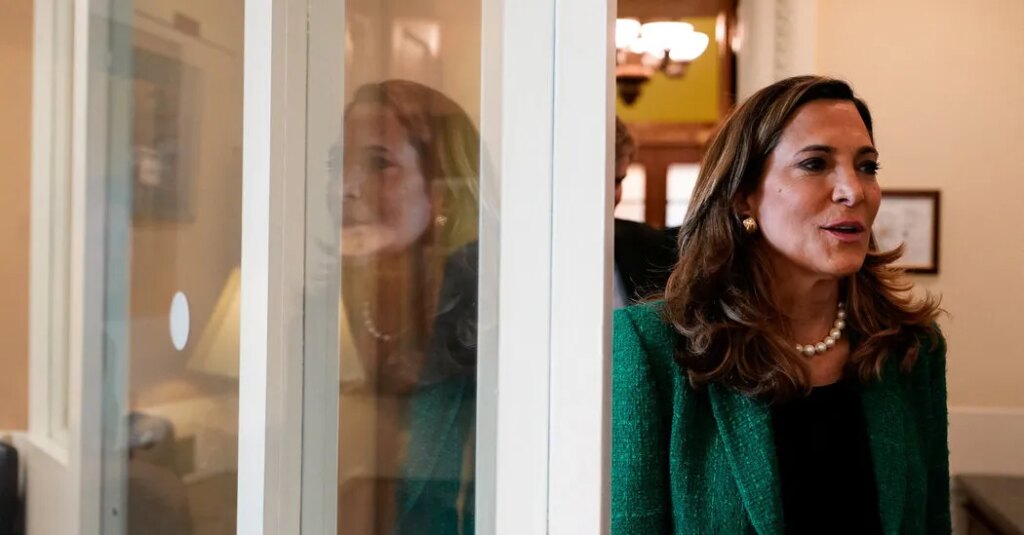
To hear Representative María Elvira Salazar explain it, few should have been surprised to see her in a television ad standing in front of the White House, telling President Trump that his immigration crackdown had “gone too far” and that some Hispanics who had voted for him now felt “betrayed.”
The three-term Republican congresswoman from Florida had been saying much of the same for months. Since releasing the ad two weeks ago, Ms. Salazar has insisted that she didn’t break with the president. She was simply warning him, she said, that trouble was on the horizon.
But Ms. Salazar’s ad struck a nerve, both angering Mr. Trump and his allies and perhaps emboldening other Republican candidates around the country hoping to distance themselves from the government’s crackdown on immigrants.
The ad underscored just how much Mr. Trump’s support has plummeted among Hispanic voters beyond places like South Texas. South Florida’s conservative Cuban Americans have long made the region Republican friendly, and Miami-Dade County swung to the political right in recent national elections.
But the Trump administration has deported a record number of Cubans. Older Cuban men who had lived in the United States for decades have been deported to Mexico, where they have struggled to get by. Some Cubans have been deported to Africa.
Senators in West Virginia and Kansas have recently criticized the deportations of immigrants without a criminal record and Immigration and Customs Enforcement raids.
Ms. Salazar made a career on Miami’s Spanish-language television, leaning into splashy political controversies and knowing how to get attention. Her former TV viewers call her simply “María Elvira.” Surely, those who know her say that she knew her ad would be provocative.
Maybe not this provocative.
With her 30-second spot, she managed to anger the MAGA base, spur Mr. Trump to promote criticism of her on Truth Social and perhaps move donors to give money to her Democratic opponent.
But she also steered the conversation away from the cost of living in Miami, which by some measures is now more expensive than New York and Los Angeles. National polls show voters believe Republicans are more responsible for the rising cost than Democrats are.
Ms. Salazar won re-election to Florida’s 27th Congressional District by about 20 percentage points in 2024, and Mr. Trump carried the district with around 57 percent of the vote. Few had considered it competitive this year. Yet Ms. Salazar’s ad has made the race the talk of the town.
Though she declined interview requests from The New York Times and most other national outlets, she has sat for local television, radio and podcast interviews, most of them friendly and most of them in Spanish.
“Politics is harder than television,” she told a pair of Cuban American comedians and self-described Republicans on their video podcast this week, after praising their studio lighting.
The ad also boosted interest in Eliott Rodriguez, her Democratic rival, who is a fellow Cuban American former broadcast journalist. “We raised a lot of money — thanks to my opponent!” Mr. Rodriguez said while campaigning last week amid salsa music and sun showers in Miami’s Little Havana neighborhood.
In March, the ICE field office in Miami, which covers Florida, Puerto Rico and the Virgin Islands, was leading the nation in immigration arrests. Foot traffic is down so dramatically in the city of Doral, which is outside of Ms. Salazar’s district and heavily Venezuelan, that a neighborhood canceled Oktoberfest after people said they feared that a public gathering might draw law enforcement.
Some Miami Republicans have sounded alarms for months about unpopular immigration policies costing the party in the midterms. Some privately urged Ms. Salazar to take a more forceful public position. Her district is more than 70 percent Hispanic.
“We did not vote to demonize hard-working immigrants with no criminal record, nor did we authorize the militarization of our government,” said State Senator Ileana Garcia, a Cuban American Republican whose district largely overlaps with Ms. Salazar’s and who praised her ad.
Mr. Rodriguez said that Ms. Salazar and Republicans were “nervous” that their voters would cast ballots for Democrats or stay home in November. “People are terrorized,” he said, citing people he knows with pending immigration cases who are scared to leave their homes.
He has criticized Ms. Salazar for voting to fund ICE — and for saying last year that the beds inside a state-run facility for federal immigration detainees known as Alligator Alcatraz were “soft.” The facility has since closed amid cost overruns and poor conditions for detainees; Ms. Salazar has noted that she visited before the facility opened and any detainees were there.
In a statement in response to written questions, Ms. Salazar said the community “understands the difference between protecting the border, as President Trump has done, and the irresponsible and reprehensible influx that occurred under Biden.”
Ms. Salazar has spent years trying to convince House Republicans to support a bipartisan bill that would give some immigrants with no criminal background a path to obtain legal status and work permits, but not citizenship. It has yet to get a hearing; immigration hard-liners consider the bill to be a form of mass amnesty.
“I am making sure that voters are aware of what I’ve delivered for the district and where I stand on the issues that impact the community,” Ms. Salazar said in her statement. “This race is no more competitive than others I have had.”
There has been no independent public polling. Campaigning in Miami is expensive; House Majority PAC, the leading super PAC supporting Democratic campaigns, has reserved about $4.2 million in ad spending this year to try to flip the seat, according to the media tracking firm AdImpact. Choose Freedom Inc., a group supporting Republicans, has spent around $650,000 on broadcast and cable TV ads, and Ms. Salazar has spent around $37,000.
Mr. Rodriguez, who does not have Ms. Salazar’s more aggressive demeanor, retired from CBS Miami in December. His campaign logo looks like a television, with the “O” in Eliott reminiscent of the CBS eye.
“I’m trying to make it about the cost of living,” he said of the race, “and people that are leaving Miami because they can’t afford it, like my daughters.”
Former Representative Donna E. Shalala, a Democrat who lost to Ms. Salazar in 2020, described a perfect storm building against Republicans in the district.
Price hikes to the Affordable Care Act last year disproportionately affected South Florida, which has the nation’s highest coverage rate. The Trump administration’s decision to end Temporary Protected Status for many Haitians and Venezuelans has left hospitals, nursing homes and other businesses short-handed.
“I think that actually was the breaking point for a large number of people who voted for Trump,” Ms. Shalala said, adding that the cumulation of problems means Ms. Salazar is “in trouble.”
Much will depend on which Miami-Dade County voters cast ballots. Democrats and independent voters failed to turn out in large numbers in 2022 and 2024, though the city of Miami did elect a Democratic mayor last year for the first time in nearly three decades. Much of the city is in Ms. Salazar’s district.
Joe M. Sánchez, a former Miami city commissioner, lost a nonpartisan race for a Miami-Dade County Commission seat in August. He said he was “shocked” by how many friends and strangers told him to his face that they would not support him because he was a Republican. A self-described moderate, he plans to leave the Republicans and register without party affiliation.
Mr. Sánchez, who lives in Ms. Salazar’s district, recounted going to a cafeteria-style restaurant where the owner told him business was down 30 percent “because everyone that eats here is an immigrant.”
“To me, it was a rude awakening,” Mr. Sánchez said. “A lot of people were very, very upset.”
The post How a Provocative Ad on Trump and Immigration Stirred a Florida House Race appeared first on New York Times.