When Catalina Romero arrived at Catalina Island’s tiny emergency room this week with a severe allergic reaction, officials decided she needed medical attention on the mainland.
So they called a medical evacuation helicopter out of Oceanside. For residents of Avalon and the other Catalina communities, helicopters are part of life when emergencies and unexpected events require services the island doesn’t provide.
But just moments after takeoff, the helicopter crashed into the ocean near Pebbly Beach.
Romero, the pilot and medevac nurse Jessica Devries, 48, who were on board, were killed. The pilot’s name has not been publicly released. Romero’s eldest son and another passenger were injured and remain in the hospital.
As federal investigators try to determine the cause of the crash, island residents are mourning the dead and confronting the trade-offs of life so isolated from the rest of Southern California.
“It’s a small community,” said Dr. Matthew Byrnes, who works at Catalina Island Health. “The level of tragedy is so profound that you feel it to the core of your soul. And everybody feels the same thing.”
Dozens of flights to and from Catalina Island have crashed over the years, with pilots saying the airport poses its share of challenges. But Avalon Mayor Pro Tem Michael Ponce said most crashes involve sightseeing helicopters and private planes generally unfamiliar with the island’s unique landscape and runway, officials say.
Accidents involving professionals like the medical chopper crew, he said, are much rarer.
“We just want to know what happened,” Ponce said. “We know that accidents happen and that’s just part of it. But if it’s a lifesaving event, we’re going to get a medevac off the island. That’s just what happens here.”
About 4,000 people call the island home year-round.
There have been 42 accidents and crashes tied to the Catalina airport that have claimed 30 lives since 1982, according to data from the National Transportation Safety Board.
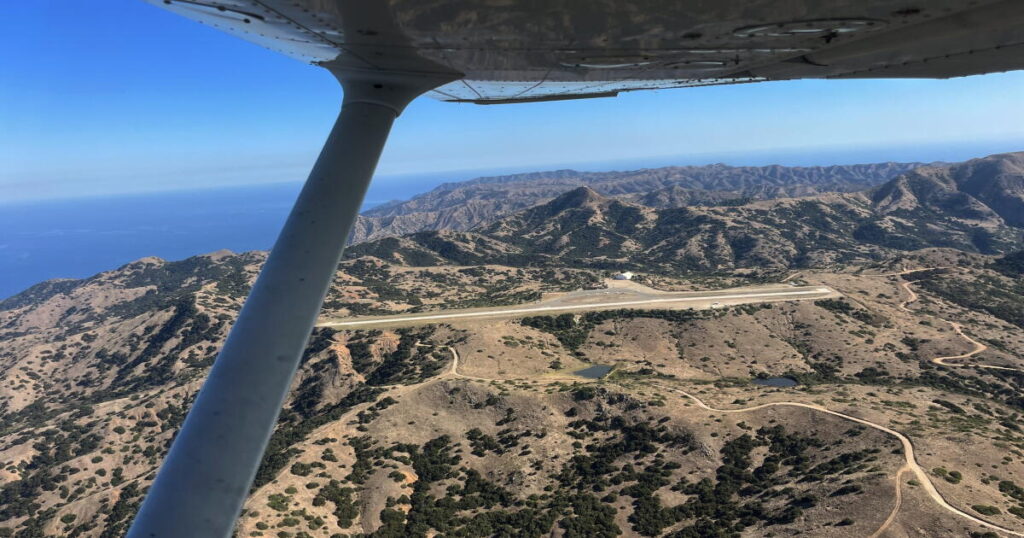
The agency’s crash reports and pilots familiar with the island’s so-called Airport in the Sky, which sits atop a 1,600-foot mountaintop about 10 miles from Avalon, have long expressed concerns about the runway where planes land.
The runway slope and width create what’s known as a crowned runway illusion that distorts a pilot’s perception of height and distance during their final approach. Pilots have compared landing on the short runway, with either side plunging straight down off the side of a vertical cliff, to landing on an aircraft carrier.
At times, pilots have panicked, fearing they were running out of runway, and braked too hard, causing accidents.
Pilots navigating the island also face heavy turbulence, low-lying sea fog, sudden microclimates and strong updrafts and downdrafts that can push a small aircraft off course.
It’s so much of a concern that night flights are banned at Catalina Airport.
The most recent fatal plane crash on the island occurred in October 2024 when a twin-engine Beechcraft 95 went down during takeoff from Catalina Airport, killing five people.
An NTSB investigation into the Wednesday’s crash continues, but a preliminary report revealed that the pilot took off from the airport after dark after suffering battery issues that delayed the flight. The airport manager told the pilot that “while he could not stop him, his departure would be unapproved and at his own risk,” according to the report.
The plane crashed into a ridgeline about a mile southwest of the end of the runway.
Medical helicopter flights land and depart not from the airport but from a separate location: a heliport on Pebbly Beach, just steps from the ocean.
The Eurocopter EC135 P2 was owned by REACH Air Medical Services.
Flight tracking data show the helicopter left Catalina’s Pebbly Beach heliport at about 7:46 p.m. and got about 175 feet above sea level about eight seconds into its flight before rapidly descending.
“We have a helicopter down right off of Pebbly Beach,” emergency dispatchers said over the radio, according to an audio recording of the incident. “We need Baywatch Avalon by boat. We’ve got a helicopter with potentially three people on board. … We have people screaming for help.”
Rescuers found four people in the water. Two of them — Devries and the pilot — were pronounced dead, and two were rescued and taken to mainland hospitals, where they were stable. The search for the fifth person, Romero, continued through the night and into Thursday when Los Angeles County Sheriff’s Department divers found her body in the wreckage of the helicopter, the Coast Guard said in a statement.
Part of the danger of air travel in and out of Catalina at night involves flying over water in darkness and spatial disorientation, which occurs when a pilot flying in low visibility due to clouds, fog or darkness cannot see a horizon and their senses conflict with the reality of their position.
Spatial disorientation was cited in the helicopter crash that killed Kobe Bryant, his daughter and seven others in 2020 and the crash that killed John F. Kennedy Jr., his wife and her sister as he piloted a plane at night over water off Martha’s Vineyard in 1999.
Zoey Tur, a veteran news helicopter pilot, said spatial disorientation is particularly problematic over water at night.
“Even with night vision, I did many over-water night flights from Catalina, and it is like being in a black box,” Tur said.
Still, medical emergencies necessitating air transport at all hours can occur on Catalina.
About a tenth of the approximately 2,400 patients who come to Catalina Island Health’s five-bed emergency room need to go to the mainland for a higher level of care. The hospital gets about 700 trauma patients each year and, of those, about 70 need to be flown to the mainland, CEO Tim Kielpinski told The Times in an interview.
“It’s hyper-critical,” he said. “Those patients that we decided need to get medevac’d need to get to a higher level of care.”
Patients can require evacuation to a larger hospital if they have a major heart attack, a stroke, respiratory failure requiring a ventilator, a ruptured appendix, internal, brain or traumatic bleeding or if they go into septic shock or need a blood transfusion, according to hospital officials.
In such cases, physicians and nurses stabilize the patient as best they can, make calls to mainland hospitals until they find one willing to take the patient and then call either commercial companies or government entities to arrange a medical transport helicopter to take the patient to the receiving hospital, Kielpinski said.
After finding a helicopter able to do the job, the aircraft has to reach the island, and the patient must be prepared for transport and taken by ambulance to the helicopter pad, which is about two miles from the hospital. The patient is usually able to lift off in the helicopter within about two hours of the decision that they need transport.
And residents think of it as just another part of island life — a minor inconvenience for small-town community charm, breathtaking views and a break from the hustle of much of the rest of Southern California.
Medical transport by air is “extremely important for people on the island,” said Mayor Anni Marshall. “And it’s amazing how quickly they can arrive.” Sometimes a helicopter gets to the island faster than an ambulance could drive across Los Angeles.”
The crash is “just all throwing us for a loop,” Marshall said.
Romero immigrated to the United States from Mexico and had lived on the island with her children since the early 2000s, according to her middle son, Michael Romero.
Michael Romero said his mother was a supremely hard worker, who did everything she could to support her three sons while making a living in hospitality. She handled housekeeping, concierge services and laundry management for Catalina Island Company, a resort operator, according to her son.
“She was such a loving mom,” Michael Romero said. “She would always crack jokes that made everyone laugh. She’d see someone sad, and she would do everything she could to make them laugh, make them happy, make them feel better.”
The county brought clinical support staff to speak with Catalina Island Health employees. Saint Catherine of Alexandria Roman Catholic Church in Avalon hosted a gathering on Thursday for community members who needed to speak to a counselor to help process what happened.
The post On isolated Catalina, a lifesaving helicopter flight ends in tragedy, questions appeared first on Los Angeles Times.