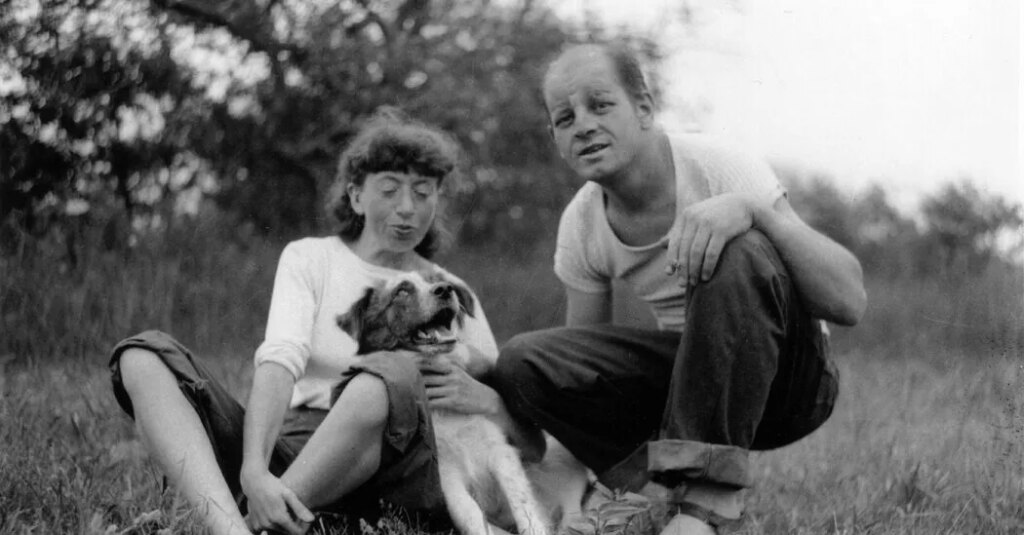
As usual, Lee Krasner was barefoot, her shirt untucked, one angular foot tapping a knee, arms akimbo, fists pounding, as she declared, “I happen to be Mrs. Jackson Pollock, and that’s a mouthful.”
She was slouched in a straight-backed chair in the house she had shared with Pollock for some 11 years in the Springs section of East Hampton. It was 1973 and I was a young reporter interviewing her for the first time. Her outsize presence was daunting, her rage palpable, her volume high. But there was also a directness about her, an appealing kind of naked honesty. She was who she was, take it or leave it.
“I was a woman, Jewish, a widow, a damn good painter, thank you, and a little too independent.”
At 65, Lee Krasner was about to have her first solo exhibition in a major American museum. At a time when, as she groused to me, “Everyone and his great-grandfather gets a show before he’s 35,” the Whitney Museum of American Art was finally mounting “Lee Krasner: Large Paintings.” The 18 works in the exhibition spanned two decades, beginning in 1953.
“The alternative is that it could all have happened after I die,” she said. “But to feel Big Boom Joy — oh, cut it out.”
One thing she knew, and that was how good she was. “When those paintings are up there,” she declared, “everybody can look and judge for themselves.”
On Oct. 4 the Metropolitan Museum of Art will open its fall blockbuster “Krasner and Pollock: Past Continuous,” with 120 paintings from more than 80 national and international lenders. Krasner’s paintings will be up there, side by side with Pollock’s, in a rare opportunity to reconsider works by both game-changing artists in conversation with each other.
Despite Krasner retrospectives in the United States and Europe, despite a growing fascination among younger artists with the abrupt shifts and U-turns in her unorthodox career, she remains engulfed in Pollock’s shadow.
And Pollock, long canonized as the breakthrough artist of American abstraction, superhero of the drip, has become something of an art historical relic. In the years since 1956, when he skidded his green Oldsmobile convertible into an East Hampton tree, killing himself and one of his two passengers, he has become buried beneath the weight of his reputation.
“Krasner and Pollock” proposes to reset both narratives. The Museum of Modern Art’s 2003 “Matisse Picasso” blockbuster illuminated the fruitful rivalry between two giants. The Metropolitan’s “Krasner and Pollock” exhibition explores the fertile complexity of a marriage in art.
This much seems surprisingly clear after a glimpse of the show during installation: Neither Krasner nor Pollock could have become the painters they did without the other. One way to tell a compelling part of that story is through four paintings in the exhibition.
‘Birth’ (1941)
You can see why meeting Pollock in 1941 unhinged Krasner. None of the training that had gone into her jaunty and meticulously composed Cubist still lifes in the show had prepared her for paintings like “Birth” that she encountered the first time she climbed the five flights of stairs to Pollock’s Greenwich Village studio in the weeks after the Pearl Harbor attack. Spiraling masks, faces and body parts shape-shift with emotional intensity in the painting of which John Updike wrote years later: It is as if Picasso’s ‘‘Girl Before a Mirror’’ “were further fractured and made to writhe in pain.”
“There it is!” was Krasner’s reaction. “I saw an energy and a living force,” she told me.
She was thoroughly educated in modern painting, embedded in the New York art world, entranced with Mondrian and Matisse, experimenting with Hans Hofmann’s synthesis of cubism and bold color. The Wyoming-born Pollock had been working his way through the influence of Thomas Hart Benton’s regionalism, Native American art, Mexican murals, Jungian psychology and Picasso. But Pollock was finding a way to twist art history to his own ends.
In our conversations over the years, Krasner took a contrary pride in talking about what happened after her encounter with Pollock’s work, especially once she moved in with him in 1942. For three years Krasner struggled to jettison the discipline of her Cubist training with a more intuitive process. She painted and overpainted until she called her works “gray slabs.”
“I must have been an awful bitch,” she told me one day in 1981. When Thomas Hart Benton asked to see her work, “We looked at the slabs of gray. There was such a stony silence.” She said “I was having a rough time, and I didn’t care who knew it.”
Those were the years in which news of the Holocaust was making its way to New York, which might also account in part for the persistence of the leaden slabs from this daughter of immigrant Jews, as Robert Hobbs, organizer of a 1999 Krasner retrospective, has suggested.
From the first, Krasner championed, promoted, and protected Pollock and his fragile psyche, through the alcoholic bouts that turned him ugly and aggressive.
Before they met, she told me, she’d never turned on her stove. When Pollock accepted an offer of a cup of coffee the first time he visited her studio at 51 East 9th Street, she took him to the drugstore soda fountain. Quickly, though, she took on the role of artists’ helpmeet, making dinners for influential critics and curators.
And when it all became too much — her painting, his drinking, the command appearances at his dealer Peggy Guggenheim’s social events that were excruciating for the socially awkward Pollock — they married, borrowed $2,000 for a down payment from Guggenheim toward the $5,000 house, and escaped to the Springs in the autumn of 1945.
Once there, they settled into a domestic routine. “This big male Pollock was extremely generous with household chores,” Krasner said, beating her chest, as she brewed tea in her Manhattan apartment. “If I washed dishes, he dried.”
She painted every day. “What I couldn’t have was a career,” she told me. It was Pollock’s paintings that were selling, though at prices so low that some winters there wasn’t money for proper heating. I watched Krasner haggle over the price of two filets of fish in her wealthy later years and saw the lasting toll of those deprivations.
They grew tomatoes, radishes, lettuce, eggplant and okra. Krasner cooked for friends, Pollock baked. Summers after supper, they sat silent on the back porch, looking out over the day lilies to Accabonac Creek.
In the Springs, with uninflected time, they both made painting breakthroughs.
In her upstairs bedroom studio, Krasner covered old canvases with layered grids and infinitely varied marks in a shifting vocabulary of airy or tightly packed “Little Image” paintings. In the barn, Pollock began to experiment with dripping, flinging, and pouring paint onto raw canvas, working big and on the floor.
There’s a story that David Breslin, the Metropolitan’s curator in charge of the department of modern and contemporary art, and an organizer of the exhibition with Brinda Kumar, an associate curator, tells in the catalog.
Early in Pollock’s foray into drips, he invited Krasner to take a look. “Is this a painting?” he asked. That’s how untethered to anything recognizable as art his undergrowth of tangled marks seemed at the time.
Each in their idiosyncratic way was testing the possibilities of colonizing the entire canvas with passages that the eye could prospect without a focus; each incorporated objects; each teased out calligraphic lines. “It’s like with an old friend,” Breslin told me. “You forget whose story it is.”
‘Number 1, 1950 (Lavender Mist)’
In 1948 Pollock stopped drinking for a time. He found his rhythm, making 50 paintings in 1950, the year of his most celebrated works. Virtually nothing sold from the exhibition at Betty Parsons Gallery until Pollock’s friend, the artist Alfonso Ossorio, bought “Number 1, 1950 (Lavender Mist)” for $1,500.
My first memories of “Lavender Mist” in the 1970s are inextricable from its setting in The Creeks, Ossorio’s eccentric East Hampton mansion. “Lavender Mist” was embedded within the exuberance of plants, Texas longhorn chairs, trophy stingrays, paintings by Jean Dubuffet and Clyfford Still, and the myna birds pronouncing, “Here Today, Gone Tomorrow” at stately intervals.
Even so, “Lavender Mist,” with its pulsating webs of poured lines, its shimmering transparencies, and nearly 10-foot-long scale, had no problem competing. It focused light. “Iridescent” is the word Kumar uses for the painting.
After Pollock’s death, the Metropolitan Museum paid $20,000 for “Autumn Rhythm (Number 30),” another monumental drip painting from that 1950 exhibition. Irving Sandler, an art critic on the scene, believed the art market as we know it was born with that sale. “We couldn’t believe it!” he told me.
Ossorio sold “Lavender Mist” to the National Gallery of Art for more than $2 million in 1976.
‘Blue Level’ (1955)
Pollock wrote to Ossorio in 1951, “Lee is doing some of her best painting — it has a freshness and a bigness that she didn’t get before.” He urged Betty Parsons to come see those paintings and give Krasner a show. This was Krasner’s first solo exhibition and it didn’t do well. After a time, she began tearing up the paintings, and collaging them, often incorporating strips of drawings that Pollock had discarded, salvaging what she could after he was discouraged by the reception of his own show.
He was reintroducing the figure with enamel black lines in a direction with real possibilities except that he was drinking again and painting less and less.
“The marriage couldn’t have been more rough,” she said. “Big deal. I was in love with Pollock and he was in love with me.”
Her response to life with a mean and desperate drunk was to cannibalize her old canvases and explode into the pugnacious scale, audacious color, and thrusting verticles of collages like “Blue Level” (1955). Hung within sightline of Pollock’s classic drips, it is her work that comes across as macho, Wagner to his Charlie Parker.
By the time Krasner left for Europe in July 1956, Pollock had started an affair with a young fan, Ruth Kligman. “I’d had it on every level,” Krasner told me. “I wanted to Be By Myself.” The phone call reached her in Paris. He was dead.
It took years of analysis before she would say about Pollock’s death, as she did to me in 1981, “It would have happened if I’d been here or in Timbuktu. I’m not God.”
‘The Seasons’ (1957)
In 1957, she moved her studio into Pollock’s barn. “The Seasons” was the first painting that she completed there. She painted against the wall, instead of the floor as he did, but for the first time she was working at Pollock’s scale, and, like Pollock, she was using raw canvas and letting it show through. The swooping arabesques were all hers, the vertiginous fluidity of bodies that morphed into plants, the painted passages that masqueraded as canvas, the voluptuous pinks and fecund greens. It had an energy and a living force, as she once said of Pollock.
As she continued painting, her work changed, then changed again. You wouldn’t always know it was by the same person.
On what turned out to be her last New Year’s Eve, 1983, Lee Krasner made dinner for two guests. William Lieberman was an old friend from long before he became chairman of the department of 20th-century art at the Metropolitan Museum. The more recent acquaintance was me.
She was more hunched, her adamant features less thrusting than the last time I’d seen her on her 75th birthday. She’d been buoyant that evening at the Houston Museum of Fine Arts opening of “Lee Krasner: A Retrospective,” the magisterial traveling exhibition of 152 paintings, drawings, collages, and mosaics organized by Barbara Rose, her greatest champion. “Better late than never,” Krasner told me. And then, astoundingly, “All I can say is Hallelujah.”
In New York, as we bussed dirty dinner dishes to the sink, cascading New Year’s fireworks erupted outside her kitchen window. In her studio was a collage she’d been “poking at,” she said, painfully and intermittently as she battled rheumatoid arthritis. It would be her last work before her death on June 19. The painting, beige and gray with accents of red and slashing vectors of collage, could be seen as an epilogue to the series of complex collages with which the Met ends its exhibition. Krasner had found drawings from her Hans Hofmann student days and was once again forging forward by reshaping the past.
The post From a High-Intensity Marriage, Game-Changing Art appeared first on New York Times.