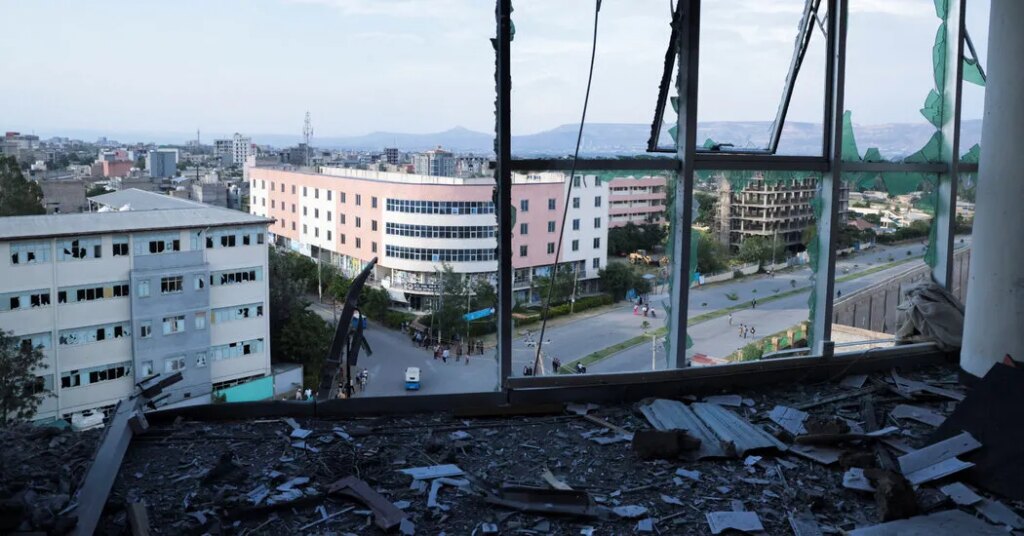
Fighting between Ethiopia’s government and the authorities in the northern region of Tigray has escalated sharply in recent days, signaling what could be the start of a new war in Africa’s second-most populous country.
The two sides fought a two-year conflict beginning in 2020 that claimed hundreds of thousands of lives, with reports of widespread atrocities and mass sexual violence. The new hostilities have caused global alarm, with fears the fighting could spiral into a regional conflict that would draw in neighboring countries in the Horn of Africa and the Gulf.
Who is fighting?
The conflict pits the Ethiopian National Defense Force, the army of the federal government based in the capital Addis Ababa, against the Tigray People’s Liberation Front, in the north.
Last month, the T.P.L.F. joined six armed opposition groups to form a new coalition, the Alliance for Survival. Their aim is to topple Prime Minister Abiy Ahmed of Ethiopia, who has been in power since 2018, and to reform the constitution.
Two members of the rebel alliance, from the northern regions of Afar and Amhara, have also joined the recent fighting. Mr. Abiy’s government has allied with a breakaway faction of Tigrayan fighters who recently split with the T.P.L.F.
What has happened so far?
The recent fighting was preceded by months of federal drone attacks in Tigray, skirmishes in parts of northern Ethiopia and bellicose political rhetoric.
In the spring, the T.P.L.F. reasserted political control in Tigray and announced that Debretsion Gebremichael, who led the region during the last war, would become regional president.
The fighting intensified on Sept. 23 when the T.P.L.F. seized airports under federal control in Tigray’s capital, Mekelle, along with the towns of Axum and Shire. The Tigrayan fighters said the group was “entering defensive operations” in response to drone and artillery attacks by the federal government and an invasion.
Government forces and their allied militia have recently moved toward Mekelle. The Alliance for Survival militias have pushed south into Amhara and east into Afar.
One objective of the alliance, according to experts, is to sever the highway that connects Addis Ababa and Djibouti. Ethiopia is a landlocked nation, which makes Djibouti’s port a vital conduit for trade and arms.
What other countries are involved?
Several countries have security and economic interests in the region, none more so than Eritrea. It fought a war with Ethiopia from 1998 to 2000, and relations between the two remained hostile for many years.
In 2020, after a rapprochement that won Mr. Abiy the Nobel Peace Prize, Eritrea fought alongside the federal government in the 2020 war against Tigray. Human rights groups accused Eritrea of committing some of the worst atrocities in that conflict.
But Eritrea has recently moved closer to Tigrayan leaders, in part because Tigray is a bulwark against Ethiopia’s stated ambition to secure access to the Red Sea. Eritrea’s port of Assab is just 40 miles from Ethiopia’s northern border.
With tensions rising between Ethiopia and Eritrea, both countries announced on Thursday that they would close their respective embassies and expel their diplomats. Ethiopia’s foreign ministry accused Eritrea of “acts of hostility,” while Eritrea said Addis Ababa was guilty of “incessant hostility” in pursuit of a port.
It is not yet clear whether Eritrean forces will become directly involved in the fighting, analysts said.
Eritrea’s allies include Egypt, which has publicly criticized Ethiopia for building a giant dam on the Nile River. Other Eritrean allies include the Sudanese Armed Forces and Saudi Arabia.
Ethiopia has close ties with the United Arab Emirates, a major investor in the country. The Emirates is widely accused of backing the Rapid Support Forces, a paramilitary group that is fighting the Sudanese Armed Forces in a catastrophic civil war.
Analysts warn that a renewed conflict in Ethiopia could effectively merge with the civil war in Sudan along their shared border, with rival interests from foreign powers such as the U.A.E., Egypt and Saudi Arabia competing by proxy.
What has been the international response?
Several world leaders, including the Pope, have called for mediation, and six Democratic senators have called on Secretary of State Marco Rubio to intervene.
Former Nigerian president Olusegun Obasanjo, one of Africa’s foremost statesmen, is leading mediation on behalf of the African Union. But Tigrayan leaders have criticized the A.U., which is based in Addis Ababa, saying it favors the federal government.
As a result, there is no high-profile mediator trusted by all sides, analysts say.
Brian O. Otieno contributed reporting from Nairobi
The post What to Know About Fighting Between Ethiopia and Rebels in Tigray appeared first on New York Times.