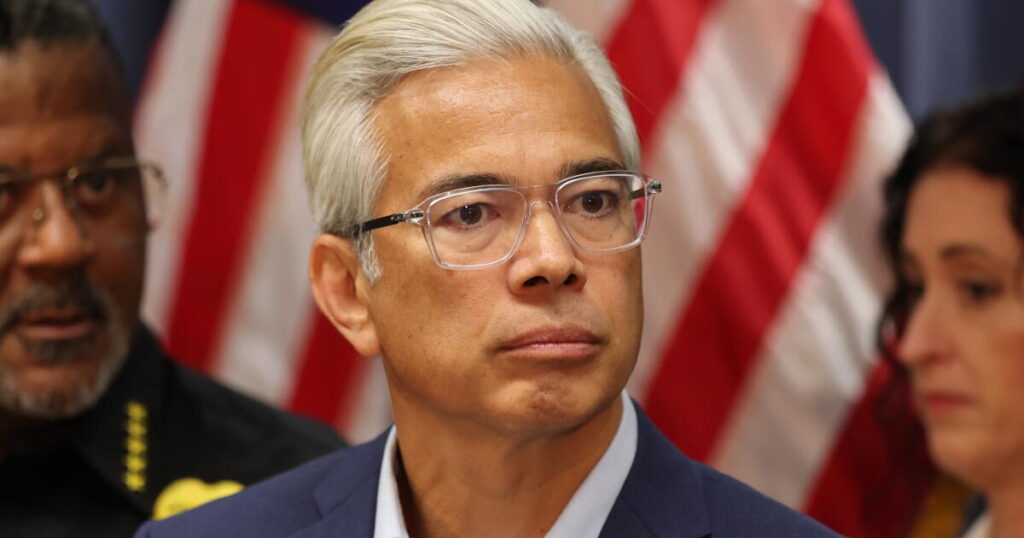
California is leading a coalition of states and local governments in suing the Trump administration over its rollback of federal vehicle mileage standards, alleging the new rules illegally weaken fuel-economy requirements for cars and light trucks.
The lawsuit, filed Friday by California Atty. Gen. Rob Bonta and a group of 26 states, counties and cities, is one of at least three legal challenges this week to new rules from the U.S. Department of Transportation and National Highway Traffic Safety Administration.
The change lowers the fuel-economy requirement for 2031 model-year vehicles to 34.9 miles per gallon, when it would have been 50.4 miles per gallon under rules from the Biden administration. Federal officials said the change will boost the domestic auto industry and lower consumer costs.
It comes as fuel prices remain elevated amid Trump’s war with Iran, which has disrupted the global oil supply since February. In California, gasoline averaged $6.40 a gallon on Friday, compared with $4.65 a gallon one year ago, according to AAA.
In the lawsuit, California and its allies argue the NHTSA failed to meet a Congressional mandate to set corporate average fuel economy standards, or CAFE standards, at the “maximum feasible” level — a reflection of available technology, economic practicability, the effect of other motor vehicle standards and the need to conserve energy.
Instead, the new standards governing the next five years require fewer miles per gallon than the U.S. fleet achieved in 2021, Bonta told reporters Friday. The lawsuit was filed in the U.S. Court of Appeals for the First Circuit in Massachusetts.
“The benefits of helping Americans drive on less gas should be obvious by now,” Bonta said. “Using less gas means less dependence on oil, less exposure to global oil shocks, and less pollution from vehicles and oil production. And it means drivers spend less money at the pump.”
Congress established the “maximum feasible” rule in 1975 when it began regulating vehicle fuel efficiency in response to a global oil crisis after a war in the Middle East. At the time, cars averaged about 13 miles per gallon.
The new change also removes existing electric vehicles from the baseline used to determine how much additional fuel economy automakers can feasibly achieve, which “wildly distorts the starting point for NHTSA’s analysis and leads to dramatically weaker standards,” Bonta said.
It also ends a credit trading program that allowed EV companies such as Tesla, Rivian and Lucid to sell credits to other manufacturers to help them comply with the standards, which brought them considerable revenue.
It is California’s 97th lawsuit against the Trump administration in 88 weeks, Bonta said.
When asked to comment on the suit, officials with the NHTSA pointed to U.S. Transportation Secretary Sean Duffy’s earlier statement about the rule change.
“Joe Biden and [former Transportation Secretary] Pete Buttigieg illegally twisted mileage standards to create an electric vehicle mandate — jacking up car prices for American families and forcing manufacturers to produce vehicles no one wanted,” Duffy said. “I’m proud to stand with President Trump to say that those days are over.”
Other suits brought by nonprofit environmental groups this week similarly challenged the agency for failing to meet the “maximum feasible” levels requirement set by Congress.
The nonprofit Natural Resources Defense Council, which filed in the U.S. Court of Appeals for the Second Circuit in New York, noted that the NHTSA itself predicts the change will force the average driver of a new car to pay about $1,600 more in fuel costs over the lifetime of the vehicle.
The new standards also will lead to billions of gallons of additional gasoline consumption, resulting in a “windfall for oil companies at the expense of the American public,” the group said.
They pointed to a 2020 study from researchers at Princeton which found that in the 50 years since the CAFE standards were established, they have saved more than 2 trillion gallons of gasoline, saved drivers a combined $5 trillion in fuel costs and avoided 14 billion metric tons of planet-warming carbon dioxide emissions. Burning gasoline causes climate change.
Not everyone was opposed to the rule change, which President Trump first proposed in December alongside auto industry executives from Ford, General Motors and Stellantis. Officials with Stellantis told The Times the company “welcome[s] the administration’s efforts to reset the CAFE regulations to more achievable targets that are better aligned with market realities.”
In a press release, NHTSA administrator Jonathan Morrison said the rule “restores integrity to the national fuel economy program, balancing vehicle affordability and energy conservation goals while improving safety on our roadways.”
But Ann Carlson, a professor of environmental law at UCLA who helped set the previous rules as acting administrator of the NHTSA under President Biden, described the new standards as “audaciously, aggressively awful.”
She had anticipated swift legal challenges based the interpretation of maximum feasible standards. While Congress previously mandated at least 35 miles per gallon by 2020, “they’re not even professing to reach that by 2030,” she said by phone on Monday.
Environmental groups said they’re confident their legal challenges will prevail. They include the nonprofits Public Citizen, the Center for Biological Diversity, Conservation Law Foundation, Environmental Defense Fund and Sierra Club, which filed the third suit Friday in the U.S. Court of Appeals for the District of Columbia Circuit.
“Consumers need more fuel efficient choices when considering new cars, and they deserve vehicles that get more miles per gallon and miles per dollar,” said Robert Weissman, Public Citizen’s co-president. “Trump’s lawless push to roll back key safeguards on fuel economy will pollute our air, and line the pockets of oil and auto CEOs.”
The rollback follows other efforts from the Trump administration that favor the fossil fuel industry and contribute to air pollution, such as the Environmental Protection Agency’s recent reversal of greenhouse gas regulations for power plants that burn coal or natural gas.
The post California leads lawsuit challenging Trump’s rollback of fuel economy rules appeared first on Los Angeles Times.