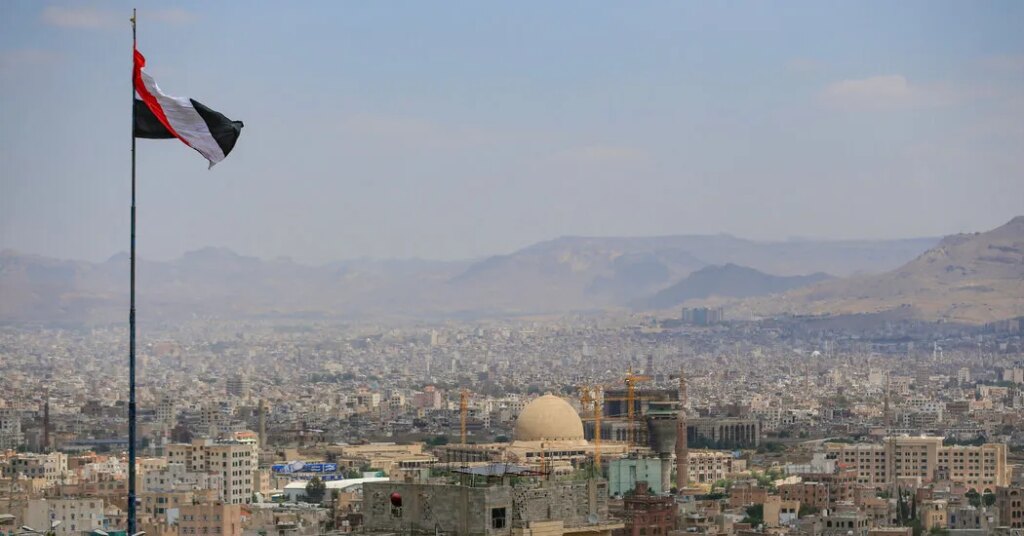
Airstrikes rocked Yemen’s Houthi-controlled capital overnight into Friday after some of the fiercest fighting in years erupted in the country’s third largest city, Taiz — the latest signs that the country is sliding back toward full-scale war.
Al-Masirah, the television channel of the Iran-backed Houthi militia, said strikes had hit Yemen’s capital, Sanaa, and at least three provinces, including Taiz. It blamed what it called “Saudi aggression,” a reference to the Saudi-led coalition that backs Yemen’s internationally recognized government.
A spokesman for forces aligned with Yemen’s government said they had struck “high-value targets” in Sanaa, but did not provide further details.
Renewed fighting erupted last month, shattering a fragile military stalemate in the country, as the Houthis launched a lightning offensive and seized the entire Red Sea coast, giving the militant group a foothold near one of the world’s most important shipping routes, the Bab al-Mandab Strait.
The Houthis have accused Saudi Arabia of launching hundreds of airstrikes in Yemen, which Saudi officials have largely not acknowledged.
Fighting has restarted along multiple front lines as the Houthis battle forces allied with the Yemeni government for territory. More than 800 people have been killed and thousands more have been injured or displaced since fighting started up again, according to the World Health Organization.
Col. Abdul Basit al-Baher, an officer in the Yemeni government’s military, said the Houthis had launched one of their most aggressive attacks in years around Taiz on Thursday, triggering “fierce, simultaneous clashes” across dozens of fronts. Government forces repelled most of the assaults, but the Houthis captured three rural villages, he said.
By Friday, the ground fighting had eased significantly, though the Houthis continued shelling government-held areas, Colonel al-Baher said.
Taiz sits at a strategic crossroads between Houthi-held northern Yemen, the government-controlled south and the Red Sea coast. Expanding their control there would help the Houthis secure recent coastal gains and increase pressure on government forces farther south.
The Houthi offensive has drawn Yemen more deeply into the wider war between the United States and Iran. Shipping through the Strait of Hormuz, a narrow 90-mile waterway connecting the Persian Gulf to the open ocean, has been disrupted for months as Iran launches drones and missiles at commercial ships. Saudi Arabia has since become more reliant on oil-export routes through the Red Sea.
The Houthis’ expanded foothold around the Bab al-Mandab Strait now places an Iran-backed force beside another crucial artery for energy and trade, at a time when the wider conflict has already sent global oil prices skyrocketing.
Hans Grundberg, the United Nations special envoy for Yemen, said on Thursday that fighting had “significantly intensified” in Taiz and called on the Houthis to halt their offensive. He said his office had received reports of casualties, infrastructure damage and road closures preventing people from leaving.
Yemen, one of the world’s poorest countries, has been devastated by more than a decade of war and economic collapse. The latest escalation has only deepened its humanitarian crisis. The World Food Program said on Friday that more than 150,000 people had been displaced in recent weeks. In government-held areas monitored by the agency, nearly three in four households could not meet their basic food needs, the highest level recorded this year.
In a statement issued early Friday, the Yemeni military said its air defenses had also shot down Houthi attack drones over Aden, the temporary seat of the internationally recognized government, before they reached what it described as civilian targets. It did not identify the targets or report casualties.
Saudi Arabia, which led a military coalition into Yemen’s civil war in 2015 and remains the government’s principal foreign backer, has itself come under renewed attack. The latest cycle of cross-border violence began in July, after the Houthis accused Saudi Arabia of bombing Sanaa’s airport to prevent an Iranian aircraft from landing.
In response, the Houthis launched drone and ballistic missile barrages at Saudi military bases, ports and airports, while targeting oil tankers in the Red Sea in what they called a naval blockade.
The Saudi-led coalition said on Thursday that it had intercepted ballistic missiles and drones aimed at southern Saudi Arabia. Early Friday, it reported intercepting another ballistic missile aimed at the same region. The Houthis have not yet claimed responsibility for the attacks.
The Saudi-led coalition also accused the Houthis on Thursday of carrying out a drone attack earlier in the week against an electricity-distribution station in Medina, Saudi Arabia, that provides services to the Prophet’s Mosque, Islam’s second-holiest site and the burial place of the Prophet Muhammad. One transformer was knocked out, the coalition said, although the broader electricity network was unaffected.
Saudi officials cast the Medina incident as part of repeated Houthi attempts to target Islam’s two holiest cities, after accusing the group of trying to strike Mecca two weeks earlier. The Houthis have denied both accusations.
The post Fighting Intensifies in Yemen, Raising Fresh Fears of All-Out War appeared first on New York Times.