Putting the latest AI models into buildings, factories and kitchens is much harder than putting them into a chatbot. That was the message from executives at Honeywell and Ecolab, though they were fairly positive about AI overall.
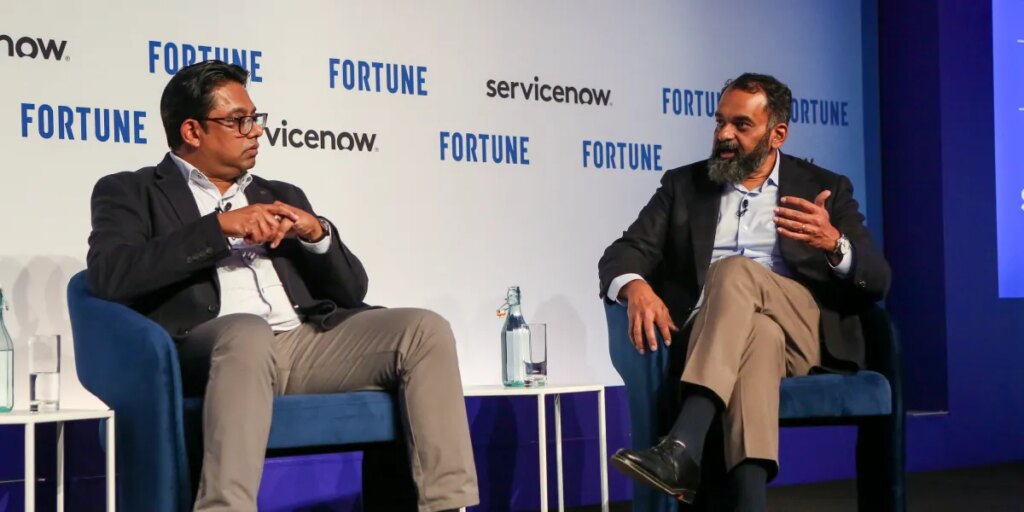
Honeywell Chief Technology Officer Suresh Venkatarayalu said at Fortune’s AIQ Summit at the New York Stock Exchange on Thursday that the problem is accuracy. The industrial giant’s customers “really demand 99.9999%,” he said, while frontier models “could be at 85%.”
Ecolab Chief AI Officer AJ Wijesinghe described a different limit: cost. When the company put “the best model that’s out there” on high-volume work, “the tokenomics go off the roof,” he said. “Sometimes it’s more expensive than having humans.”
The water-management company then optimized its models and cut token costs by about 70% to 80%, he said. Ecolab uses both frontier and open-source models, including Anthropic’s Claude and OpenAI’s. “Sometimes you don’t have to have the fastest car,” he said.
Neither executive described a fully autonomous future. Venkatarayalu said the move is toward “a semi-autonomous world” where operators build trust in the systems, and that “autonomy is also not about removing people.” Wijesinghe described a “human in the lead” model, saying agent technology “is not matured enough” to run at scale on its own.
Slower than software
Physical equipment can’t be updated like a phone. Venkatarayalu said over-the-air upgrades are coming to commercial buildings, but with an operator in the loop. Buildings and industrial sites are “mission critical and safety critical,” he said. A Tesla can be down for 1.5 hours for an update, but “you cannot afford to have a building shut down for one and a half hours.”
Moderator Emily Forlini, senior AI reporter at Fortune, noted the company recently announced a partnership with Nvidia at its investor day. Venkatarayalu said it’s fine-tuning open-source models partly because customers want sovereignty over their data and models. He said Honeywell hand-picks them and works with Nvidia’s Nemotron team, because an unsupported open-source model without guardrails would be “dangerous.”
Honeywell describes a “see, think, act, and learn” framework. It starts by cataloguing a building’s assets, including HVAC, fire control, and security and access control, and connecting them over the BACnet protocol. AI agents then learn how the systems relate and run them. Venkatarayalu also said the company is exploring how to teach AI about chemistry, such as catalyst formulation.
Ecolab uses sensors in dishwashers, pest traps and water systems to cut service visits and predict maintenance. Its executive said the company also manages water for chip production, power and cooling in AI infrastructure.
What separates results from stalls
An audience member from a systems integrator asked what separates AI work that creates value from work that stalls. Wijesinghe said individual AI adds little measurable value at the enterprise level, and vertical AI within a function adds some. The most value, he said, comes from “horizontal” AI that works backward from an outcome across functions such as sales, finance and supply chain.
AI “should not be just another technology,” he said, and should be tied to a company-wide transformation. Ecolab expects $325 million in annual run-rate savings by 2027, and he said “significant” amounts are already in hand. Data foundation, process readiness and cost discipline matter equally, he said: “If one is heavier than the other, then you don’t get the value.”
Honeywell’s executive said where AI runs, at the edge, on a customer’s premises or in the cloud, depends on latency, data-transaction cost and sovereignty. Customers who got 7% energy savings from existing controls now ask whether AI can deliver 30% or 40% more, he said.
For this story, Fortune journalists used generative AI as a research tool. An editor verified the accuracy of the information before publishing.
The post ‘Sometimes it’s more expensive than having humans’: Honeywell and Ecolab get real about AI’s limits in the physical world appeared first on Fortune.