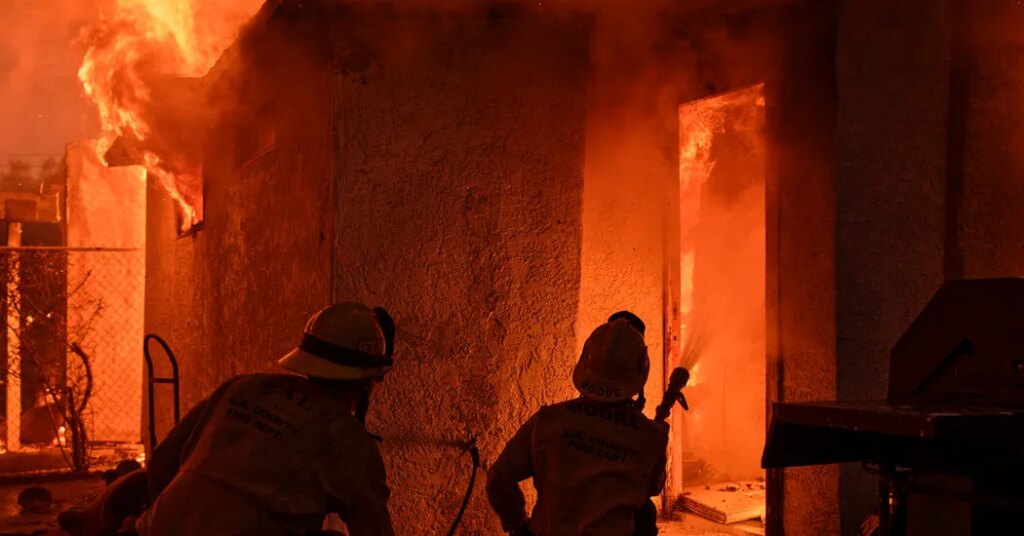
Wildfires have become so deadly and vast that urban areas need to rethink their approach to fighting them, an investigation into the fires that devastated parts of Southern California last year reported on Friday. The study found that the protocols firefighters relied on as flames erupted in the Palisades and Altadena fires were overwhelmed by the disaster’s “speed, scale, and complexity.”
The comprehensive analysis found that while several state and local agencies fell fatally short in their preparation and response, the clearest lesson from the disaster was the extent to which climate-driven fires are outstripping modern firefighting.
“The Southern California fires got so large, so fast, that they outpaced the capabilities of the very people trained to fight them,” Derek Alkonis, a senior research program manager for the Fire Safety Research Institute, said in a recorded news briefing. “Some of the most well-trained firefighters in the world” work in the state, he said, but their training and coordination have not kept up with the mounting risk.
The review, commissioned by Gov. Gavin Newsom and conducted by UL Research Institutes, a public safety nonprofit, was the second part of a wide-ranging examination, and the latest in a series of local, state and federal post-mortems after the fires that erupted in and around Los Angeles starting on Jan. 7, 2025.
At least 12 wildfires raged over that month across drought-parched Los Angeles and Ventura Counties, driven by extreme winds. The two largest — in the coastal Los Angeles enclave of Pacific Palisades and the historic San Gabriel Valley community of Altadena — killed a total of 31 people and destroyed more than 16,000 buildings. Thousands of survivors remain displaced.
Calls for accountability have been intense. Federal authorities have attributed the Palisades fire to buried embers that smoldered for days and then rekindled after Los Angeles city firefighters declared a small Jan. 1 brush fire extinguished. A 30-year-old man has pleaded not guilty to federal arson charges in connection with that initial fire.
Los Angeles County fire investigators have traced the Altadena fire to a transmission tower belonging to the utility company Southern California Edison.
But government agencies also have been accused of failing to do all they could to pre-empt the fires after meteorologists warned of an incoming windstorm, and to control the flames once the fires started.
The Los Angeles Fire Department failed to adequately deploy firefighters and equipment ahead of time in and around Pacific Palisades despite the heightened fire risk, decisions that the department’s internal review blamed on efforts to control spending and overtime. The Los Angeles Department of Water and Power has been sued over a disastrous loss of water pressure to fire hydrants in the Palisades; survivors say the fire might have been mitigated had a critical city reservoir not been emptied.
Los Angeles County, which had jurisdiction over the Eaton fire in Altadena, has been sued over late evacuations in an area where at least 18 people died.
Friday’s report found that Los Angeles city fire officials underestimated the fire risk, failed to deploy enough fire equipment ahead of time in Pacific Palisades and disastrously opted against holding over a shift of firefighters. The city, historically focused more on urban structure fires than on wildfires, failed to adequately monitor the sites of prior brush fires as conditions worsened, underestimating reports that one may have rekindled.
In Altadena, the investigators found, the evacuations were indeed late and chaotic. Poor communication and confusion over who was in charge slowed warnings, and authorities lost track of the fire’s direction because the wind grounded firefighting helicopters and trees blocked fire-tracking sensors. Many of the residents who died had also refused to leave despite multiple warnings, orders and pleas.
The institute’s analysis, based on data from 22 agencies and an examination of nearly 900 structures, yielded hundreds of recommendations, from standardized methods to ensure old fires don’t reignite to greater use of swimming pools as a water source for fire suppression.
But the report also painted a sobering bigger picture.
Both the Palisades fire and the Altadena fire ignited in dense metropolitan communities that back up to fire-prone wilderness areas and foothills, a development pattern that has become increasingly common in California as affordable housing has become scarcer. That, fire experts say, points to an ongoing risk.
To combat it, the investigators said, local governments need to take a broader approach to firefighting, dealing with issues like preparedness and emergency response in a much more comprehensive way at a regional level.
“Incremental improvements to individual programs alone will not be sufficient to address future wildfire risk,” the report found. “Long-term risk reduction requires coordinated action that improves wildfire resilience at the community, regional, and state and federal levels.”
The post Powerful Wildfires Require a New Approach, California Report Finds appeared first on New York Times.