Each fall, New York City Ballet hosts a gala in which fashion designers descend on the company with eager thoughts about, say, how fringe or feathers might punch up a ballet. Barbara Karinska, the visionary designer of whom George Balanchine said, “I attribute to her 50 percent of the success of my ballets to those that she has dressed,” would be spinning in her grave.
For the fashion gala, choreographers team up with designers, a tradition started by Sarah Jessica Parker, a vice chair of the company’s board, in 2012. The costumes often have a way of overwhelming the dance, but this year the choreography fought back, making a stronger contribution to the silliness of it all. Ballet, like fashion, is about fantasy, yet the premieres were more juvenile than imaginative, like skits stretched reluctantly into longer lives.
Three choreographers teamed up with designers to create ballets: Alysa Pires with Victor&Rolf; Justin Peck with Simone Rocha; and Jennifer Archibald with Robert Wun. In “Auspicy,” Pires showed her conceptual bond with the Dutch designers, but what did it matter? Her choreographic conceit, about the challenges of motherhood in turbulent times, washed across the stage like an expensive school pageant.
At first, a huge golden structure filled the space, operating like Mother Ginger’s skirt in “The Nutcracker.” Two dancers dashed out of it, zipping around like children finding their footing. Unity Phelan, the mother figure, arrived wearing an opulent, gilded coat with a message: Starting on one shoulder and ending at the other was a cartoonish rendering of the word “protect.”
It was ludicrous, like a voice-over in a film telling us a character’s name. Burdened by the weight of the world — and her armor-like costume — Phelan took hesitant steps. Shielding children from danger is weighty work. At the start and end of the ballet, she held up her hands to stop the curtain from falling. This was even cornier the second time around.
The music, two selections by Jocelyn Morlock, including “Oiseaux bleus et sauvages,” or “Wild Blue Birds,” put avian imagery on overdrive. The corps de ballet were referred to as Fledglings, and as such, their elbows pointed up framing their faces in a V, and their arms pulled back before spreading like wings. At least their shimmering unitards fit like a glove. They could move.
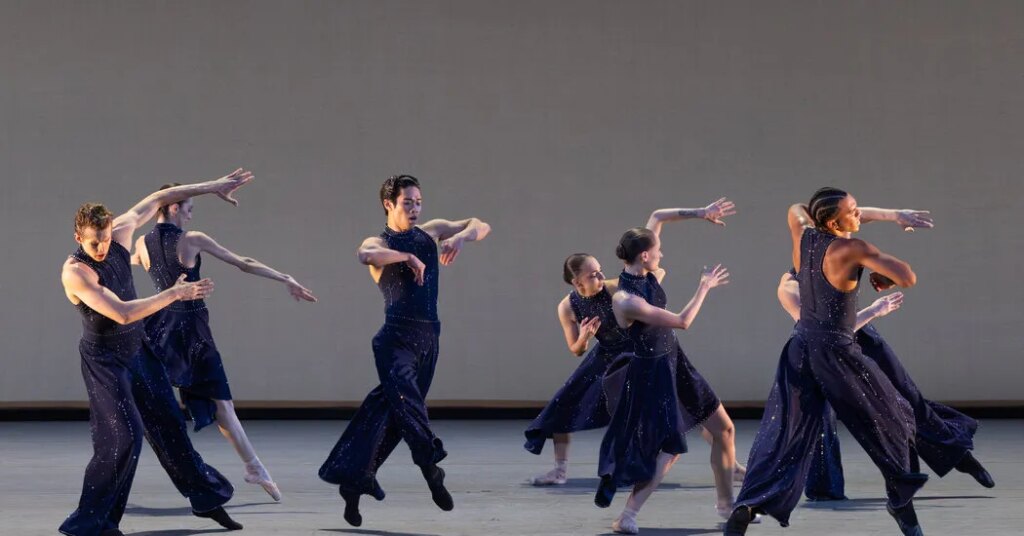
For “Shared Rain,” Archibald, who works in hip-hop as well as classical dance, took on the notion of rain, or climate change, as a collective experience. Who can escape a storm? It opened with glittering umbrellas gracing the dancers’ bowed heads to the echoing sound of a downpour. The headpieces, inspired by Wun’s recent runway show, were fitting but comically overt.
Archibald created a mixed score, which moved from the sound of breath to driving percussion, eventually ending with Tokio Myers’s “Bloodstream.” Wun’s midnight blue costumes were embedded with jewels that created a beautiful effect once the dancers started to cover space with more vigor, leaping and whirling with spectacular force. Their racing bodies flickered like rain under city lights.
Throughout this ballet for eight dancers, the men had the upper hand; the women were less empowered and, at times, resembled puddles as they were pulled across and spun on the floor. But at least Archibald used her time wisely: She gave the evening some energy. And Victor Abreu and KJ Takahashi were dazzling.
Wedged into the middle was a pas de deux by Justin Peck, the company’s resident choreographer, for Tiler Peck and Roman Mejia, two sleek, virtuosic principals. “Mirror/Sky,” takes its title from a commissioned composition by the composer Gabriel Kahane, the latest of many versions of Stevie Nicks’s “Landslide.” As the lyrics go, “Oh, mirror in the sky, what is love?”
The score’s first half was little more than incidental movie music. Then it eased its way into the song’s melody. Vocals came courtesy of the singer-songwriter Haley Heynderickx. Nicks, the evening’s honorary chair, was in attendance. She wore a floral wreath.
“Landslide” is a classic. Nicks is a hero of music, of fashion (leather! lace!) and even of dance, as her stage spins attest. But the ballet, featuring Rocha’s unfortunate costumes — Mejia’s unitard had a vine with red flowers, perhaps mirroring his ribs, while Peck’s blossoms were planted, oh nuts, on her breasts — was a tepid response to Nicks’s poignant song.
“Mirror/Sky” landed like a middle school version of a dream ballet. Peck, who took off her pointe shoes halfway through, used her musicality to help build tension with Mejia and let love rule, but the choreography hovered in a state of wistfulness. On the lines, “Even children get older/And I’m gettin’ older, too,” Peck poured her weight onto Mejia’s shoulder as he faced away from the audience.
Was it serious? Playful? It was treacly. As the movement wavered between slow motion and focused speed, with some unsightly cartwheels with bent knees thrown in, this portrait of a couple was affected from the start. The landslide brought it down.
New York City Ballet
Through Oct. 18 at the David H. Koch Theater; nycballet.com
The post Review: Stevie Nicks, Fashion and Ballet. What Could Go Wrong? appeared first on New York Times.