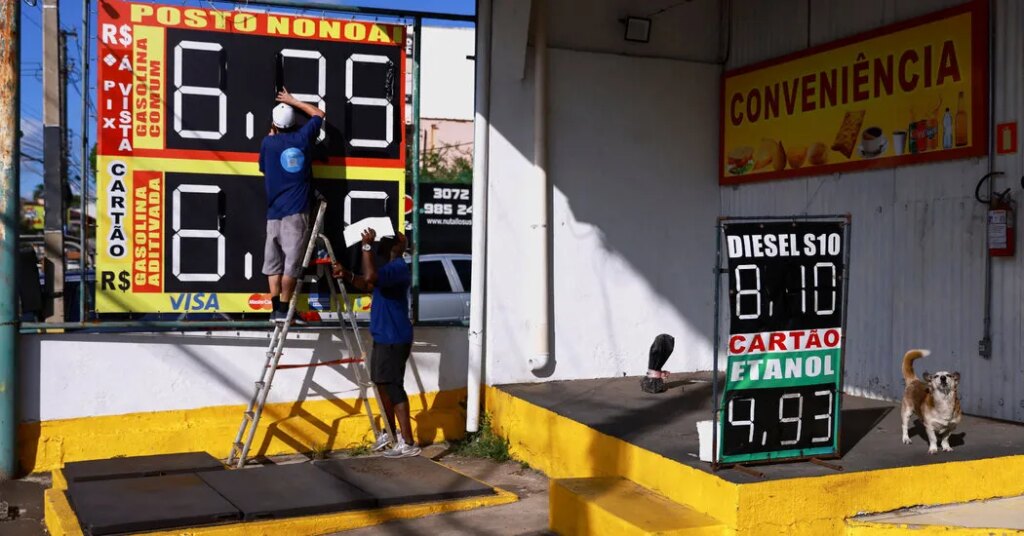
The decision on Friday by the world’s wealthiest nations to release diesel from their stockpiles is meant to help lower record-high prices.
It could also ease anxiety around the world over a ban on U.S. diesel exports that has been under consideration by the Trump administration. Such a move could inflict pain on economies in Latin America and Europe that are among the largest trading partners of the United States.
Concern over a possible ban had been climbing especially in Latin America’s two biggest economies, Brazil and Mexico, and in other countries in the region, like Chile and Ecuador, where Trump allies have risen to power. Some Republican lawmakers in the United States have called for the ban in response to soaring diesel prices.
In Europe, Britain, a leading trade partner, and the Netherlands, an important energy hub, would be hard hit if the United States were to halt diesel exports, which are crucial for long-haul trucking, agriculture and mining.
The concerns reflect how the United States has grown into the world’s largest diesel exporter. American diesel supplies have become even more important as turmoil in Russia and the Middle East has choked off maritime trade routes and refining.
Latin America Would Be ‘Hammered’
Six of the top 10 destinations for U.S. diesel exports were in Latin America in September, according to Vortexa, which tracks energy shipments. Brazil and Mexico lead the world in buying diesel from the United States.
“Latin America would get absolutely hammered by a ban,” Robin J. Brooks, a senior fellow at the Brookings Institution, wrote in an online appraisal.
Brazil has recently emerged as the top buyer of diesel from the United States, a shift that has accelerated in recent weeks after Russia extended restrictions on exports of the fuel after Ukrainian drone strikes on refineries.
Brazil relies on diesel for its vast agricultural sector and is looking for ways to bolster supplies while easing the economic pain resulting from high prices.
The authorities have been examining options such as increasing imports from India or expanding production of biodiesel, which can be made from soybeans. President Luiz Inácio Lula da Silva has also raised diesel subsidies.
Magda Chambriard, chief executive of the Brazilian oil giant Petrobras, sought to ease some of the concerns when she revealed that the company had already booked cargoes for October.
While Brazil does have a large refining industry that could respond to a ban, “They don’t quite have enough domestic capacity to meet demand,” said Reid I’anson, an economist at Kpler, a research firm.
Mexico Is in a Bind
Mexico, the top U.S. trading partner, has sought for years to reduce reliance on imports of American fuels. But technical delays and cost overruns have plagued efforts to expand domestic refining.
Shortfalls in Mexico’s own diesel production now expose big parts of the economy to a U.S. ban. Northern Mexico, home to a vast industrial base, could be especially vulnerable if cross-border pipelines in Texas are ordered to halt exports.
Smaller Latin American countries are even more exposed, potentially affecting key producers of copper, silver and lithium. Reliance on U.S. diesel is particularly acute in Central America, which has relatively little refining capacity.
Chile, which recently swung to the right with the election of the Trump ally José Antonio Kast as president, would be especially affected. Chile relies on the United States for 88 percent of diesel imports, according to S&P Global Energy, a research firm.
Fears of Recession in Europe
Europe also would be hurt, especially after European countries curbed purchases of Russian fuel after Moscow invaded Ukraine and the war in Iran reduced energy flows.
Britain and the Netherlands are currently the largest European importers of U.S. diesel, followed by France and Spain.
Britain occupies a uniquely fragile position since the United States supplies about a third of the country’s imported diesel. Domestic refinery closures have also reduced Britain’s capacity to lift its own supplies.
The Netherlands is also vulnerable as both a consumer of U.S. diesel and as a regional storage and refining hub. A U.S. ban could empty inventories in the Netherlands, causing barge flows on the Rhine River to drop and leading to secondary diesel shortages in Western Europe.
U.S. Could End Up Hurting Itself
Philip K. Verleger, an energy economist, said a diesel ban could have had unintended consequences beyond short-term disruptions.
Mr. Verleger drew a comparison with President Richard Nixon’s temporary embargo on soybean exports in 1973 in response to U.S. domestic inflation and a bad harvest.
That move created a shock in Japan, which in turn helped finance Brazil’s transformation from a minor player in the global soybean market into the pre-eminent competitor in global agriculture of the United States.
Similarly, Mr. Verleger said, a ban could push other countries to find alternative supplies or to accelerate their transition to renewable energy sources.
“A ban on diesel exports would undermine U.S. credibility as a dependable energy supplier,” Mr. Verleger said.
The post Why U.S. Diesel Is So Important to Major Trading Partners appeared first on New York Times.