For years, the mood in China has been darkening.
A weakening economy has left many disillusioned, a state of mind expressed privately and across the heavily controlled internet in lowered expectations and quiet anxiety.
Some of that may now be surfacing in more troubling ways.
In March, a man drove a heavy construction vehicle through an outdoor market in a Beijing suburb, reportedly killing several people. In June, a small aircraft crashed into a prominent office building in the capital, killing the pilot and injuring 13 others in what may have been a suicide. And last month a man was arrested in the southern city of Guangzhou after allegedly slashing the faces of multiple women in a busy shopping district.
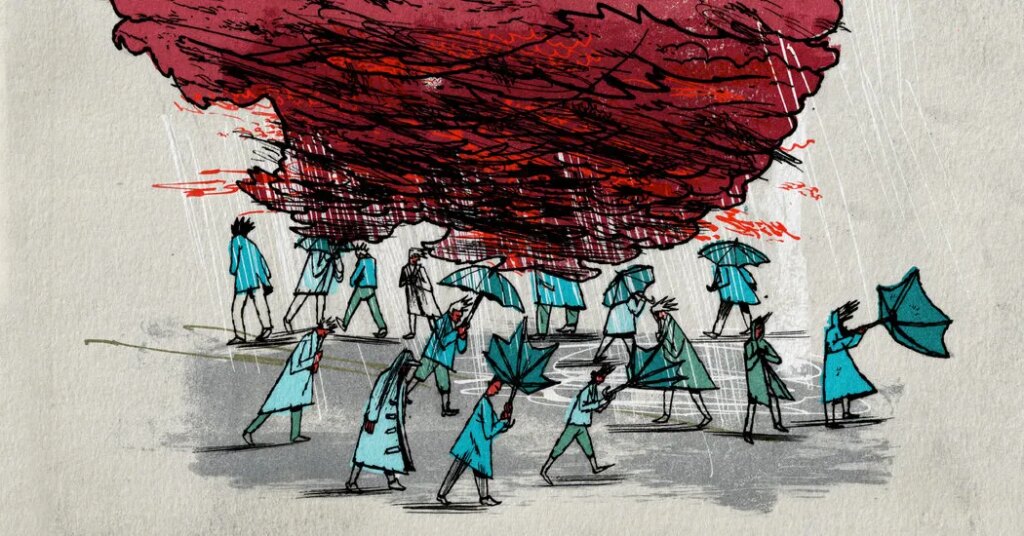
Incidents like these are rare in China and heavily censored, making motives difficult, if not impossible, to discern. But in a country where it’s dangerous to vent at government policies, I can’t shake the sense that people are instead beginning to take their anger and frustration out on one another.
Intensely focused on competing with the United States, Beijing is pouring resources into building up its advanced manufacturing and technology industries, seeing them as the future drivers of national growth. During a summit meeting with President Trump at the White House last week, President Xi Jinping of China spoke confidently, saying China was “breaking new ground” in his modernization drive.
But much of the broader economy remains weak. Unemployment is high, especially for younger people, and wages are stagnating. Households still reeling from the long-term collapse of the country’s real estate market are cutting back on spending. The government this year set its lowest annual growth target since 1991.
The impulse to find someone to blame is clearly evident in the viral doxxing phenomenon called “ba,” or “to strip.” In these campaigns, which have intensified in recent months, posses of digital sleuths comb through the backgrounds of people who have attracted attention for their academic or professional achievements, “stripping” them down in a hunt for evidence that connections, fraud or favoritism paved their way.
In late July, a 29-year-old podcaster named Zhuge Yiyang — a Ph.D. candidate at Boston College — went viral after she interviewed the director Christopher Nolan about his movie “The Odyssey.” Ms. Zhuge had been admired by many of her online followers as proof that hard work and merit lead to success, and she was widely praised for the intellectual depth of her questions in the interview.
Soon, however, the online stripping started, leading to accusations that she had plagiarized material in her podcasts and writing. Ms. Zhuge has disputed some of the accusations, but canceled public appearances and described herself as emotionally exhausted.
Often, the scrutiny seems less about exposing wrongdoing than about a reflexive resentment of perceived elites who have become avatars of an economy in which many people see their own prospects narrowing. Other recent targets have ranged from a Chinese actress to prominent doctors and a Harvard graduate who last year became the first Chinese woman to speak at a commencement ceremony at the university. The young woman called for global unity in her speech but was soon accused of using family privilege and connections to further her academic career.
Fraud, nepotism and plagiarism are hardly new in China, nor is the tendency for people to take aim at perceived inequities online. What feels new is how automatic and ferocious the hunt for them has become as sensitivity rises over who gets ahead — and how — at a time of pervasive economic anxiety.
Bitterness is intensifying between men and women, too. In online forums men complain that more of the pressure from the worsening economic prospects falls on them. They rail against feminists, and some have even called for a men’s rights awakening.
Male frustration spilled into the streets in August when groups of young men, apparently protesting the effeminization of youth culture, reportedly gathered in the city of Chongqing outside the office of a talent agency that handled boy bands. After police detained one of the men, the protesters marched down a major road, demanding his release and chasing, shoving and kicking female fans waiting outside the agency. Some took photos of the women, which were digitally altered as pornographic images and disseminated online.
Studies suggest that many Chinese men, particularly those with fewer resources, face mounting difficulty fulfilling traditional expectations to marry and become stable breadwinners. A man is often expected to have an apartment and a car before he can secure a wife. For many, that’s becoming nearly impossible.
In some parts of the country, a groom’s family may also be expected to pay a “bride price,” a payment to the bride’s family as part of the marriage agreement. A survey of young male migrant workers, which was published in February, put the average price at around 130,000 yuan ($19,000) — about six times the respondents’ average annual savings.
Marriage prospects are worsened by the government’s former one-child policy which, combined with a traditional preference for male heirs, led many families to abort female fetuses, skewing China’s gender balance. The policy was ended a decade ago, but single men of marriageable age outnumbered unwed women by as much as two to one in some parts of the country, according to the most recent detailed census in 2020. Last year, China still had nearly 29 million more men than women.
I grew up in a China whose ascent was powered not just by factories, investment and growing incomes, but by the sense that all boats were rising. Even if some rose faster, people could see those who had made it and imagine joining their ranks. They could look forward to building families and bringing up children whose lives would be better than their own.
What’s disturbing about China today is not simply that those expectations are fading, but that success itself is cause for suspicion and outright hostility: If I am falling behind, someone else must be getting ahead at my expense; if I can’t meet the expectations society places on men, a woman must be to blame.
The Chinese state has enormous power to steer the economy and shape public life. What it cannot simply command back into existence is good will between its citizens.
Economic downturns end. A fraying social fabric may prove harder to mend.
Helen Gao is a freelance writer based in Beijing.
The Times is committed to publishing a diversity of letters to the editor. We’d like to hear what you think about this or any of our articles. Here are some tips. And here’s our email: [email protected].
Follow The New York Times Opinion section on Facebook, Instagram, TikTok, Bluesky, WhatsApp and Threads.
The post China’s Stressed People Are Starting to Turn on Each Other appeared first on New York Times.