It seemed a small act of vandalism.
A man was caught on a surveillance camera in August cutting through a border fence from Belarus into Latvia, where he bashed another such camera with a pole before fleeing back to where he had come from.
Yet his crime was also emblematic of a broader security threat emanating from Belarus and its close ally Russia, Latvian officials, including the foreign minister, Baiba Braže, said in interviews in Riga. The Russian and Belarusian intelligence services are facilitating an elaborate scheme to illegally funnel migrants from the Middle East and Africa across the border into Latvia and other NATO and European Union countries, Latvian officials said.
Thousands of migrants have streamed toward Latvia this year, and more than 11,000 were turned away, totals that were unheard-of just a few years ago in this Baltic country of less than two million people. An unknown number broke through the country’s border defenses, cutting gaps in an extensive fence and more recently burrowing under it. Latvian officials described the damage as part of a targeted campaign.
Criminal gangs lure immigrants to Russia and Belarus on commercial flights and then send them to the border, Latvian officials said, with the backing of those countries. Officials said that the Russian and Belarusian governments sometimes even offered chartered flights to Moscow or Minsk for migrants and then provided transport to the forested frontiers bordering Latvia, Lithuania, Poland and elsewhere. Geolocation data from the phones of immigrants showed that some had traveled through Russia, Ms. Braže said.
Russia’s goal in Latvia, where immigration is a contentious political issue, is to stir up tensions ahead of parliamentary elections on Saturday and to help usher in more Russia-friendly lawmakers, Latvian officials said.
“They would destabilize the situation to get politicians in Parliament that are more friendly to Russia,” said Gen. Guntis Pujāts, chief of the Latvian State Border Guard.
Russian officials have denied Latvia’s accusations. “This is the latest in complete stupidity from the Latvian government,” Dmitri S. Peskov, the Kremlin spokesman, said in a text message. A spokeswoman for the government of Belarus did not respond to a request for comment.
Latvia is bolstering its defenses.
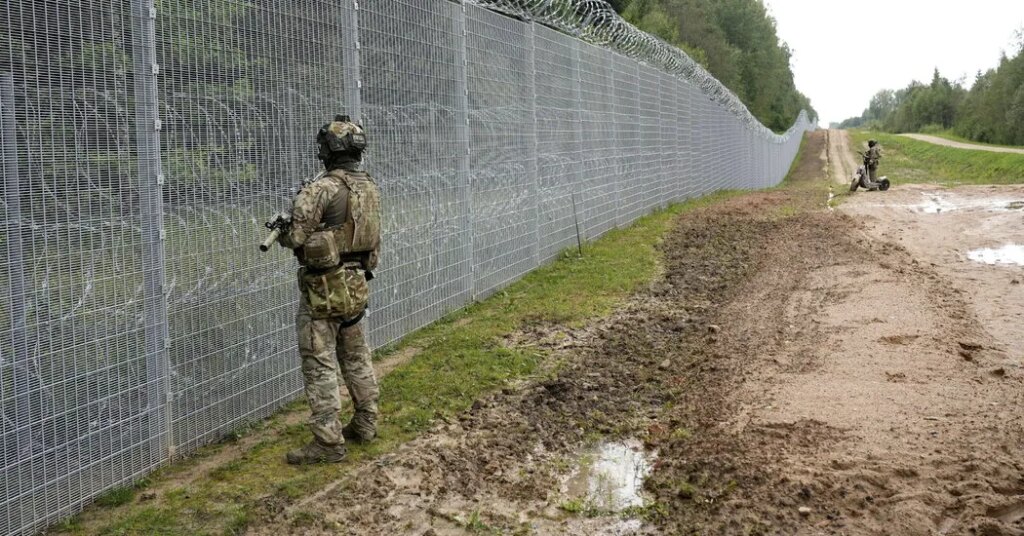
On a recent visit to the Latvian-Belarusian border, there were soldiers on all-terrain vehicles patrolling as part of a quick reaction force, while other soldiers raked the dusty road to make footprints more visible.
Where there was once an open frontier with Belarus, a lofty steel fence topped with barbed wire now stands. The fence, which stretches the length of Latvia’s 107-mile border with Belarus, is equipped with video cameras and motion sensors along with artificial intelligence programs that help distinguish between animals and people. Border guards at a nearby outpost watched monitors, tracking any movements, while surveillance drones flew overhead.
The migrant scheme, according to officials, is part of Russia’s broader strategy for sowing discord in the West, if more subtle than other recent operations pinned on the Kremlin. The goals are the same, officials said: to impose consequences on countries for supporting Ukraine and to tie up the resources of the police, military and security services, while skirting the threshold of an all-out war and maintaining deniability.
The weaponization of immigration by Russia and its ally Belarus checks each of these boxes, Latvian officials say.
“It’s part of the warfare industry,” Ms. Braže said in an interview. “They are waging a subconventional attack, and that includes not only the sabotage or state-sponsored terrorist attacks, but also constant hostile information attacks, constant cyberattacks, all of it.”
Latvian officials recently began what they are calling Operation Werewolf, an effort to blunt an anticipated surge of immigrants ahead of the elections. As part of the operation, the army and national guard have been mobilized. Allied countries like Estonia and Finland sent border guards to help.
A chorus of European political and intelligence officials have warned recently that Russia was planning to intensify its yearslong sabotage campaign against the West, perhaps even mounting a small-scale incursion or attack in the Baltics or elsewhere. Such an assault, the officials said, could serve to test NATO’s Article 5, which states that an attack on one member is an attack on all.
German officials blamed Russian intelligence operatives in August for plotting to blow up cargo planes filled with goods destined for Ukraine. On Tuesday, Estonian officials alleged that Russia’s security services were behind an August fire at a defense technology company that supplies Ukraine. The Latvian authorities have accused a pro-Russian group of planning to carry out terrorist attacks against arms manufacturers supplying Ukraine in the war against Russia.
Security officials caution that there are few signs that Russia is planning an imminent military operation on a NATO country.
Still, Latvia is heightening its defenses, in part because officials know that its support for Ukraine makes it a target for Russia. Latvia had provided about $1.3 billion in aid to Ukraine as of May, the most recent period with available data. That is nearly 1 percent of Latvia’s gross domestic product — a significant contribution for a small country. Prime Minister Andris Kulbergs recently said that next year, the country would spend 5 percent of its G.D.P. on defense.
Latvia sealed its Silene border crossing in the country’s east in 2023 to prevent any potential military incursion. Once a bustling transit area with goods passing between the European Union, Belarus and beyond, it is now fortified with heavy concrete blocks and anti-tank barriers called hedgehogs.
Since Russia invaded Ukraine, the numbers of migrants showing up at the border has steadily increased. In 2021, nearly 4,400 were turned back. By 2025, it had nearly tripled.
The increase forced Latvia to divert crucial resources and shut down all but one border crossing with Belarus. Latvia has spent more than $1 billion securing its borders with Russia and Belarus, Mr. Kulbergs said in August at a conference in Riga.
The migration crisis began before Russia’s full-scale invasion of Ukraine in 2022. In 2021, European officials accused Belarus of using migrants as pawns to punish the countries along its borders, particularly Poland, for their support of political forces opposing Belarus’s authoritarian president, Aleksandr G. Lukashenko. The standoff trapped migrants in the frozen gray zone between borders. Some perished.
Vladimirs Sersts, a captain with Latvia’s State Border Guard, said the immigrant situation escalated this year. Officers recently found two tunnels — one estimated to be about 130 feet long and the other about 65 feet — dug under the border fence. Similar tunnels have been found along the Belarus border in neighboring Lithuania.
Once inside Latvia, immigrants attempt to link up with smugglers whose job is to drive them deeper into the European Union. Many of the immigrants — who come from countries as varied as Eritrea, Afghanistan, Iran, Somalia and Cuba — are trying to reach places farther west, like Germany, officials say. Some of the immigrants appeared to have been deceived by their smugglers into thinking they actually were in Germany after crossing the Latvian border, officials said.
There’s no doubt, officials said, of Belarus’s complicity. Belarus is run as a police state. Its intelligence service, which is still called the K.G.B., is pervasive. The smugglers, for example, work for criminal gangs that, in turn, work with the Belarusian K.G.B., Latvian officials said.
At the border with Latvia, the Belarusian side looked wild and unkempt, with no visible patrols. Videos show crowds of migrants congregating at the border fence without any oversight from Belarusian authorities, something Belarusian citizens would never be allowed to do.
For Captain Sersts, this is proof of the Belarusian government’s involvement.
“When you see a group of migrants freely walking along the fence on the Belarusian side, this is your answer,” he said. “This is a restricted area.”
Ms. Braže, the foreign minister, raised the immigration issue in a call in recent weeks with John Coale, the U.S. special envoy to Belarus. She and General Pujāts, the border chief, met with him in September in Riga. Mr. Coale met separately with Mr. Kulbergs, the prime minister.
General Pujāts said in an interview that he knows his counterpart in Belarus, but they do not speak. And anyway, he said, it is Russia, whose military operates out of Belarus, that is truly in control.
“Russians,” he said, “like to use other hands for their own purposes.”
The post A Front Line at the Border: How Russia Uses Migrants as Weapons Against Europe appeared first on New York Times.