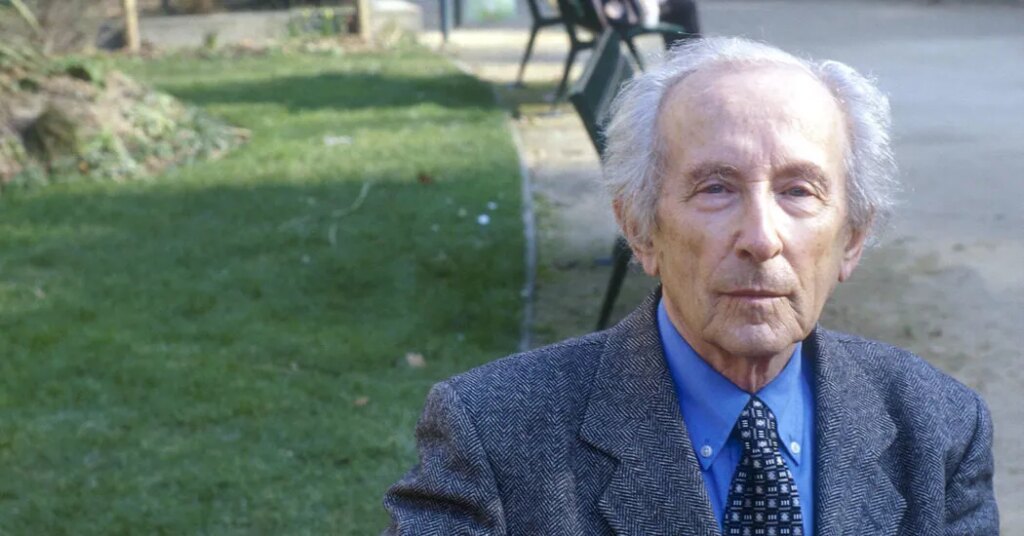
Lucien Lazare, a historian and teacher whose account of fighting in a little-known Jewish resistance unit in occupied France shed light on underground operations run by Jews during the Holocaust, died on Sept. 22 at his home in Jerusalem. He was 101.
His death was announced by Yad Vashem, the Jerusalem Holocaust memorial; Mr. Lazare was a member of the memorial’s commission honoring those who aided Jews during World War II.
Like other French Jews who had escaped the Nazis’ dragnet, Mr. Lazare was living a semi-clandestine life when he was recruited by a member of the armed resistance in the late spring of 1944.
He promptly accepted the invitation, slipping deep into the French countryside to join what was known as the Marc Haguenau unit, “a minuscule company of around 200, all of us green,” he later wrote. They liberated Castres, a city in southern France; received and distributed parachutes dropped from Allied planes; suffered severe losses in one particular clash with the enemy; and ambushed a German train as the Wehrmacht forces fled east in August 1944.
Seventy years later, Mr. Lazare recalled the feeling of victory after the ambush — when the German soldiers surrendered — in his memoir, “Le Tapissier de Jérusalem” (2015, not translated).
“There were 60 of them, lined up in the field, their hands in the air, their uniforms bloodstained, trembling like leaves,” he wrote.
“We marched triumphantly in front of them,” he continued, and he mocked them by shouting, “I am a Jew!”
He experienced “an immense joy,” he wrote. “The encounter with the heavily armed German, drunk with his power, and the weakened Jew, a defenseless victim, had become radically reversed.”
Mr. Lazare’s resistance unit went on to join the French Army under Gen. Jean de Lattre de Tassigny, taking part in the fierce campaigns in eastern France — in the Vosges Mountains and in the liberation of Alsace. “Not exactly a cakewalk,” he wrote in his memoir.
After the war, Mr. Lazare worked as a teacher in Paris and Strasbourg, founded a school in Jerusalem, wrote histories of the Jewish resistance in World War II and became an outspoken peace activist in Israel, where he emigrated from France in 1968.
It was his experience in combat that led to his pacifism in Israel, Mr. Lazare explained to interviewers. “The human condition is made up of paradoxes,” he told Le Monde in 2015.
As an Alsatian Jew, Mr. Lazare was part of a community that had been embedded in France for centuries and was confident about its rightful place in the national fabric.
But in 1942, after the Germans and their Vichy allies began to round up Jews in France, Mr. Lazare had to assume a false identity and procure forged identification papers. He joined a well-established Jewish scouting troop, the Éclaireurs Israélites de France, which operated semi-covertly during the war and became an “operational cog of combat,” he wrote in his memoir. He began helping the group deal with the fallout from the mass deportation of Jews.
“On a number of occasions, I was delegated to ferry by night, on the trains, groups of three to five children” whose parents had been taken, he wrote. “They had been handed over to me by another smuggler, and I was charged, in turn, with handing them off to the next smuggler, at the next stopping point.”
That October, Mr. Lazare left Lyon to move farther into a zone in southern France that was not yet entirely under the control of the Germans. After arriving in the city of Limoges, he enrolled in a newly established Jewish school there — a “crazy idea,” he wrote. By the end of the next year, with the Germans fully in control in the south and pressure tightening on Jews in Limoges, Mr. Lazare’s thoughts turned toward joining the rural resistance in the French countryside.
Several months later, in June 1944, after a perilous rail journey that involved dodging German soldiers, he arrived at the remote farm in south-central France where the Jewish unit was training. It was “an emotional moment,” he wrote, “as though I were returning to republican France. The return, in fact, was definitive.”
Lucien Léopold Lazare was born on Nov. 24, 1924, in Strasbourg, France, the middle of three children of Maurice Lazare, a traveling salesman, and Renée (Weill) Lazare.
His father died when he was 14, and two years later, after France’s defeat and the loss of Alsace to the Germans, the family wound up in Lyon, where Lucien briefly attended the Lycée Ampère.
Then the Vichy government’s anti-Jewish law of October 1940 changed everything: “All of a sudden,” he wrote, “we Jews were outside the law, excluded from society.”
After the war, Mr. Lazare studied at a yeshiva in Aix-les-Bains and received a degree in history and geography from the University of Lyon. After graduating, he taught at schools in France and Belgium, and then served as secretary-general of Strasbourg’s Jewish community from 1957 to 1968. He earned a doctorate in history from the University of Strasbourg in 1967.
The next year, he and Janine Hemmendinger, whom he had married in 1949, immigrated to Israel with their four children. Mr. Lazare founded the Lycée René-Cassin, a secondary school associated with the Alliance Française, in Jerusalem in 1970.
In addition to his memoir, he was the author of several other books, including three on the Jewish resistance.
In 2003, Mr. Lazare clashed with his synagogue in Israel after translating an article for Le Monde written by his son-in-law Avraham Burg, a peace activist and former speaker of the Knesset, who posited the death of Zionism, arguing that “Israel, today, is nothing but a formless mass of corruption, oppression and injustice.”
Members of the synagogue declared Mr. Lazare persona non grata, a “moment of terrible crisis,” he told the newspaper Ha’aretz.
“He was rejected by his community,” Mr. Lazare’s son Daniel said in an interview. “Father was always for peace, and against the settlements.”
Mr. Lazare’s wife died in 2017. In addition to his son Daniel, he is survived by another son, Michael; two daughters, Yael Burg and Elizabeth Goldwin; 20 grandchildren; and about 50 great-grandchildren.
Mr. Lazare remained steadfast in his devotion to the cause of peace with Palestinians, and with Israel’s Arab neighbors, Mr. Burg wrote in memory of his father-in-law.
“There was something wondrous in the human journey of a young fighter who carried a rifle and grew into a gentle prophet of nonviolence,” Mr. Burg wrote on Substack. “When he was asked some years ago what he wished to bequeath to the generations that would follow, he answered: Banish hatred.”
The post Lucien Lazare, Jewish Resistance Fighter in Occupied France, Dies at 101 appeared first on New York Times.