This week in Newly Reviewed, Travis Diehl covers Celeste Dupuy-Spencer’s visionary pictures, Marc Kokopeli’s jewelry store, Michael Assiff’s depictions of environmental spoilage, and Alfredo Jaar’s riffs on American logos.
Celeste Dupuy-Spencer
Through Oct. 31. Jeffrey Deitch, 76 Grand Street; 212-343-7300, deitch.com.
In April, days before these feverish paintings debuted at Jeffrey Deitch in Los Angeles, Celeste Dupuy-Spencer died by suicide. The artist didn’t shy from the moral conflicts of our age. Her subjects included the Jan. 6, 2021, Capitol riot, and she faced fierce backlash for her support for Gaza.
But this exhibition’s damning jeremiad is much broader, a mythic tale of death and plunder. These pictures are visionary, the way a medieval saint might hallucinate an encounter with God. Step back and take in the whole of “Untitled” (2026), an image of a Blakean flaming angel breathing fire on a town, its wings encompassing walls of crashing water. From a distance, it’s an allegory of creation and destruction. Step closer and the composition breaks into veins of froth, clutching hands, drowning and begging figures on the rocks.
In another 2026 work, the bronze armor of conquerors is filigreed with weeping souls. A four-panel altarpiece from 2022, “The Shape of the Rock That’s Hurling Towards the Sea,” manages to convey something like humanity’s evolution from animals to apes to rapacious capitalists and politicians.
Dupuy-Spencer painted with a palette of emeralds and blood, mud and sun, churned with a violence you want to call incredible, except it’s all too real. In the introduction to her final monograph, Dupuy-Spencer wrote that meaning emerges “when a viewer and a painting agree to stand in the same place and face the same uncertainty.” Standing with these paintings takes courage.
Marc Kokopeli
Through Oct. 24. Gladstone, 130 East 64th Street; 212-753-2200, gladstonegallery.com.
The multimedia artist Marc Kokopeli has a knack for probing the weirdness of popular forms of art and craft. Previous groups of work have riffed on “diaper cakes” (a baby-shower trend), television sets and cheesy educational videos.
His latest sculptures are rings. Gladstone Gallery’s Upper East Side location, with its breeze blocks and high ceilings, makes a convincing jewelry store: Pedestals bear oddball wares like a circular cat doll made of felt and a pig-shaped ring printed in 3-D from wood-infused plastic.
Armatures mounted to the wall thrust out jewel-encrusted silver rings with hinged faces, many of them opened to reveal tiny LED screens playing sped-up footage of what may be game shows. A particularly elaborate gold-plated piece is styled like the wheel from “The Price Is Right.” A ring can be a frivolous luxury, but can also seal a solemn contract or declare a rank. Kokopeli’s deadpan delivery of the ring into the setting of contemporary art seems to appreciate all its precious and pretentious facets.
Michael Assiff
Through Oct. 18. Post Times, 29 Henry Street; 612-386-6971, post-times.com.
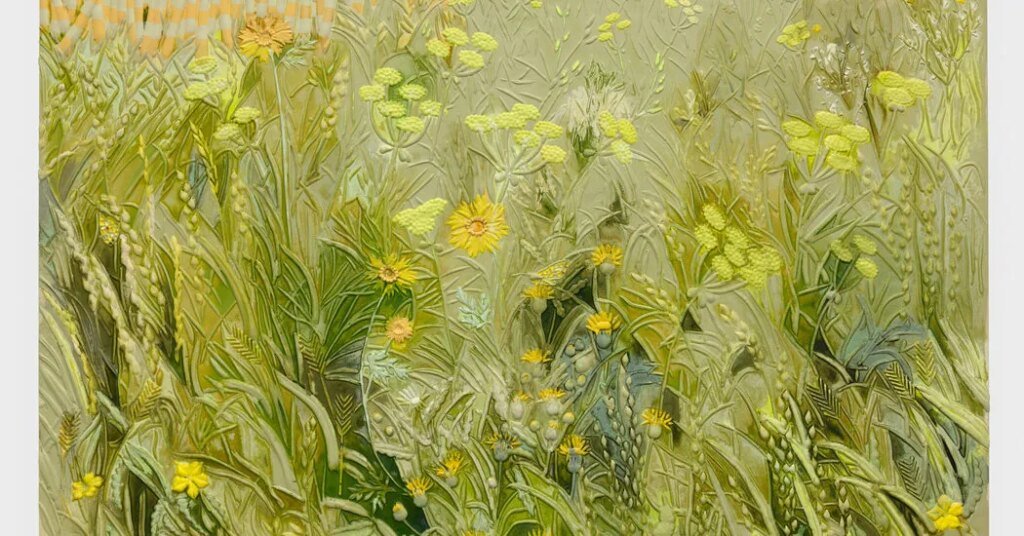
To make his low-relief canvases depicting chemical plants, roadside fields and other scenes of the heartland, Michael Assiff squeezes liquid plastic on top of a drawing, and then stains the forms using house-paint dyes. The effect is modern, obviously synthetic and petroleum based, even machine-like. The relief format also echoes ancient stone carvings, and it’s possible these hydrocarbon images will outlast us all.
This artificial vibe meshes well with many of Assiff’s subjects: tangled brown-gray pictures of boilers, tanks and pipes, geometric and almost abstract. In “Untitled (Pipe Factory)” (2026), the caution-yellow vests of workers fleck the converging and parallel putty-colored ridges of an assembly floor.
But Assiff’s renderings of the plant kingdom are just as sickly. “Untitled (Laramie Welcome Center, Lincoln, Magnum)” (2026) is thick with rustling flowers and rhythmic kernels in pale synthetic greens; a cluster of anemic Creamsicle-colored road markers stand in one corner. Nothing is quite neon, or coal, or grass — Assiff’s palette hovers in a bleached, manufactured range. This gives the elements of each picture, and the show overall, a sort of unity. The work depicts environmental spoilage on some level, but treats weedy lots and highway shoulders like brand-new industrial ecologies. Here, the same chi flows through both energy drinks and lilies.
Alfredo Jaar
Through Oct. 24. Galerie Lelong, 528 West 26th Street; 212-315-0470, galerielelong.com.
When President Trump talks Gulf of America instead of Gulf of Mexico, or Lake America instead of Lake Ontario, he’s right — just not in the way he means. A focused retrospective for Alfredo Jaar, a Chilean-born photographer who lived in New York for decades, centers on “A Logo for America,” a monochrome animation first staged on a Times Square marquee in 1987.
His gist is that the United States is not America — not South, Central nor all of North. An outline of the continental United States bears the phrase “This Is Not America,” and “This Is Not America’s Flag” is imposed on the Stars and Stripes. A vitrine displays the hand-drawn storyboards for Jaar’s original piece.
There are also photographs of other installations over the years, from black-and-white photos of the sign above a military recruitment booth in Times Square in 1987 to an electronic billboard mounted on a boat floating off Miami Beach in 2018. If the point seems obvious, that’s because it still bears repeating, as Bad Bunny did during the 2026 Super Bowl halftime show when he said, “God bless America” before listing a dozen American countries.
See the September gallery shows here.
The post Art Gallery Shows to See in October appeared first on New York Times.