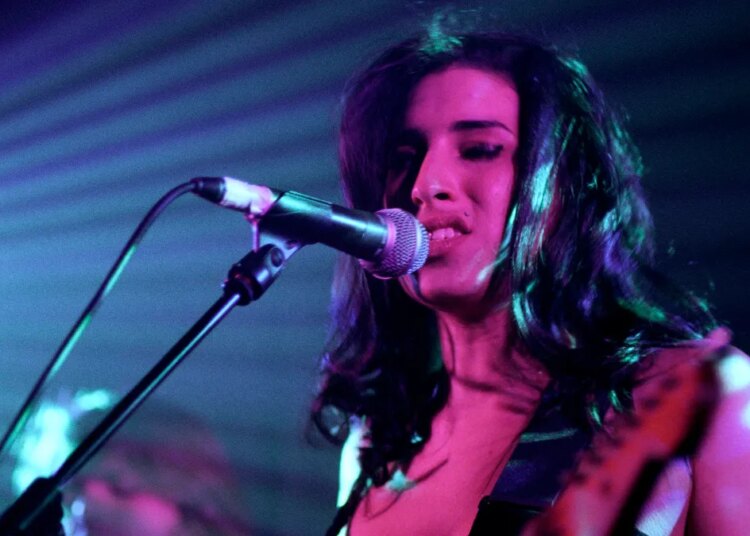
The press has often labeled Mon Laferte a “femme fatale” — a seductive woman who inflicts distress upon her love interests.
Nearly two decades into her singing career, the Chilean singer-songwriter has learned to embrace the old-fashioned trope of the wizened seductress in “Femme Fatale,” her ninth studio album, which she released in October.
“I came to the conclusion that there’s a perception of me as a woman who is really liberated — that’s why it’s dangerous. [She’s] a person who is sure of herself and that generates a lot of insecurity in other people,” said Laferte in a Zoom call, just after she attended the 2025 Fashion Awards with designer Willy Chavarria in London. (“I went to Camden and took a photo next to [Amy Winehouse’s] statue,” she noted, citing inspiration in the late R&B star.)
Laferte reckons with her dangerous womanhood on “Femme Fatale:” a compilation of jazzy, cabaret pop ballads, elevated by the roaring theatrical vocals she made famous in such past hits as “Tu Falta de Querer” and “Mi Buen Amor.” Prior to releasing the album, Laferte notably starred as Sally Bowles in a Mexico City production of the famous American musical “Cabaret.” It was a crash course on theater — which heavily influenced Laferte’s now most penetrating record to date.
Each song in “Femme Fatale” feels like a descent into a speakeasy. It tells stories of loves past — which at times feel nauseating for the 42-year-old singer, born Norma Monserrat Bustamante Laferte in Viña del Mar, Chile.
Among them is “Otra Noche de Llorar,” in which she mourns an unrequited love; then there’s “El Gran Señor,” in which she scorns a cowardly abuser of women. The record climaxes with “1:30,” a briskly improvised tune, in which Laferte balances stories of abuse, self-pleasuring and fake orgasms with historical themes — like the global industrial revolution, as well as Pinochet’s Caravan of Death in 1973.
“The song is really political and everything is my own story,” said Laferte, who admits that even she finds her song difficult to listen to. “The last part is the hardest — where I talk about a conquest — to the point where I can’t listen to that song. It’s really uncomfortable. It’s hard to talk about something so shamelessly.”
“Femme Fatale” is a deeply personal journey that leads to Laferte making peace with her past. The record concludes with the lively orchestral number “Vida Normal,” in which she grapples with the revelation that she’s turning into her mother — especially after giving birth to her first child in 2022 with husband Joel Orta, guitarist for Mexican band Celofán.
“It was a really honest way of saying that, after everything, I just want a normal life,” said the five-time Latin Grammy winner.
But before the Chilean femme fatale can settle into a vida normal, she will first embark on the 2026 Femme Fatale tour, which includes dates in Latin America and later the United States. Laferte’s first stop will be in her hometown of Viña del Mar for the International Song Festival. “It’s like returning home,” she said.
This interview has been edited and condensed for clarity.
You were just in London for the Fashion Awards with Willy Chavarria, who was nominated for designer of the year. How was that experience? I came as a guest of Willy’s. We had dinner and saw a lot of super fashionable people, many artists with their super cool looks. Fashion has always been interesting to me ever since I was a little girl, outside of singing, dancing and playing the guitar. I liked to draw women and their outfits, dresses, things like that… Perhaps that’s where my dreams began to be a designer. Aesthetically in my last album, “Autopoiética,” it was all baroque — I was a bit like Marie Antoinette, I wore large dresses in my shows. This time in “Femme Fatale,” [the style is] bohemian, with sequins and makeup running.
“Femme Fatale” is intense and sexy. Why did you decide to go with that phrase for the album title? ”Femme fatale has a bit of a negative weight to it. You think of a scornful woman that always brings misfortune and does evil things. And it’s a name that the press has given me: La Femme Fatale Chilena.
And I liked it. I like this title because I like to play with the concepts of a dangerous woman. I like that it’s dramatic, because I like music that is theatrical and dark. It doesn’t mean that I am that woman who is secure and free — I have been in various moments in my life, not all the time. But I like that people label me in that way.
How would you describe the musical style? I wanted to take [the album] into the world of jazz so that it could sound nocturnal, so it could sound melancholic. In the last couple of years I’ve been listening to a lot of jazz, so why not make an album that I like to listen to? When I was a little girl, I listened to jazz in my home because of my mom, but I felt like it was boring. Later when I was in my teens I was like: “This is elevator music.”
But as I kept growing, I got rid of that prejudice. When I began to listen to jazz without any judgment, I began to find poetry and a lot of madness as well. I think it’s the improvisation aspect; you have to be very daring to enter the void, because your improv is coming and it’s to the death. That’s something that I’m passionate about. I think it’s demented and poetic at the same time.
This fall you were in a production of the musical “Cabaret” in Mexico City. How was that experience and did it inspire your music for “Femme Fatale”? Yes! I feel like they complemented each other. I feel that my role as Sally Bowles in the theater fed that universe of “Femme Fatale.” There’s a song in the album, “Vida Normal,” that is a song that could go in a musical and that was the intention. My experience with theater was wonderful and I had a lot of fun and learned a lot in the intensive process.
I wanted to talk about the song, “Vida Normal.” You hint at becoming more like your mother and living a normal life, which feels a bit at odds with the “Femme Fatale” theme. Was that intentional? Totally. Because the first song, “Femme Fatale,” describes me up to the present: I always bring chaos, I always destroy what I love, I’m an expert in self-sabotage. But I have been letting those things go with time, thankfully. With the songs in “Femme Fatale” I went deeper into my past, in order to kill that persona.
[“Vida Normal”] is really honest and represents me in the present. I look in the mirror and I don’t recognize myself when I’m barefaced or before getting in the shower — my body changed, especially after motherhood. It’s true that I see my mother’s face and it’s hard to recognize that. I’m getting old. I’m at that age where I don’t recognize myself as either young, or old, in my 40s. It appeared beautiful to close that album that way. It was a really honest way of saying that after everything, I just want a normal life.
One song that caught my attention was the jazz song “1:30.” You talk about fantasies that women don’t often talk about. What was the thought process behind this song? I think those have been the hardest lyrics I’ve ever written. I touch on a lot of microtopics — masturbation, fake orgasms — I think many of us have gone through that. I talk about abuse, sexual abuse, the Caravan of Death that occurred during the dictatorship of Pinochet in Chile. The song is really political and everything is my own story. The last part is the hardest, where I talk about a conquest, to the point where I can’t listen to that song. It’s really uncomfortable. It’s hard to talk about something so shamelessly.
I talked with my musicians and told them that I wanted this to be fast, almost desperate, almost like the bass being the protagonist so that it gives you a sense of urgency, like [we’re] fleeing in a way. We played together like 8 times and I liked that take.
The album also features Natalia Lafourcade and Silvana Estrada on “My One and Only Love.” What was it like to work with these different voices that are often compared to each other? As all three of us sang, I realized that we are so different, each our own universe. I guess we relate to being singer-songwriters but we are distinct universes. I think that [comparison] has to do with us being women; there’s so many male-led bands that one can say are similar too.
We’re all good friends. I’ve known Natalia for many years now and we love each other and they’re all talented women. All three voices sound very beautiful together and I love harmonizing. It was precious to sing together in a song that I find to be the most beautiful in the album. It’s sweet and honest. It talks about the difficulties between partners — and it describes me and my husband. At the end of the day we love each other and continue to be present.
The post Mon Laferte on her edgy ‘Femme Fatale’ LP: ‘I went into my past to kill that persona.’ appeared first on Los Angeles Times.