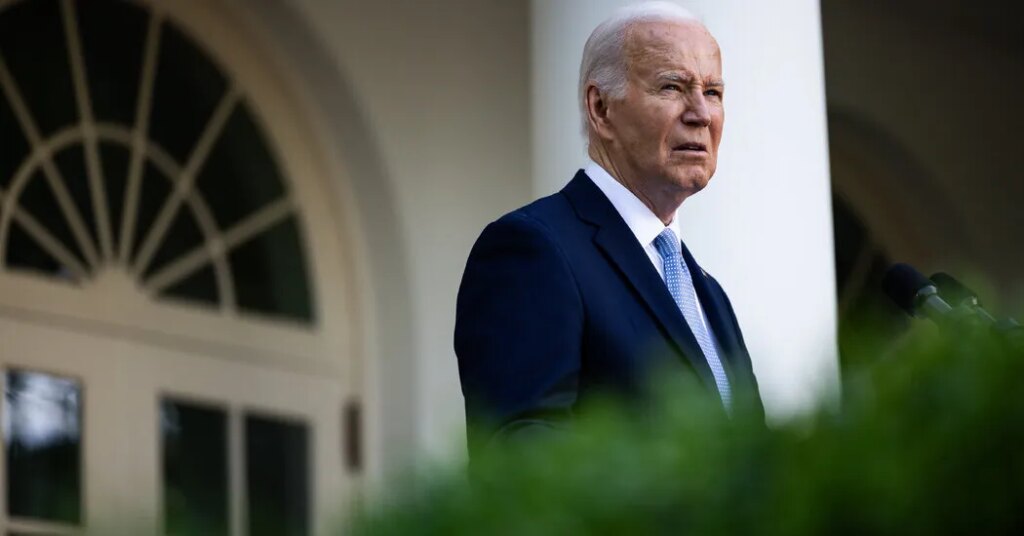
When aides gathered in the Oval Office one day in the spring of 2024, they found President Joseph R. Biden Jr. on the verge of an outburst. His “face was red like a beet” and he “seemed ready to blow his stack,” his top Middle East adviser recalled.
Mr. Biden had grown so livid at Prime Minister Benjamin Netanyahu of Israel over the conduct of the war in Gaza that he appeared close to washing his hands of the whole conflict and cutting off the critical flow of American arms.
“Bibi, man, what the fuck are you doing?” Mr. Biden demanded, using the prime minister’s nickname when they got on the phone, as the adviser recalled. “You think I’m Santa Claus? No Santa in Israel, pal.”
It was one of the most combustible moments in a fraught relationship that consumed much of the last 15 months of Mr. Biden’s presidency. Now, in the first inside-the-room account of Mr. Biden’s struggles to manage the war, Brett McGurk, his top Middle East adviser, reveals how close the two leaders came to a complete schism and describes the rocky path from the Hamas terrorist attack of Oct. 7, 2023, to the cease-fire and hostage-release agreement sealed in the final days of the administration.
Mr. McGurk’s account, outlined in an interview and in a new memoir called “Brink” to be published Tuesday, provides new details about the friction between Mr. Biden and Mr. Netanyahu during those months of terrorism, war and humanitarian crisis. Perhaps no foreign policy issue bedeviled Mr. Biden as much as Gaza, and he found himself under criticism both from the left in his own party for not restraining Mr. Netanyahu more and from the pro-Israel camp for restraining him too much.
“He always said this was the worst crisis he ever dealt with in his entire career,” Mr. McGurk said in the interview. As it was for Mr. McGurk, who spent more than a year shuttling back and forth to the region after Oct. 7 trying to find a way to stop the war and to free hostages held by Hamas, even developing a hernia along the way. “It was the most complex, difficult, horrific crisis I’ve ever seen,” he said.
Mr. McGurk is an unusual figure in today’s polarized Washington, a survivor who has crossed lines that are rarely crossed these days. The son of two teachers, Mr. McGurk, 53, trained to be a lawyer and clerked for Chief Justice William H. Rehnquist only to divert into foreign policy after Sept. 11, 2001, volunteering to go to Iraq as a legal counsel and then advising four presidents of both parties on the Middle East.
He worked for President George W. Bush on the Iraq and Afghanistan wars, stayed on when President Barack Obama came into office and then served President Trump in his first term. He resigned after Mr. Trump decided to abandon America’s Kurdish allies by abruptly withdrawing troops from Syria, then returned to the White House as Mr. Biden’s coordinator for the Middle East and North Africa.
Mr. McGurk had already written a draft book about his work for other presidents, but his publisher insisted that he had to include three chapters about Mr. Biden and Gaza. Those three chapters became a book unto themselves, one that he wrote while it was “very fresh, very raw.” At some point, he still hopes to publish the other book. But this is the first of a series being written by Biden foreign policy counselors like former Secretary of State Antony J. Blinken and Jake Sullivan, Mr. Biden’s national security adviser.
According to Mr. McGurk, the nearest Mr. Biden came to a full break with Mr. Netanyahu was on that spring day in 2024. Mr. Biden was frustrated over civilian casualties, blocked humanitarian relief and stalled negotiations to end the war. He had grown more distant from the Israeli prime minister. While the two spoke 20 times in the final three months of 2023, they spoke only twice in the first three months of 2024.
On April 1, Israeli forces struck a convoy killing seven relief workers from World Central Kitchen, the humanitarian organization founded by the chef José Andrés. In her own memoir earlier this year, Jill Biden wrote that she was so upset about the attack that she left a Post-it note for her husband on the bathroom mirror urging him to pressure Mr. Netanyahu: “Net has to stop.”
Three days later, Mr. Biden was scheduled to speak with the Israeli prime minister — and teetered on the edge of abandoning him.
“He was just completely fed up with everything and I think at that moment he was ready to just say, ‘I’m done.’ Like, ‘You’re finished,’” Mr. McGurk said in the interview. “Now, I don’t think that would have ended the war, but that was kind of his head space when I walked into the Oval Office that day.”
Some advisers urged Mr. Biden to tell Mr. Netanyahu that the war was over and, if he refused to end it, threaten to cut off support. Mr. Biden was concerned about what that would mean for the hostages being held by Hamas in tunnels beneath Gaza. William J. Burns, the C.I.A. director who had played a key negotiating role, said a hostage deal with Hamas remained the only path to a cease-fire, which meant maintaining support for Israel in the meantime, according to Mr. McGurk, who agreed.
When Mr. Biden got on the phone with Mr. Netanyahu and declared that he was no Santa (“his words, flecked with spit,” Mr. McGurk writes in the book), the Israeli asked what he meant. Mr. Biden said he could cut Israel’s military aid with the snap of a finger.
Mr. Netanyahu started to explain that the strike on the aid workers was a tragic miscommunication.
Mr. Biden interrupted. “I don’t want to hear it, Bibi,” he said.
What saved Mr. Netanyahu from Mr. Biden’s wrath, as it turned out, was Iran. Just as the president’s patience was running out, Tehran was poised to launch a barrage of missiles and drones at Israel in the largest such attack it had ever carried out. And Mr. Biden, his frustration notwithstanding, stuck with America’s ally and came to Israel’s defense.
“So at the same time the president is completely fed up, we face this,” Mr. McGurk said in the interview. “We have to help Israel defend against this attack.”
The evening of the attack, Mr. Biden and his team watched screens in the Situation Room as streaks representing missiles raced toward Israel. “I’d never felt so helpless,” Mr. McGurk recalled. But in an extraordinary military feat, American forces along with Israeli and Arab partners deployed defenses knocking down nearly all of the incoming missiles, avoiding major casualties.
Mr. Biden hoped to hold Mr. Netanyahu back from retaliating in a way that would escalate the conflict.
“Get Bibi on the line,” he instructed his staff.
“What do you want to say to him?” Mr. McGurk recalled asking.
“I just saved his ass, that’s what,” Mr. Biden replied. “Cut this off here.”
Mr. Sullivan offered another formulation. “Take the win,” he said.
Mr. Biden adopted that more diplomatic phrasing when he got Mr. Netanyahu on the phone. The Israeli leader pushed back. “We need to teach these maniacs a lesson,” Mr. Netanyahu said. But ultimately, he complied with Mr. Biden’s wishes and refrained from mounting a heavy counterattack.
Mr. Biden had known Mr. Netanyahu for decades and had long been one of the Democratic Party’s strongest supporters of Israel, much to the consternation of liberals who have grown more critical over the years. Mr. McGurk writes that “no single incident soured the relationship,” although he notes that Mr. Netanyahu seemed to blame Mr. Biden for a speech by Senator Chuck Schumer of New York, the Democratic leader, calling on Israelis to hold elections to replace their leader.
At one point, Mr. Biden did suspend the supply of certain heavy bombs to Israel. While some aides wanted him to go further, Mr. McGurk concluded that the move made the situation worse, not better, because it encouraged Hamas to think it could win and therefore made it more resistant to negotiating a cease-fire.
On the spectrum of Mr. Biden’s foreign policy team, Mr. McGurk was on the side more likely to see Israel’s point of view and to remind colleagues that Hamas had triggered the war through its attack. He pushed for what he called “more stringent measures” against Iran and its proxies when they attacked American forces in the region.
“During this period, I felt out of sorts with some of my colleagues, who seemed to take a two-dimensional view of the crisis, focused solely on Gaza and not the regional threat that Iran had unleashed, and which every day risked American lives,” he writes in the book.
Mr. McGurk, however, offers no criticism of Mr. Biden, portraying him as a tough and thoughtful leader managing a difficult situation. In the interview, he said he did not see the signs of age that would end Mr. Biden’s re-election campaign. “When I was with him, he was always engaged on this and there was not a time in which I thought to myself, ‘He’s not in command of the situation,’” Mr. McGurk said. “It’s actually quite the opposite on this issue.”
Negotiating the cease-fire that was sealed days before Mr. Biden left office was an exasperating, Sisyphean process; each time a deal appeared close, one side or the other introduced a new condition or changed positions. “You’d finally solve it and it was like unlocking a door to a hallway full of locked doors,” he said.
In the end, it took help from the incoming president, Mr. Trump, and his special envoy, Steve Witkoff, to push the parties to finally accept the agreement that Mr. Biden had painstakingly crafted over the preceding months.
“We agreed to work together with zero daylight and we did,” Mr. McGurk said of Mr. Witkoff. “The deal could not have gotten done without Trump and Steve Witkoff,” he added. And at the same time, “the deal could not have gotten done without Joe Biden putting that deal on the table in the months of negotiations that set it up.”
The post ‘Ready to Blow His Stack’: How Biden Nearly Cut Off Netanyahu Over Gaza appeared first on New York Times.