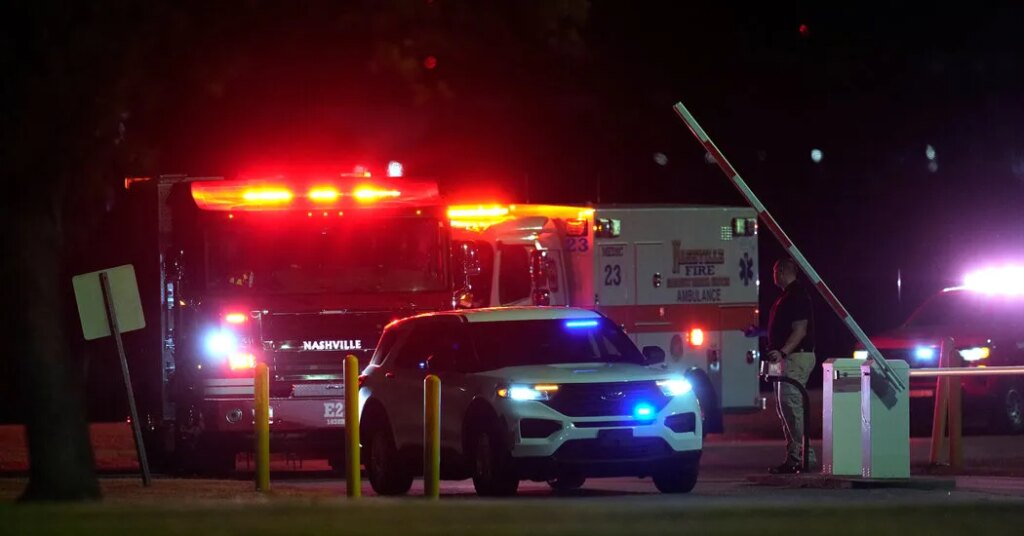
The failed execution of Christa Pike in Tennessee was the latest in a long string of botched executions in the United States, a history that extends almost as far back as executions themselves.
The failures have varied widely — trouble finding a vein; drugs that didn’t kill, as happened in Tennessee on Wednesday night; and gruesome scenes involving blood or flames. Ms. Pike snored and breathed for an hour before prison officials abandoned the effort to end her life with pentobarbital.
Even as the technology has evolved from ropes to firing squads to modern chemistry, the effort to spare prisoners a protracted, painful death is still far from reliable. While most executions end with the death sentence fulfilled, mistakes can be harrowing.
‘An Awful Sight’
New York carried out the United States’ first execution by electric chair in 1890 when it put William Kemmler to death at a prison in Auburn.
A front-page headline in The Buffalo Evening News said the execution “was an awful sight” and declared “the process a failure.” One doctor involved predicted, wrongly, that “there will never be another electrocution.”
The Evening News article described Mr. Kemmler as the “coolest man in the room” as he adjusted his tie and sat in the electric chair.
The current was turned on and the doctor soon announced that the man was dead. Moments later, in a panic, he asked for the current to be run again.
“This man is not dead,” the doctor cried, according to the Evening News account. “Faces grew white,” the article said.
Mr. Kemmler’s lips dripped, his chest moved, and he made a loud wheezing and groaning sound. Finally, he was again pronounced dead.
“FAR WORSE THAN HANGING,” The New York Times wrote on its front page on Aug. 7, 1890.
Flames and Smoke
One of the more horrific executions took place in 1983 in Alabama, when executioners sent three different jolts of electricity into John Evans III’s body. The first two failed to kill him, but rather sent flames flying from his leg and head.
Mr. Evans’s lawyer called the execution “a barbaric ritual” and said that his client had been “burned alive tonight by the state of Alabama.”
In 1990, a similarly disturbing execution took place in Florida, when fire and smoke emanated from the body of Jessie Tafero as he was put to death.
Unreliable Injections
The Death Penalty Information Center, a research group, says that lethal injection, introduced as a humane alternative to the chair, had the highest botch rate in executions between 1890 and 2010.
In 2018, Alabama prison officials were unable to insert an intravenous line into Doyle Hamm, who was terminally ill, and he became one of a small group to have survived an execution attempt. He died in prison of natural causes three years later.
In Oklahoma, John Grant vomited and shook for several minutes in 2021 during the state’s first execution since 2015, when it had mistakenly used the wrong drug to stop his heart.
The next year, again in Alabama, executioners tried for hours to find the veins of Joe Nathan James in 2022 as he lay in the death chamber. They eventually sliced into one of his arms in what is known as a “cutdown” in order to give him the fatal drugs, according to a private autopsy.
And in 2024, Idaho executioners tried for nearly an hour to insert an intravenous line into the arms, then hands, then legs of Thomas Creech, who was then 73. “I was thinking the whole time that this is really it,” he told The Times several months later. He remains one of eight people on Idaho’s death row.
New Method, New Problems
Alabama pioneered killing prisoners with nitrogen gas in 2024, the first new execution method in decades.
Kenneth Smith, one of three men convicted of murdering Elizabeth Dorlene Sennett, was the first prisoner killed by nitrogen gas. After the execution, the state prison commissioner, John Q. Hamm, said that “nothing was out of the ordinary from what we were expecting.”
But several witnesses told The New York Times that what they saw was disturbing.
“We were told by some people that worked” in the prison system “that he’d take two or three breaths, and he’d be out and gone,” said Mike Sennett, Ms. Sennett’s son. “That ain’t what happened. After about two or three breaths, that’s when the struggling started.”
Mr. Hamm and Mr. Sennett said they believed Mr. Smith might have tried to hold his breath to delay his death.
“With all that struggling and jerking and trying to get off that table, more or less, it’s just something I don’t ever want to see again,” Mr. Sennett said.
Witnesses reported that two other men who were later killed by nitrogen — Alan Miller in 2024 and Anthony Boyd in 2025 — shook and gasped for several minutes before they were pronounced dead. Alabama officials have maintained that the executions had followed protocol.
The post America’s Long History of Executions Includes Many Botched Ones appeared first on New York Times.