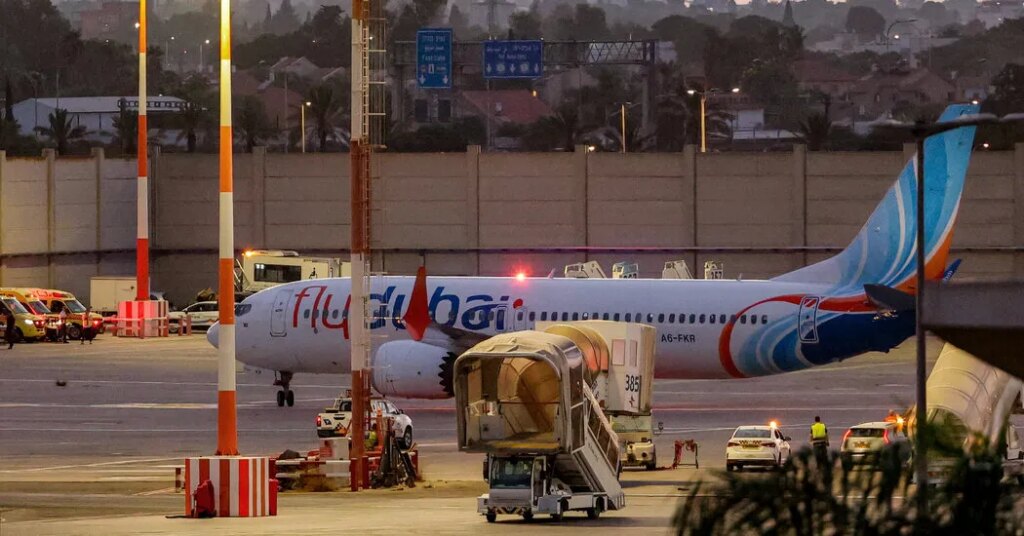
The authorities in Israel and the United Arab Emirates were trying to understand on Thursday how a weapon entered the cockpit of the diverted FlyDubai flight to Tel Aviv, as they investigated the co-pilot’s stabbing of the captain.
Many questions remain unanswered about the attack, including the attacker’s motive, his ultimate intention and how he came to have a weapon. As the plane plunged thousands of feet while en route from Dubai on Wednesday morning, passengers and crew members rushed the cockpit and took control of the aircraft, a Boeing 737, and two reserve pilots on board landed it at an airport in Tabuk, in northwestern Saudi Arabia.
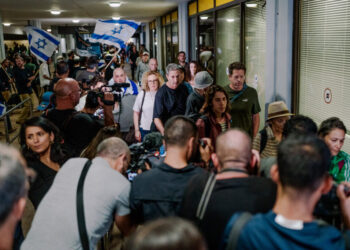
The co-pilot, whom Israeli officials identified only as an Omani national, was arrested by the Saudi authorities. The airport in Tabuk said that two pilots were treated for injuries. All the passengers were flown to Israel in another FlyDubai plane.
In an interview with Fox News on Thursday, Prime Minister Benjamin Netanyahu said that he did not know what weapon the attacker used or how he was able to access it in the cockpit.
The authorities were exploring two possibilities, Mr. Netanyahu said: The co-pilot smuggled the weapon through Dubai’s airport security by evading a metal detector or he used a sharp object that was stored aboard the plane, such as an ax.
“He could have carried a knife or an ax, or he might have gotten an ax from the equipment that might be standard on this airplane,” said Mr. Netanyahu, who cautioned that it was too soon to know for certain.
Marco Chan, a retired airline pilot who teaches aviation operations at Kingston University in London, said on Thursday that Mr. Netanyahu was referring to a “crash ax.”
According to Mr. Chan, who flew for Cathay Pacific and Hong Kong Airlines for 10 years, the cockpits of commercial airliners are typically equipped with axes, which crew members are trained to use to break open the fuselage in emergencies.
On a Boeing 737, as with other models, Mr. Chan said, crash axes are typically stored inside the cockpit directly behind the co-pilot, under a cover but without a lock.
“It’s sharp,” he said. “When we can’t open the door, we would use a crash ax in a location where the external structure of the airplane is slightly weaker, using the ax to break the fuselage open to escape.”
Mr. Chan said that the interior of the cabin is typically marked to show where the wall is slightly weaker, directing crew members where to aim the ax in an emergency evacuation. He said the ax is typically stored very close to the co-pilot’s seat, potentially within direct reach.
The Emirati authorities, who are leading the investigation into the attack, have not provided detailed information on their progress, including any suggestion about the type of weapon that might have been used and how it entered the cockpit.
A spokesman for FlyDubai declined on Thursday to respond to questions about security protocols on its flights to Israel from Dubai.
Ismaeel Naar contributed reporting.
The post Investigators Seek to Determine How a Weapon Entered FlyDubai Cockpit appeared first on New York Times.