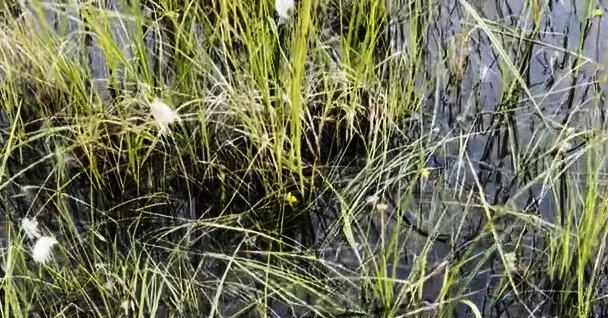
The first thing any bog teaches you is that the ground cannot be trusted. You step onto a patch of moss that looks solid, only to feel your boot sink into layers of partly decomposed plants, peat that has accumulated over millenniums. Somewhere below lies stable earth, but in a bog, safety is always elusive.
If you can make peace with your peril, bogs — and their organic-rich wetland cousins like fens, swamps, mangroves and mires — have a lot to teach you. Each has its own voice.
A peat swamp in Brunei, on the island of Borneo, hums with insects, birds and frogs, the sound crescendoing to a peak every few minutes like a wild orchestra. Across the vast mires of Britain, the soundtrack is the soft rush of water beneath your feet, the brush of wet vegetation, and the deep, satisfying squelch of each sinking step. And in the heart of Canada’s boreal bogs, the air can feel wrapped in silence, broken only by the passing breeze and a thrumming drone of tiny wings that vibrate deep in your ears.
Bogland landscapes vary even more wildly. In the Arctic, they may stretch as low, lichen-crusted expanses of tundra. Farther south, among the boreal forests of Alaska and Canada, bogs unfurl rich carpets of sphagnum moss in apple green, ocher and deep crimson. From this soft ground rise ancient conifers, their gnarled trunks barely reaching human height, as though the trees are creatures of the bog themselves.
Along river plains, dense shrubs can knit together into thickets that are nearly impenetrable. Bogs sometimes form floating waterbed-like mats that tremble beneath your feet over open water, while tropical peat swamps rise in towering forests, with crowns of woody giants reaching for the sky. But beneath them all lies the same gloriously thick and soggy layer of peat, their strange, unstable living foundation.
For more than 30 years, I have worked in places like these. I cross peatlands on foot, by boat and, when there is no other way in, by helicopter. Once, while my team was conducting fieldwork in a remote Canadian peatland, our pilot couldn’t land. The wind was too strong, the ground too uncertain. Stepping out of the hovering helicopter, I lost my balance and fell face first into the peat, arms spread wide.
When leaving several hours later, I looked down from the helicopter and saw the imprint of my body — a snow angel pressed into the peat.
It’s probably still there.
That is the strange power of a bog. It remembers. Bogs exist in a weird tension, soft and unstable yet stubbornly capable of preserving traces of environments that vanished millenniums ago. They have survived vast climatic and environmental shifts, in some regions outlasting the world’s glacial-interglacial cycles. Yet they are also fragile, because their future rests entirely in human hands.
Only 17 percent of the world’s peatlands fall within protected areas, leaving much of these ancient, fragile wilderness areas vulnerable to being drained and destroyed. These vital ecosystems are increasingly under siege from agriculture, commercial peat mining, severe fire and urban development.
Peatlands occupy only a small fraction of the planet’s land surface, yet they store an enormous share of the carbon held in global soils. When a peatland is drained, oxygen penetrates the peat and decay accelerates, releasing greenhouse gases. And the same drying that releases carbon also threatens archaeological remains and other organic materials that have been preserved within it for thousands of years.
Bogs are a living archive. Because of the bog’s specialized ecology — an oxygen-poor, acidic habitat created in part by the otherworldly mosses that grow there — the decomposition of dead plant material slows to a near halt. Year after year, layer after layer, plant debris accumulate, storing carbon and recording the changing world with it.
We tend to think of preservation as something humans do deliberately, after we recognize that something matters. But a bog has its own logic of preservation: Long before we notice, the bog’s waterlogged depths are already holding fragments of the past that would have vanished elsewhere. We may discover what they reveal only centuries or even millenniums later.
Pollen, seeds and wood reveal how vegetation and landscapes shift over time. They also keep a record of us: our food, rituals, travels and ways. Bogs have preserved ancient paths laid with wooden planks from the Iron Age, their tool marks still visible; vast quantities of ancient butter sealed in its original containers; prehistoric garments made from wool and animal skins. The stomach contents of preserved human bodies from more than 2,000 years ago reveal ancient diets, evidence of a final meal and how it was prepared.
The chemistry that preserves these objects also allows us to reconstruct the ecosystems in which those people lived. We gain glimpses into long-gone environments and people whose lives are otherwise lost to history. The discoveries can seem almost miraculous, but they are a natural part of this peculiar ecosystem.
A bog contains an archive far larger than anything we could ever uncover, and we cannot know in advance which pieces will matter, or which preserved fragments will reveal a lost landscape or lost life. It is valuable partly because we have not finished discovering it.
We cannot safeguard the things a bog protects without preserving the bog itself. Archaeologists can sometimes carefully excavate a single barrel of ancient butter without disrupting the surrounding landscape, but most bog treasures are discovered as bogs are drained or mined. Once the bog is drained, however, the conditions that preserved those treasures begin to disappear. The same chemistry that captures a wooden tool, a pollen grain, or the remnants of an ancient meal is the very mechanism that locks away global carbon.
It was their strangeness, their departure from ordinary nature, that drew ancient cultures to them in the first place. Long before scientists learned to read peat layers, humans understood that bogs were places apart. Neither fully land nor fully water, neither fully alive nor fully dead, their ambiguity made them powerful in the human imagination. They were liminal spaces where offerings were made, human lives sacrificed, and the boundaries between worlds were thought to be permeable.
Today, we do not need to view a bog as a gateway to the gods to appreciate its power. These landscapes guard our history and sustain our future in ways we are only beginning to fathom. We need to act to secure them.
We must aggressively expand protected boundaries to include bogs and other peatlands, enforce strict bans on industrial drainage, forbid the use of peat in agricultural and gardening products, and actively re-wet degraded peatlands to restore their natural water levels.
To save a bog is to save a piece of ourselves, our deepest origin and whatever comes next.
Merritt R. Turetsky (@queenofpeat) is a professor of ecology at the University of Colorado, Boulder, and the author of “Bogland: The Secret World That Defies Death and Protects Life.”
The Times is committed to publishing a diversity of letters to the editor. We’d like to hear what you think about this or any of our articles. Here are some tips. And here’s our email: [email protected].
Follow the New York Times Opinion section on Facebook, Instagram, TikTok, Bluesky, WhatsApp and Threads.
The post You See Muck. I See the Most Beautiful Places on Earth. appeared first on New York Times.