The Iran war has sent diesel prices soaring around the world, straining national budgets, adding costs to businesses and snarling supply chains from farms to ports.
Now President Trump is threatening to ban or restrict the export of diesel from the United States, which is the top supplier to more than a dozen countries including Mexico, Canada and much of Europe. Oil executives and world leaders are issuing increasingly dire warnings that the result could be global price spikes on everything from groceries to jet fuel.
“I’ve sent a very clear signal to my American counterpart and also the public, which is that it is not in the interest of anybody — not the U.S., not us — to not have as free a flow of energy as possible in these difficult times,” Dan Jorgensen, the European Union’s energy minister, said on Tuesday.
Often called the workhorse fuel of the global economy, diesel is made from crude oil at refineries. It powers the heavy machinery, trucks, tractors and agricultural equipment crucial to heavy industry. When diesel prices rise, so do freight charges and other transportation costs, which often cascade into higher prices for things like food at the supermarket or even gasoline at the pump — because the heavy-duty tankers that deliver gas themselves run on diesel.
The primary reason for the price jump is a lack of refining capacity caused by the war in Iran. Missile strikes have damaged refineries in the Middle East, and the disruptions in shipping in the region have made it harder to transport. In addition, Ukraine has attacked and damaged many Russian refineries. That has forced Russia, a major exporter, to hoard its supplies of diesel.
In the United States, retail diesel prices climbed this month to a record high of more than $6.50 per gallon — nearly 70 percent more than this time last year. That’s put intense pressure on Mr. Trump and Republicans to find ways to lower costs, particularly before the midterm elections in November.
The crunch touches many corners of the world.
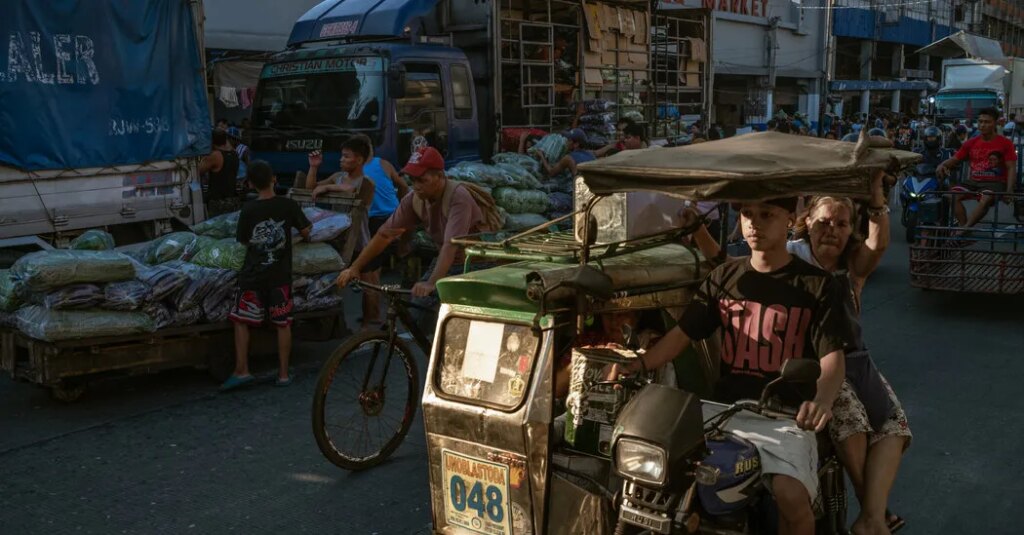
In Europe and Britain, the price of diesel has gone up by 40 percent since mid-June. In Canada prices have surged to record highs of more than 2 Canadian dollars per liter for the last 12 weeks, up about 59 percent compared with before the war. In some places, diesel shortages and high fuel costs are leaving irrigation pumps empty, damaging rice harvests.
Analysts are warning, nearly uniformly, that if the United States held back its diesel from the global market, the result would briefly lower prices for Americans, but rapidly hurt the rest of the world. Even in the United States, many warn, a ban would soon be self-defeating.
“This would be a tremendous shock and blow,” Robert McNally, president of Rapidan Energy Group, a research and consulting firm in Washington. “The rest of the world would have no choice but to absorb a huge price increase for diesel,” he said.
Capital Economics, a research firm based in London, warned that a U.S. diesel export ban could cause a shock comparable to the natural gas crisis in Europe after Russia’s invasion of Ukraine in 2022, which caused gas prices to surge more than 180 percent, according to the European Central Bank.
Ben Dietderich, a spokesman for Chris Wright, the U.S. energy secretary, said Trump administration officials “continue to work closely together as they consider a variety of options to help lower energy costs for the American people.”
A U.S. export ban on diesel would be deeply damaging in Europe, which has become increasingly dependent on American fuel since the loss of supplies from Russia.
The continent is also going into the winter with natural gas storage levels at multiyear lows, driven by the disruptions in the Middle East.
“Europe is one of the most exposed regions, if not the most exposed one, when it comes to diesel, because Europe imports a huge amount of diesel and we are entering the harsh season, the winter season,” Fatih Birol, head of the International Energy Agency, said this week ahead of a European Union energy ministers meeting in Dublin.
Europe imports about 1.5 million barrels a day, with a third coming from the United States, according to S&P Global, a market data firm. The dependency on American imports is made more difficult by a reduction in European refineries in recent years because of high operating costs and climate regulations.
“Europe is in a really tight spot,” Mr. McNally said. “They’ve been shutting down refining capacity, they’ve lost access to Russia and they import heavily on the United States.”
In general, analysts expect Asia to be less directly affected by a potential ban on U.S. diesel exports than other regions, including Europe. That is because Asia largely draws from regional producers, including South Korea and China, which are among the biggest in the world.
Asia is typically a net exporter of diesel and receives only a small percentage of U.S. diesel exports each year, according to Vortexa, a commodities-data firm.
The problem for Asia is that reduced diesel supply to Europe, Latin America and elsewhere will drive up prices globally, said Sushant Gupta, research director of Asia Pacific refining and oils at Wood Mackenzie, an energy consultancy.
“The world is already reeling under the pressure of diesel shortages,” Mr. Gupta said. If Europe runs low on diesel, it will bid up prices from available suppliers, he said. “Whether it is Asia or whether it’s Europe, they’re all globally connected.”
Asia is still managing to secure most of the oil it requires, but at much higher costs, which are reflected in diesel prices. Benchmarks for diesel sold in Asia have come down from a high of more than $200 a barrel in March, though at around $180 a barrel in mid-September, current levels remain twice their prewar values.
The countries most vulnerable to supply shortages and diesel price increases include Australia and many nations in Southeast Asia, which are the region’s biggest diesel importers.
In the Philippines and elsewhere, the high cost of diesel and other fuels has caused inflation to rise. The Asian Development Bank forecasts that inflation in developing Asia and the Pacific region will accelerate to 4.2 percent this year from 3 percent last year. Several governments, including Indonesia and Malaysia, have begun subsidizing energy to help lower prices, but this adds to national debt burdens.
A big unknown for global markets is how much diesel China, the world’s largest importer of oil, will export in the coming months. Immediately following the start of the war in Iran, China restricted diesel exports — a move that worsened already-high prices for diesel and other petroleum products for major importers in Asia.
But, analysts say, China has started again to restrict some of its sizable exports of refined crude products including diesel.
Right now, “China is the only country which has spare capacity to run more crude to produce diesel,” said Wood Mackenzie’s Mr. Gupta. If the United States decides to ban exports, “other major refineries can’t run more to produce more diesel to fill up that gap.”
Rick Joswick, an oil analyst for S&P Global, said the most acute pain would be felt in countries with little or no refining capacity, particularly in Latin America. Honduras, for example, gets about 40,000 barrels a day of diesel from the United States, and Panama which gets 30,000. Those aren’t enormous amounts, but neither country has a refinery.
“It would be a traumatic loss for Europe, but for those countries it would be catastrophic,” Mr. Joswick said.
Keith Bradsher contributed reporting from Beijing and Alexandra Stevenson from Hong Kong.
The post Trump’s Threat to Ban Diesel Exports Sets Off Global Alarms appeared first on New York Times.