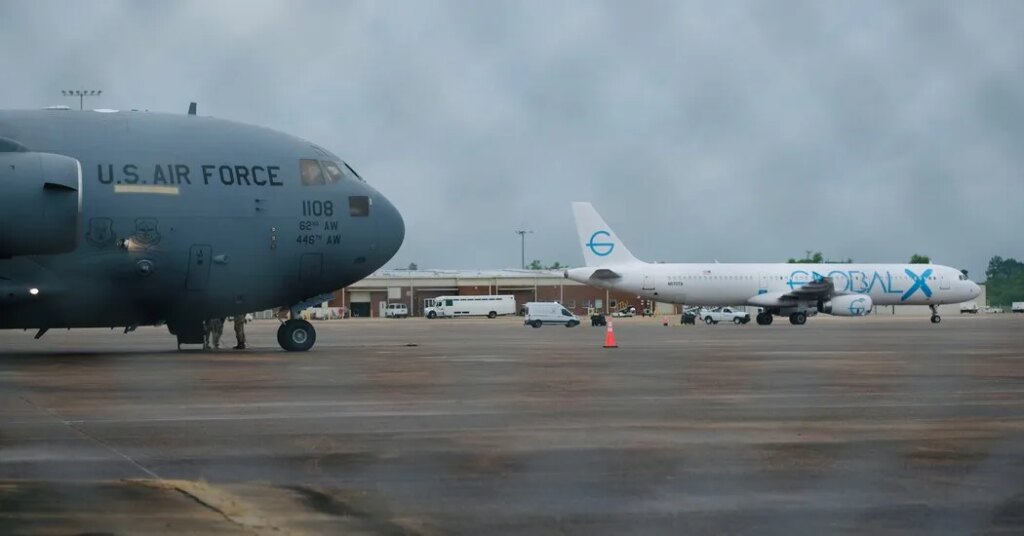
A 528-bed facility for immigrant children and families is expected to open soon at a Louisiana airfield, according to local officials and advocacy groups, a major expansion of the Trump administration’s busiest deportation hub.
Fashioned from renovated Air Force barracks at England Airpark, home to the Alexandria International Airport, the site will house people as they await removal from the United States.
Local officials who toured the facility in Alexandria, La., last week said it would open within two to three weeks. In addition to the barracks, they reported seeing prefabricated structures that will hold immigrants. Intake, medical and other personnel were already on site, they said.
The new facility will more than double the number of immigrants that can be heldon the airport’s premises. Currently, adult men slated for deportation are confined in a 400-bed facility on the tarmac.
Roughly 30 percent of all deportation flights from the United States leave from Alexandria. From January through August, 579 flights departed from the airport, putting it on pace to surpass 657 flights in all of 2025 and 357 in 2024, according to Human Rights First, a nonprofit that tracks the flights.
The detention expansion would add to a huge statewide system. Louisiana already hosts a sprawling network of at least nine immigration detention centers, primarily operated by private, for-profit prison corporations under federal contracts.
A local board approved plans for the Alexandria facility in February. The plans have drawn condemnation from some residents of central Louisiana, and immigrant advocates and child welfare experts have expressed concerns about possible trauma inflicted on detained children, deportations without due process and contamination from hazardous chemicals, which were previously detected there.
In a statement, the Department of Homeland Security described the site as a “staging area,” rather than a detention center where people are confined for long periods. The agency did not respond to specific questions, including when exactly the facility will open. Situated adjacent to the airport, the new facility will streamline and accelerate deportations.
Leecia Welch, chief legal counsel at the nonprofit Children’s Rights, said, “Any new immigration detention facility built for children and families should raise alarm bells.”
“Whether they are calling it a holding facility or a staging area, history tells us that temporary detention has a way of becoming prolonged detention,” said Ms. Welch, who has for years interviewed children and parents in detention.
The facility will be managed by the LaSalle Family Foundation, the nonprofit arm of LaSalle Corrections, a private prison company that operates immigrant detention facilities in Louisiana.
For impoverished rural communities across the state, immigration detention centers have emerged as important job generators, providing relatively well-paying and stable employment with benefits. Officials said the new facility in Alexandria would create as many as 200 jobs.
The England Authority Board of Commissioners, the governing body of the former military base, voted in February to enter an intergovernmental agreement with D.H.S. and a contract with LaSalle to use the barracks, another building and 10 acres of land for about $535,000 annually.
At the February board meeting, David Broussard, deputy director of England Airpark, described the new project as a “humanitarian effort” and “family center” for families who are self-deporting.
At the latest board meeting, on Sept. 24, LaSalle’s project manager, Robert Hagen, reported that the facility was 95 percent complete.
“There’s no residents at the facility currently,” he said. “We would be expecting some in the near future, though.”
It would have playgrounds, soccer fields and “day rooms” for when there is inclement weather, he said.
Day-to-day operations will be handled by Anovaeon, a Texas-based company. Eric Fritz, president of Anovaeon, said there would be 45 clinical staff members and 24/7 coverage by two registered nurses and two licensed practical nurses at the new facility. Detainees would receive three “quality meals” a day, he said.
“We don’t decide the fates of migrants, their immigration status or anything else,” Mr. Fritz said. “What we do is take care of people.”
A pamphlet distributed at the meeting said that “voluntarily departing migrant families” would be in a “nondetained setting.”
It cited strict adherence to religious and medical dietary requirements and “24/7 access to healthy snacks.” Spanish-language television, video games and free international calls would be available, the pamphlet said.
Among the more than 100 opponents in attendance was Pat McGinty, a 45-year-old Alexandria resident who was also at the first board meeting in February.
“I’m not going to agree to have kids locked up with families or without,” he said in an interview on Tuesday. “Let them go through the legal process at home here in the U.S.”
Beyond the conditions inside, opponents have raised concerns about a lack of transparency surrounding the D.H.S. contract and health risks from potentially high levels of “forever chemicals,” or PFAS, in the area.
Overcrowded conditions and extended stays in temporary holding facilities for children and families have previously stirred controversy.
During President Trump’s first term, temporary housing in a stretch of desert in Tornillo, Texas, that opened in 2018 expanded into a vast, heavily guarded tent city for hundreds of migrant children who had crossed the border. It closed in early 2019 amid a barrage of criticism.
In the early months of the Biden administration in 2021, “emergency intake sites” were established to absorb another surge of minors. Reports about the massive, soft-sided warehouse tents at Fort Bliss Army base in Texas cited depression among the children and unsanitary conditions.
But the focus of both sites was intake and processing into the United States, while that of the new Louisiana facility is deportation.
The post New Facility at Louisiana Airport to Hold Immigrant Children and Families appeared first on New York Times.