Samara Klar, a professor of political science at the University of Arizona, is the co-author of “Partisan Hostility and American Democracy: Explaining Political Divisions and When They Matter.” Jennifer Wolak, a professor of political science at Michigan State University, is the author of “Compromise in an Age of Party Polarization.”
Arizona Gov. Katie Hobbs is widely considered the most vulnerable Democratic governor in the country. To win reelection in her Republican-leaning state in November, she needs to run a bold campaign.
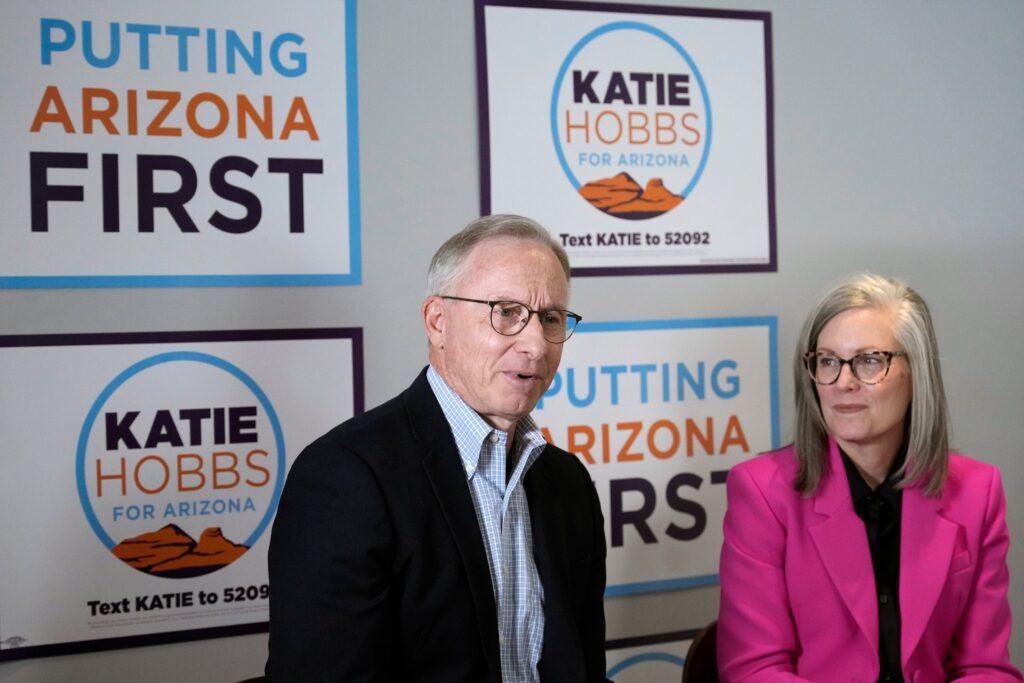
But her boldest move so far was unexpected. Last month, Hobbs named John Giles — the former Republican mayor of Mesa, a reliably conservative town east of Phoenix — as her lieutenant governor running mate.
Giles, though a Republican for decades, had been indicating his dissatisfaction with President Donald Trump’s party for some time. In 2024, he endorsed Kamala Harris. This May, he switched his voter registration from Republican to independent.
Still, his appearance on a Democrat-led ticket could be a harbinger of bipartisanship to come. As our research and that of others has shown, Americans are tired of partisan bickering and ready to embrace Republicans, Democrats or anybody else who wants to solve problems and move forward.
So far, bipartisan tickets — or, as they are sometimes called, “fusion tickets” — have been rare. One can understand why it might seem like a losing strategy; in a deeply polarized era, some scholars argue that Americans vote against the other party more than they vote for their own, a concept that political scientists call negative partisanship. Contaminating one’s own candidacy by joining forces with the opposing party is seen as too great a risk for candidates who need to rally their base to win.
It is true that, for the most highly engaged Americans on both sides, there is only one party worth supporting. But the most highly engaged people are not most people. For many voters, the choice is less clear and party loyalties are not set in stone.
In July, in the middle of primary season, we surveyed more than 3,000 Americans of voting age, asking them how they planned to vote in the 2026 election, how their personal political views have changed over time and whether they perceived ideological changes in the two parties.
Fifty-four percent of them said they believe that the Democratic party has grown more liberal. Thirteen percent said it’s become more conservative. Similarly, 57 percent of the respondents believe the Republican Party has become more conservative, while 12 percent said it’s more liberal.
More than a fifth of them said they were “not sure” about whether they will support Democratic or Republican candidates in the midterm elections. These respondents were the most likely to say that their preferred party has strayed further to the extreme and that their own views have stayed in the middle.
Nearly 60 percent of self-identified Democrats who were not sure whom to support in 2026 said their political views have remained stable over time, and more than 20 percent said they have become more conservative. But 34 percent said the Democratic Party has moved toward the left.
Meanwhile, 41 percent of Republicans who were unsure about their vote choice said the Republican Party is more conservative than it once was, while only 26 percent said their own views are more conservative.
These undecided Americans are not easily categorized. In our survey, undecideds have less formal education than decideds, but about half have pursued higher education and 28 percent have earned a degree. Women in our survey are slightly more likely to say they are politically independent relative to men, but they are significantly more likely to say they are still undecided about this year’s candidates.
Hyper-partisan voices probably overstate what politicians risk by reaching out to the other side. Pew Research Center datashow that 81 percent of Republicans and 82 percent of Democrats think it is very or somewhat important for their own party to be willing to make compromises. Some academic work has shown that even strong partisans support bipartisan efforts because their positive feelings toward their own party motivate political engagement far more than negative feelings about the other party. In a UMass Poll from August, 60 percent said they wanted their member of Congress to work with the other side. Two-thirds said their representative should break from their party if that vote would benefit the district.
Polarization has come to be accepted as fact in America’s political discourse. But an abundance of research has convinced us that most Americans are not particularly mad at each other about politics. They dislike political elites — from both parties — and they are tired of partisan wrangling.
In 2026, both parties have a chance to win back voters if they can learn to embrace bipartisanship. Hobbs’s Arizona gamble seems, so far, to be paying off: Since announcing a former Republican as her running mate, she has gotten better polling numbers. Whether this is a predictor of an era of bipartisanship remains to be seen, but the appetite is out there.
The post There is hope for bipartisanship. Really. appeared first on Washington Post.