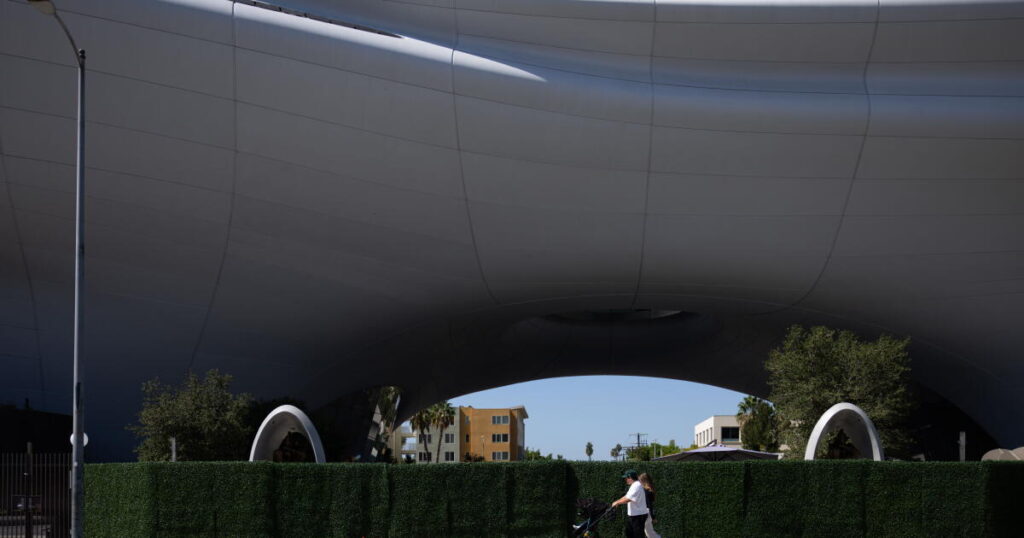
The Lucas Museum of Narrative Art’s central plaza, which spreads out beneath the building’s curved, hovering form, was always meant to be a generous civic space. Ma Yansong, the museum’s architect, has called it the “Gateway” between the museum and Los Angeles, opening to both Expo Park and the surrounding South L.A. neighborhood.
But that gateway, it turns out, is more like a gate.
This weekend — the first that the museum was open to the public — fences covered in plastic greenery blocked entry to the plaza from both sides. Standing sentry, bizarrely, were tall, cartoonish statues — half storm troopers, half USC Trojans. Visitors were directed to enter through the museum’s two enclosed security booths off the plaza.
In the coming weeks, permanent plaza fences will be erected here — curvy stainless-steel structures that MAD Architects principal Dixon Junliang Lu compared to the lacy filigree of Art Nouveau architecture. Lu added that they would eventually be draped in real greenery, not the plastic version.
While certainly an improvement on the current barriers (which are a shockingly makeshift solution for a museum that cost over $1 billion), the plaza’s main entryways will remain gated off, confirmed both Lu and Lucas Museum spokesperson Seth Fowler.
“It’s about creating the best possible visitor experience when you’re there, with an eye on safety,” said Fowler, who cited a need to protect the plaza from car traffic on both sides and the ability to control visitor flow among the reasons for the enclosure.
Visitors without tickets, Fowler added, are still able to enter the plaza, as well as the museum’s cafe and gift shop, after passing through security, “pending capacity limits.” They can enter the museum’s adjacent park without security screening.
Museums of course have legitimate security concerns, especially in and around such a high-traffic location. A growing list of threats, from violence to vandalism, has changed the calculus for what’s acceptable in public life. But surely the building’s talented design team could have developed a security plan that better preserved the plaza’s open arms? Lu acknowledged that the fence design had “evolved as the project developed and the operational and security requirements became more defined.”
When I visited the Lucas earlier this month for its press preview, I assumed the plaza’s (then chain-link) fences were temporary — a byproduct of construction still underway. I had no idea that its primary entryways would remain closed off to the public.
The plaza is one of the museum’s most powerful gestures, creating much-needed civic room for Expo Park, and the city. The gates blocking it, and the security checkpoints along its flanks, will dramatically limit the public’s desire to enter, and change the tenor and experience of a space that should feel porous and inclusive. What could have been a grand welcome has become a gated off, highly controlled space that now feels separate from the park and the neighborhood. Sure, anyone can come, but they are no longer invited.
Just a few miles away at LACMA’s new David Geffen Galleries, visitors can enter the plazas beneath that building without first passing through security. In fact, I don’t know of a single civic plaza (and there are not enough!) in Los Angeles that requires passing through security checkpoints to enter. Think about this scenario in other cities. In New York, can you imagine having to go through metal detectors to sit at the Met steps? Or to enter Central Park?
Speaking of parks, it’s inconsistent and puzzling that the museum’s beautiful park, which edges right up to the building, can be entered without having to also pass through security. I, for one, am thankful. Access to this area is already being limited to some degree. Its long fences, with relatively small openings, are not exactly screaming “come in.” The green space, as it was this Saturday, will be closed to nonticket holders on USC game days. And if locals who live to the west of the museum want to reach Expo Park outside of the Lucas park’s hours — 8 a.m. to sunset — they need to make their way around the entire complex; which a few are already grumbling about.
It’s hard not to wonder whether these barriers represent something more than security: the extension into public space of the gated, closely guarded world inhabited by co-founders George Lucas, Mellody Hobson and those in their orbit. Is this truly what museum security requires, or has the logic of a private compound shaped an institution that was supposed to welcome the city? That is the uneasy promise of privately controlled public space: It looks open to everyone, but access ultimately depends on the owner’s discretion.
It is an especially peculiar contradiction for a museum whose site is being leased from the stateat just $30 a year and was founded to celebrate the “people’s art” — comics, illustrations, movie imagery — and to bring that art to the broadest possible public. Renderings introducing the project never showed the walls and fences that now cover the plaza’s perimeter. (A model produced later, now in the museum, does.)
I last encountered this type of scenario when visiting the Eiffel Tower, whose base has been closed since Paris’s 2015 terrorist attacks. (The attacks did not occur at the tower itself.) Its sealed perimeter, only accessible via lines and screening, now makes one of the world’s wonders feel less like a wondrous part of the city than an attraction held behind glass.
I’m not suggesting we leave major public spaces vulnerable. But security can be built into buildings’ plazas in myriad ways without sealing them off: reinforced planters and seating can stop vehicles; grade changes, landscapes and water features can establish protective distance; clear sight lines, lighting, cameras and visible staff can improve oversight; and retractable barriers can be deployed during large events or credible threats. Screening can remain at the museum doors, leaving outdoor space free.
At the end of the day, civic space depends on a willingness to share some level of uncertainty. A public plaza brings all kinds of people together, including those we don’t know and can’t entirely predict. If every risk leads us to add another checkpoint, fence or barrier, we may gain a sense of control but lose the ability to create the kind of public togetherness that forms a bonded city.
If this plaza, and this museum, are truly meant to serve the public it should be clear that all are welcome once they arrive. Openness is more than an architectural effect: It depends on having the freedom to enter without having to justify our presence.
The post As Lucas Museum cordons off main courtyard, a public space inches toward gated compound appeared first on Los Angeles Times.