For much of my life funerals were, well, funereal, as black as attendees’ attire. Yet in recent decades, I’ve found that I often leave memorial services less mournful than upbeat. They’re inspiring, these so-called celebrations of life, with eulogies not from impersonal priests but from people who knew the dead person best. Tributes are seasoned with humor and paeans to personal character more than professional accomplishments. I walk out thinking not about death but life — especially my own, and resolving to be a better person.
This week I left such a service with a broader resolve: that our nation was once, and can be again, a better country.
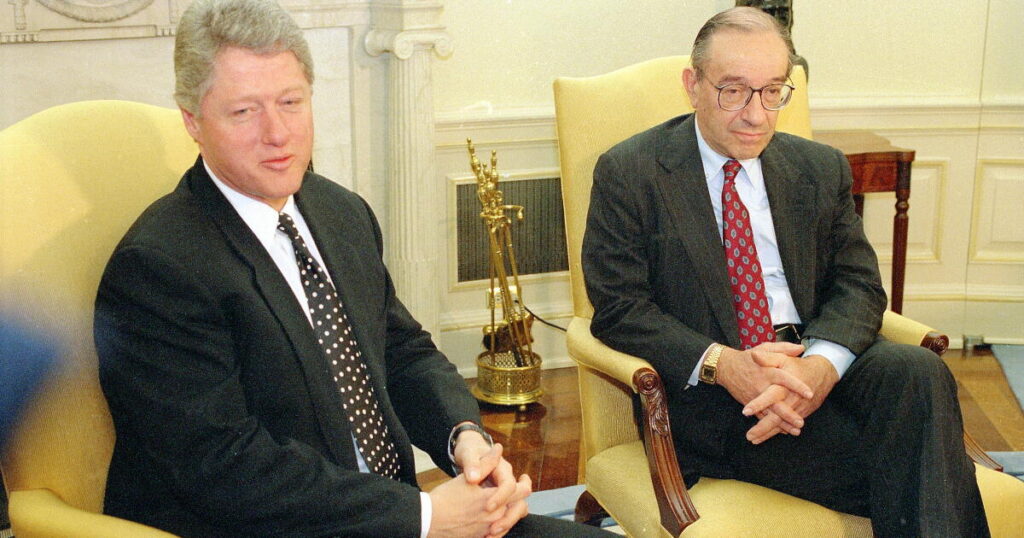
The celebration was for the full and varied life of Alan Greenspan, the legendary longtime chair of the Federal Reserve who died in June at 100. The Shakespeare Theater Company’s Sidney Harman Hall was packed with folks from both parties and no party, with VIPs and obscure current and former bureaucrats who’d fed Greenspan’s voracious appetite for data (and gossip). Folks from a time when expertise was valued and policy was deliberated — not dashed off on the whim of one inexpert man.
Greenspan, “a devout Republican” as each eulogist acknowledged, served two decades atop the Fed until 2006. It was a time when Washington frequently was virulently partisan, and yet the two parties could and did come together on policy compromises for the good of the nation.
A former jazz musician, Greenspan turned relatively late to economics. But then he was all-in: He became a policy advisor to then-presidential candidate Richard Nixon in 1968, chief economic advisor to President Ford, a broker of a bipartisan compromise for Social Security’s solvency during President Reagan’s first term and, in Reagan’s second, his pick to be Fed chair. Presidents of both parties, each of the Bushes and Bill Clinton, reappointed him.
The Democratic former president Joe Biden was present to honor Greenspan. The current Republican president was not.
Nor was Donald Trump missed. His name, for all his efforts to emblazon it all over the nation’s capital, never came up in the eulogies. Yet running strong through all of the tributes was an unspoken sense of the loss in Trump’s Washington of the true, traditional public service that people like Greenspan represented. People who put country over party. People willing to compromise, to accept the constraints of federal law and the Constitution, to respect the other co-equal branches of government. People who don’t associate public service with private gain.
That loss was what was mourned on Monday.
Had Greenspan left office sooner, he could have made tons more money than he did. Trump, in office, has made tons more money than he ever did in the private sector.
At least over domestic and global economics, Greenspan as Fed chair wielded as much power as any president. That was a good thing: Perhaps his greatest legacy, as successor Ben Bernanke noted, was his defense of the independence of the central bank from presidents’ political pressure, independence essential to the stability of the dollar and prices and to the United States’ credibility and economic leadership in the world.
Under Trump, that independence has been and remains under unprecedented threat because of his dangerous, inflationary demands that the Fed slash interest rates; at least he was forced to drop his criminal action against recently departed Fed Chair Jerome Powell.
For all the nostalgia at the Greenspan celebration, it didn’t indulge in false glorification of him or of some storied good ol’ days. Both he and especially Washington came in for deserved criticism, including from eulogists who’d had their own roles in that history. Greenspan presided over nearly 20 years of price stability and growth yet bore some blame for the dot-com bubble of the late ’90s, the subprime mortgage crisis of the aughts and his blessing of the invasion of Iraq and George W. Bush’s deep tax cuts that ended four years of Clinton-era budget surpluses.
“Did devotion to public service make Alan’s record perfect? Of course not, as he’d have been the first to tell you,” said his friend Donald E. Graham, publisher of the Washington Post during much of Greenspan’s Fed tenure. But “none of his mistakes were made because of partisanship or selfishness.”
As for “the much-derided Washington,” Graham said, “at its worst we have deserved what people say of us.” But Greenspan “aimed to make this a better country, and he did.”
Robert E. Rubin, Clinton’s Treasury secretary, recalled how he and his deputy, future Treasury Secretary Larry Summers, had weekly breakfasts at the Fed with Greenspan, discussing and debating “everything under the sun” — “except interest rates, which reflected our commitment to the Fed independence.” He added: “Alan was a Republican. We were Democrats. But … our party affiliations were irrelevant.”
And Greenspan didn’t just consult such VIPs. Bernanke recalled that Greenspan, as chair, personally sought out experts far down the Fed’s organization chart for information about esoteric economic metrics — like, say, freight loadings — before making decisions.
By contrast, Trump deliberates mostly with himself. His so-called advisors — none with the gravitas of a Greenspan, Rubin or Summers (“The Committee to Save the World,” a Time magazine cover dubbed them in 1999) — mainly nod, or bow, in agreement. So it is that Trump unilaterally has damaged the economy with tariffs, Fed interference and unnecessary war.
For nearly 40 years, Greenspan and wife Andrea Mitchell, the longtime NBC News correspondent, spent Christmas mornings with journalist friends Al Hunt and Judy Woodruff and their children. In a joint eulogy, Hunt and Woodruff spoke to Greenspan’s regard for smart Democrats — and no one, Hunt said, more than the very liberal Rep. Barney Frank of Massachusetts, then chair of the House banking committee.
Frank, told of Greenspan’s praise, assured Hunt the respect was mutual.
Those were the days. Post-Trump, we can aspire: make America great again.
Bluesky: @jackiecalmes Threads: @jkcalmes X: @jackiekcalmes
The post A visit to Greenspan’s Washington and the era of getting things done appeared first on Los Angeles Times.