With its shocking final scene, “Thelma & Louise” cemented its place in movie history. When the film’s outlaw heroines, played by Susan Sarandon and Geena Davis, are cornered by law enforcement officers at the edge of the Grand Canyon, they do the unthinkable: In the blue Thunderbird that has been their refuge, they speed off a cliff, holding hands in solidarity.
It was a risky move that paid off for the screenwriter, Callie Khouri, and the director, Ridley Scott. Not only did they win acclaim for successfully reimagining the buddy film, but the story was also viewed as a feminist alternative to the era’s onscreen misogyny. “I wanted to make a movie that, when women went to see it, they felt like somebody saw them, heard them, was talking to them, and cared enough to give them the good time at the movies that they had been missing,” Khouri said during a recent interview.
Thirty-five years later, Khouri is embracing another risk: After batting away numerous proposals to make sequels, prequels and other new stories based on her brainchild, she gave her blessing to a musical stage adaptation of “Thelma & Louise.”
What changed?
She said she felt it was time to try something different, and she liked the part of the deal that allowed her to pull the plug, if she didn’t like how it was going. Plus, she was a theater student in college, and thought her friend, the singer-songwriter Neko Case, would be a perfect collaborator in the development of the show; the two had met through Khouri’s husband, the musician T Bone Burnett.
The project is also personal. “It ripped me apart and put me back together again,” said Case, who saw it at a movie theater in her hometown in Washington. “I stood at the end and went, ‘Yes!’”
Case especially connected with an attempted rape scene, which propels the action of the movie. “I was a young woman who had been raped at 14, and for somebody to portray that in a way that wasn’t making it like sports, or an excuse for a man to come in and save the day, and for women to actually get to choose their own outcome, was unheard-of,” she added. “They made it complicated, not cut and dry.”
The musical, which like the movie, explores friendship, freedom and feminism through a story about two working-class women whose getaway goes haywire, recently opened to mixed reviews in London, where it is running through Oct. 24 at the Young Vic, a well-regarded nonprofit theater.
“It’s a love story between women — a platonic love — and it’s also a rallying cry for women,” said Nadia Fall, who, as the Young Vic’s artistic director, programmed the production. “I think in this moment, seeing what’s happening around the world, where the rights of women and girls are being steadily eroded, this rallying cry couldn’t be more timely and pertinent.”
The show has a predominantly American creative team, a predominantly British cast and the backing of commercial producers including Scott Delman, Mandy Greenfield and Ley Line Entertainment from the United States and Sonia Friedman from Britain.
Although stages these days are filled with shows adapted from movies, “Thelma & Louise” is not an obvious candidate, primarily because it’s a road movie, which is not so easy to represent onstage.
The musical’s team, led by the director Trip Cullman, made an early decision not to make the car a focus of the show — a choice that has troubled some critics. Gone is the 1966 Thunderbird the title characters drive in the film; the musical, instead, is centered on the Silver Bullet, a country-western bar, and the denizens of that bar form a sort of Greek chorus.
Cullman described the road movie as a “deeply complex knot to untangle, because I’ve never seen a show that has put a car onstage and had that be successful.”
Though adapting such a classic was “extremely nerve-racking,” he said he wanted to make something in the spirit of the film that “highlights the ability of theater to stoke an audience’s imagination, with naturalism and abstraction and poeticism.”
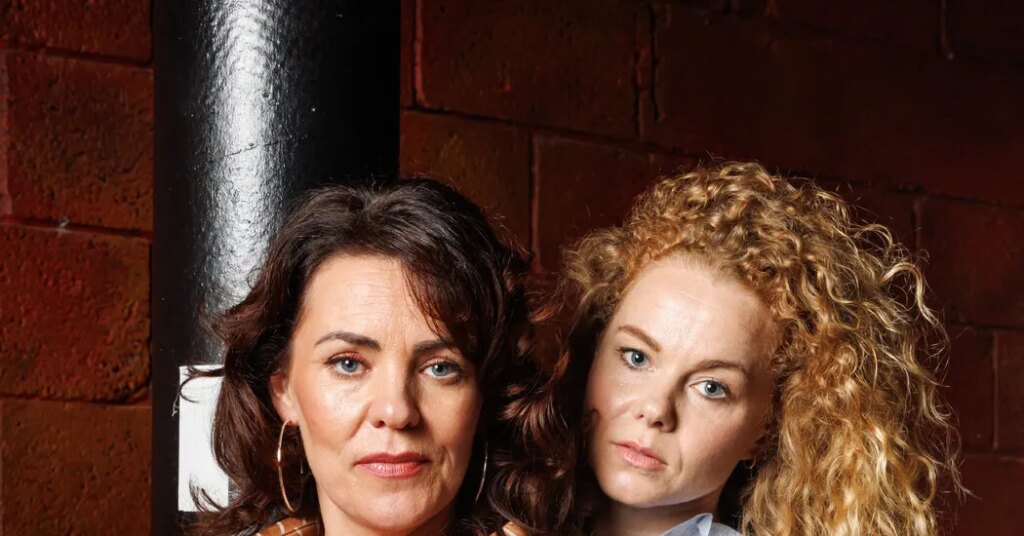
The actresses starring in the musical, both of whom are winning positive notices, are West End veterans with histories quite far from Arkansas, where the protagonists live: Rachel Tucker, who plays Louise, is from Belfast, Ireland; and Amy Lennox, who plays Thelma, is from Aberdeen, Scotland. Lennox knew the movie well (and loved it), while Tucker had never seen it before. When she finally watched the movie, Tucker said, “my jaw hit the floor.”
“We have been lucky enough to not grow up in that time where guys just put their hands up skirts and on breasts, and if you told, you got sacked,” she said.
How have they put their own stamps on these characters? “No matter what I’m doing, if it’s an iconic role, I try to ignore it, because I’m using this,” Lennox said, gesturing toward herself. “I am not Geena Davis, in any way, so I just ignore that.”
“Thelma & Louise,” released in 1991, remains Khouri’s best-known work. While working in film production, she was driving home from a music video shoot when the inspiration struck. “The sentence that came into my head was ‘two women go on a crime spree,’ but I felt the whole hit me at once,” she said. “I just started writing, with no other goal in mind other than to finish.”
Khouri, who now lives in Nashville but traveled to London to help with the development of the musical, acknowledged the project’s uncertainty, saying, “We’re all in the gambling business. Whether you’re in film, television, theater, whatever — there is no justice, you just bet. If you can’t wrap your mind around that, you’re in the wrong business.”
But she said the enduring power of the story sustains her.
“The most you could ever hope for with a piece of art is that it embeds itself into another human being in a way that they find beneficial to their worldview and their way of being, and this movie has certainly served that purpose for a lot of women.”
The post ‘Thelma & Louise’ Shifts Into a Musical Gear appeared first on New York Times.