Defense Secretary Pete Hegseth has survived in office by projecting an image of strength.
His combative style has won praise from President Trump and support from the Republican base. “He loves war,” Mr. Trump said earlier this year, slapping Mr. Hegseth on the biceps.
By many measures, though, Mr. Hegseth has never been weaker. He is leading the military through an unpopular war. Republicans in Congress complain privately — and increasingly in public — that he and his staff are dismissive of their questions and frequently unprepared for briefings.
If Democrats win a majority in the House, Mr. Hegseth will likely face new calls for his impeachment.
Mr. Hegseth’s firing and sidelining of senior military officers, often with no explanation, has fed mistrust and led many in the top ranks to question his leadership.
How Mr. Hegseth manages the contradiction between his tough guy image and his growing vulnerabilities in Washington and around the world could determine whether Mr. Trump — the person Mr. Hegseth must ultimately please — keeps him in the job.
Mr. Hegseth’s most immediate problems are in Iran, where the U.S. war shows no signs of ending, and on Capitol Hill. In the aftermath of the midterm elections, Mr. Hegseth will have to persuade a skeptical Congress to pass a $1.5 trillion defense budget and confirm nominees for key Pentagon posts. Several of his choices are being blocked by Republicans in the Senate.
He will also have to convince Congress to keep paying for the war, which the American people broadly oppose.
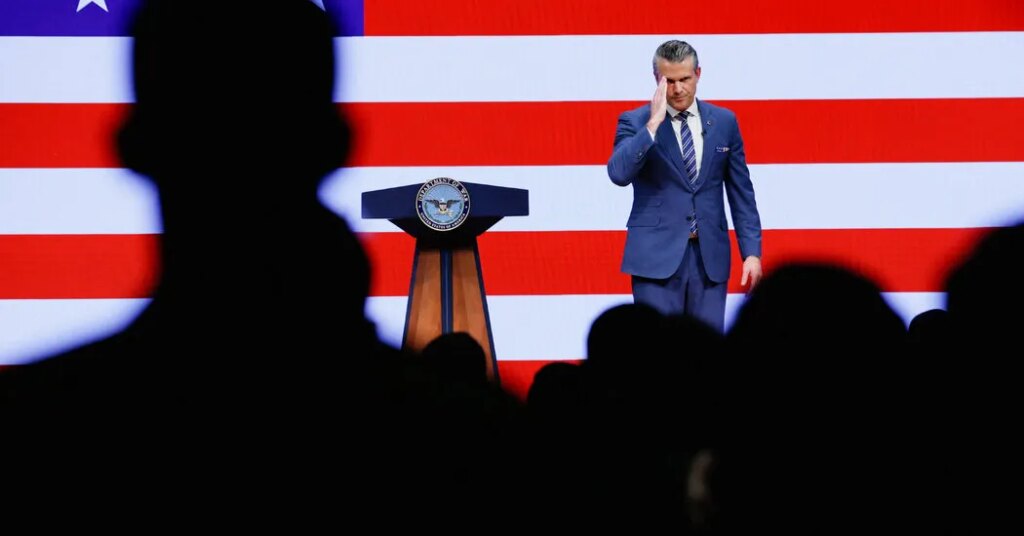
On Wednesday, Mr. Hegseth focused on the part of the job that plays to his strengths. Onstage at a military base outside Washington, with a giant American flag behind him, he attacked the media and promoted his victories in the culture wars.
“The complainers, the ideologues and the poor performers are no longer in the driver’s seat. No more silly PowerPoint trainings or drag queen shows,” Mr. Hegseth said. “No more gender pronouns. No more identity months. Only the warrior ethos.”
He also laid out an ambitious agenda that included building a massive military base and establishing a major new command focused on preparing the military for wars dominated by robots and artificial intelligence.
Most of those initiatives will require support from lawmakers who view him with unease, if not disdain.
A year ago, Mr. Hegseth stood on the same stage outside Washington and delivered a similar speech to a room full of more than 800 generals. He blamed them for acceding to overly restrictive rules of engagement intended to protect civilian lives. He bashed them for allowing liberal ideas, which he called “toxic ideological garbage,” to infect the force. And he accused them, without evidence, of lowering standards to accommodate women in the ranks.
The senior officers sat stone faced. Many said privately that they found Mr. Hegseth’s speech insulting.
This time Mr. Hegseth’s audience included about 600 junior officers and enlisted leaders.
Since taking office last year, Mr. Hegseth has overseen a purge of generals and admirals unlike anything the military has experienced in decades. He has fired or blocked the promotions of more than 80 generals and admirals.
On Wednesday, Mr. Hegseth made clear that his work was not done.
“The number-crunchers say we fired 10 percent of the generals and admirals across the force, and that number sounds about right,” said Mr. Hegseth, citing figures first tabulated by The New York Times. Almost half of those fired or removed were women or minority officers.
Mr. Hegseth’s day began outside the Pentagon, where he led the 600 junior troops in push-ups, stretching and a morning run, just as he would have when he was an Army captain two decades earlier.
To drive home Mr. Hegseth’s message of toughness and lethality, the service members traded in their military-issued workout gear for “This is War” T-shirts of the sort that Mr. Hegseth has recently modeled during his workouts, which his staff members regularly post on social media.
But Mr. Hegseth is no longer a junior officer, and the biggest challenges he faces are not among the frontline formations.
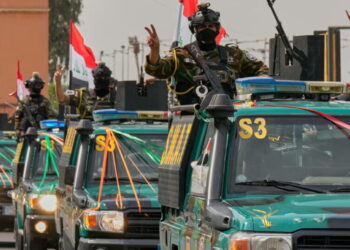
The war in Iran, which Mr. Trump started and Mr. Hegseth now leads, has drained the military’s stockpile of critical munitions that it needs to defend U.S. troops and allies in the Middle East, and to deter an even larger conflict with China or Russia. Replenishing those magazines could take two to three years, according to defense experts.
The war is also creating economic problems at home. The average American could tune out the wars in Iraq and Afghanistan. “We’re at war; America’s at the mall,” U.S. troops fighting overseas often bitterly complained.
By contrast, the war against Iran and the battle over the Strait of Hormuz have caused fuel and food prices to surge. Republican congressional candidates in Iowa, Nebraska, Ohio and Michigan have increasingly questioned the rationale for continuing the conflict.
“The war in Iran needs to end, and end quickly,” said Mike Rogers, the Republican Senate nominee in Michigan and an early supporter of the war.
Mr. Hegseth’s stewardship of the military, particularly his firing of generals and admirals, has alienated Republican national security hawks in Washington.
“It’s not the right way to treat people,” Representative Don Bacon, Republican of Nebraska and an Air Force veteran, said in a recent interview. “It’s not decent.”
Mr. Hegseth’s clashes with lawmakers extend beyond the firings. Republicans in Congress have complained that he and his staff have misled or lied to them about recent decisions to pull Army brigades out of Poland and Romania.
“We didn’t think we were treated honestly,” Mr. Bacon said.
And lawmakers from both parties have said that they cannot get answers to basic questions about the conduct of the war in Iran, or about the Pentagon’s budget requests.
“You want to sell people on your needs,” said Senator Thom Tillis, Republican of North Carolina and a key vote in confirming Mr. Hegseth as defense secretary. “You want to sell people on your priorities. Then you have to engage.”
He added: “I don’t think Hegseth has developed any productive relationships, even with Republican members.”
The Pentagon’s recent $67 billion request to pay for operations in Iran was only seven pages, compared to the Iraq and Afghanistan spending bills, which typically ran more than 100 pages and included detailed accounting of the department’s needs.
In his speech to the troops on Wednesday, Mr. Hegseth answered some of his critics by suggesting, as he had previously, that the war against Iran had already been won.
“Allow me to lay it out simply for the anti-American losers in our media,” he said. “These Americans, right here, and their peers, these have destroyed Iran’s navy, destroyed Iran’s air force, destroyed their air-defense systems, their leadership and their military industrial capacity, their entire defense base.”
His analysis did not account for Iran’s large stockpile of missiles, which it continues to fire at its neighbors and oil tankers transiting the Strait of Hormuz. Nor is it likely to satisfy skeptics in Congress.
“He’s not working with Democratic senators,” said Senator Joni Ernst, Republican of Iowa. “He works very little with Republican senators.”
Ms. Ernst added: “we need more transparency for the good of the Defense Department and the good of nation.”
The result is that many of Mr. Hegseth’s top priorities in Congress are going nowhere. Earlier this year, Mr. Hegseth fired or forced out the Army chief of staff, the Army secretary and the Navy secretary. Senators are refusing to confirm the leaders Mr. Hegseth has chosen as replacements.
The defense secretary also has struggled to convince lawmakers in the House and Senate to pay for any of the Pentagon’s spending bills. In the near term, the Pentagon will have to make do with last year’s budget of about $890 billion, or about 40 percent less than it is currently budgeting.
The difference will force the Pentagon to reallocate money set aside to repair barracks, train troops and buy weapons to pay for more pressing needs, like sustaining 50,000 troops in the Middle East. In the coming months, some of Mr. Trump’s top priorities, such as his proposed Golden Dome missile shield for the United States, will likely come to a halt.
None of those setbacks seemed to dissuade Mr. Hegseth from sketching out an even more ambitious and costly agenda. He spoke of standing up a new autonomous weapons command led by a four-star general.
He laid out a plan to make all U.S. military bases energy independent. “If an adversary takes down the grid by cyberattack, by sabotage, or by any means, our bases stay lit,” Mr. Hegseth said.
He promised to launch a competition among all 50 states and governors for the new military base, which would house as many as 25,000 troops.
“We’re talking hundreds of thousands of acres with organic power generation, modern air defenses and cutting-edge technology,” Mr. Hegseth said. “Think a fortress.”
Mr. Hegseth barely spoke of the $1.5 trillion defense budget that the Trump administration sent to Congress earlier this year. It is a budget that even Republicans concede has little chance, in its current form, of passing.
At some point Mr. Trump may have to make a choice.
“Trump really likes Hegseth, and I think that’s based on style,” said Todd Harrison, a senior fellow focusing on defense at the American Enterprise Institute.
Mr. Trump chose Mr. Hegseth in part for his bravado, which was on full display on Wednesday. The question now is whether pressure from Republican lawmakers will force the president to find a leader for the Pentagon who is less politically combative and more eager to make peace with a frustrated Congress.
Robert Jimison contributed reporting.
The post Hegseth Talks Tough as Republican Doubts About His Leadership Grow appeared first on New York Times.