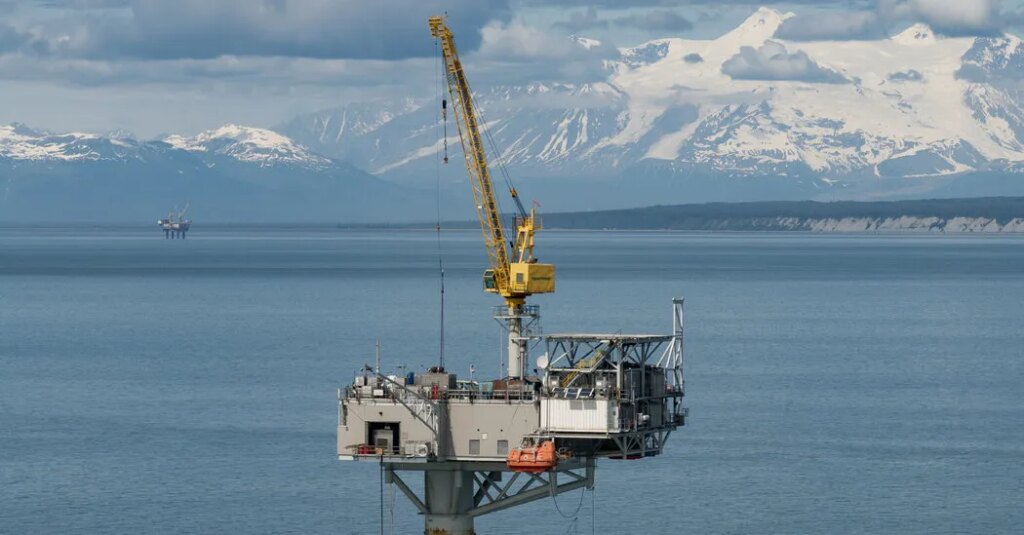
The Trump administration said on Wednesday that South Korea would invest up to $200 billion in a variety of power projects in the United States, including a power generation facility in Texas, eight nuclear power plants and a liquefied natural gas facility in Alaska.
They are part of a slate of projects announced by the White House as it tries to bolster its economic record in the run-up to the midterm elections in November. Alaska is one of several red states that Democrats have targeted to try to win back control of the Senate. Senator Dan S. Sullivan, the Republican incumbent, got fewer votes than his Democratic challenger, Mary Peltola, in the state’s nonpartisan primary last month.
The announcement stemmed from a commitment by South Korea to invest $350 billion in the United States as part of a trade deal last year.
But many experts have questioned whether South Korea will be able to fulfill that commitment, which would more than triple the country’s current investments in the United States. As of 2025, data from the Commerce Department showed that foreign direct investment from South Korea totaled $95 billion. The South Korean government has said its investments would be based on the economic feasibility of the projects.
There are also questions about the viability of the Alaska project, which has long been considered but not yet been formally approved by the developer.
The project, Alaska L.N.G., is meant to solve what is — at least on paper — a simple problem. Alaska produces a lot of natural gas on the North Slope that would be very valuable, if only companies could move the gas to where there was demand for it. Both Japan and South Korea, which are major energy importers, would be natural customers.
One way to do that would be to build a pipeline some 800 miles toward Anchorage, which is facing the risk of gas shortages, and then export the extra natural gas in liquid form, known as L.N.G. Companies have been batting around versions of this idea for decades. The problem has always been that such an undertaking would be very expensive.
Brendan Duval, chief executive of the project’s lead developer, Glenfarne, expressed optimism about the project on Wednesday.
“The pipeline is going to take three years, and we can start immediately as soon as this financing funds,” Mr. Duval said at the White House. “And then the L.N.G. we’ll start exporting roughly two years after that.”
What he didn’t say was that Glenfarne has yet to formally decide whether to move forward with Alaska L.N.G. The company had expected to greenlight the pipeline portion by earlier this year, but that deadline came and went. A proposed state tax break for the project later failed to gain sufficient support from Alaska lawmakers.
South Korean officials said this month that they would move ahead with investments in a gas-fired power plant in Texas, and consider investing in South Korean-designed nuclear reactors. South Korea is also considering the purchase of a 5 to 10 percent stake in Westinghouse, the U.S. nuclear technology firm.
The Trump administration has also been eyeing the Alaska L.N.G. project to be part of the investment commitments under the Japan deal.
In February 2025, President Trump said Japan would “soon begin importing historic new shipments of clean American liquefied natural gas in record numbers.” In October, during a visit to Japan, he claimed that the project was “well underway” and that Japan would be one of its largest customers.
Mr. Trump has repeatedly made exaggerated claims about the amount of foreign investment his industry has brought to the United States. He has said that over $20 trillion of investment is pouring into the country — a total equivalent to more than two-thirds of U.S. gross domestic product.
The administration has extracted big investment commitments from countries that are seeking to avoid tariffs, including the European Union and Japan, and some have been moving forward with those investments.
Japan, which has promised to invest $550 billion over Mr. Trump’s term, has announced investments in a massive gas generation plant in Ohio and a deepwater crude export facility off Texas. The countries are working to announce what would be a third tranche of investments.
Mr. Trump called the announcement on Wednesday “one of the largest energy infrastructure investments in American history.” Speaking from the Oval Office alongside Secretary of Commerce Howard Lutnick and several energy executives, he added, “We make great deals.”
Mr. Trump announced the trade deal with South Korea in July 2025, but the countries have continued to wrangle over some of the terms. In February, the Supreme Court struck down the tariffs that the trade agreements with South Korea and other countries were based on, sending Trump officials back to the drawing board to find other ways to issue those tariffs.
Under the agreement, the Trump administration lowered tariffs on South Korean products, including cars, to 15 percent, similar to the rates for Japan and the European Union. In addition to $350 billion of investments in the United States, South Korea promised to buy $100 billion of liquefied natural gas.
South Korean officials said they would direct some of their investment toward shipbuilding, while other funding would go into semiconductors, technology and energy. Mr. Trump subsequently criticized the country for failing to carry out the trade deal fast enough and threatened to raise tariffs again.
The Trump administration has been ramping up its investment announcements as the midterms approach, seeking to persuade voters in competitive states of the success of its economic policy.
On Wednesday, Mr. Trump announced in the Oval Office that an Indian firm would build a $15 billion steel plant in Iowa, where Republicans are trying to hold on to a Senate seat. On Thursday, the president is expected to travel to Texas to speak from a truck factory.
The post Trump Dangles Alaska Gas Project as Part of Korean Investment Package appeared first on New York Times.