For many of us, the Iraq war was a defining event. It became synonymous with the post-9/11 “forever wars,” Abu Ghraib and the limits of costly military campaigns in the name of spreading democracy.
Yesterday America’s long and unhappy adventure in Iraq formally ended. The last U.S. soldiers withdrew, leaving behind a battered nation. My colleague Alissa Rubin was there just after U.S. troops invaded, and has covered many of the chapters between then and now. Today she writes about what she saw in Iraq and what she’s still trying to understand.
What I saw as the U.S. debacle in Iraq unfurled
by Alissa J. Rubin
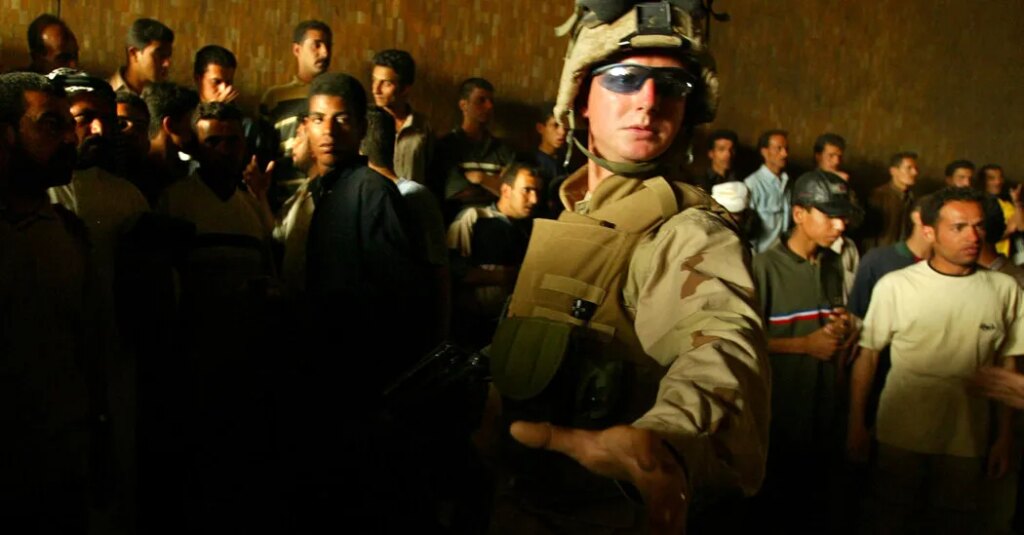
I got to Iraq a few weeks after the U.S. Army. It was April 2003, just a couple of days after the statue of the Iraqi dictator Saddam Hussein was pulled down in Baghdad.
The early days of the invasion, which toppled a hated despot, were so heady with possibility that it was easy to dismiss the warning signs.
In the streets, the mood was charged, watchful. I don’t want to suggest that the Americans were greeted with flowers, let alone as “liberators,” as the American vice president had predicted. But the Iraqis seemed not so much afraid of the invaders, even those in Humvees, as they were curious. The ones I met were intrigued by finally getting a glimmer of a future not defined by the brutality of the Hussein regime. And it was the Americans who had helped bring about that change.
But from the beginning, the United States did not understand the country it was storming into. Twenty-three years later, as it pulls the last of its forces out, it probably still does not.
One misstep after another
The reason for the invasion and then occupation always seemed like a moving target.
The Bush administration had initially justified it with the claim, later debunked — that Iraq was developing chemical weapons.
But the military officers and policymakers who moved into the palaces of Baghdad’s so-called Green Zone had a new set of rationales: It wasn’t that Hussein was a danger to mankind, or a brutal dictator. Instead, as President George W. Bush put it, the U.S. and its allies were there “to help the Iraqi people build a lasting democracy in the heart of the Middle East.”
This began the pattern of changing the justification for the continued U.S. presence in the country. Along the way, the U.S.-led coalition made one disastrous misstep after another.
Soon after the invasion, a fast-growing Sunni insurgency began taking on the American occupiers. The insurgents bombed U.S. checkpoints and military vehicles; they laid ever more sophisticated road bombs.
That made U.S. troops more skittish. They fired upon speeding cars near traffic stops, believing they were being targeted, even when the cars were merely carrying families trying to get to safety. Some U.S. troops engaged in human rights abuses, among them the sexual violence and torture at the Abu Ghraib prison and the killing of civilians in the village of Haditha.
This only fueled the insurgency, which over the years became a training ground for the even more militant Islamic State group.
Since ousting Hussein created not just a political vacuum but a security one, Iran moved methodically to fill the gap. By backing Iraqi Shia Muslim politicians with whom it shared some common ground, it gradually embedded allies in key ministries including the Interior, which controls the police. Today, parties with links to Tehran are the kingmakers in Iraqi politics.
‘Do you mean, disband the whole army?’
Of all the mistakes, one moment in particular stands out.
I remember vividly the order from Paul Bremer, the chief civilian administrator, to disband the Iraqi Army. “Do you mean, disband the whole army?” I asked a military press attaché.
Iraq had some 400,000 troops.
Stunned, baffled and increasingly angry, the dismissed Iraqi soldiers gathered every morning at the gates of the Green Zone. Some had a message for Washington.
“Tell your president that we had to fight for Saddam,” one told me. “We are glad he’s gone.”
Another said he was 51 years old and could not make ends meet without his pension. “I have five children,” he said. “My son lost his leg. I work as a janitor. I am too old to find a new job.”
One man wearing a long dishdasha robe — I can still see his face in my mind’s eye — asked the interpreter where I was from. When he heard “U.S.,” his face twisted in disgust and he spat a stream of liquid at me. Some landed on my shoe. I stared at it, unsure whether to wipe it off.
I wondered if no one saw the widening gap between Iraqi hopes for a post-Hussein future and what the U.S. was actually offering.
Many Iraqis had unrealistic expectations. They wanted America to transform their country overnight into a Middle Eastern version of the shiny, idealized American world they knew from the bootlegged movies they had watched secretly under Hussein.
But what many more were unprepared for was America’s disregard for the economic realities of their lives. They were unprepared for America’s failure to realize that when you take away a person’s job, you take away their place in their communities, their families, their dignity.
Only much later did I connect the fury of the man who spat on me with his feeling of having been disrespected. It was just a few weeks after the fall of Saddam; a dangerous dynamic had already begun.
MORE TOP NEWS
-
One pilot stabbed another at the controls of a flight from Dubai to Tel Aviv, according to Israeli officials, causing it to suddenly plunge thousands of feet before passengers and the crew regained control of the plane. Many details about the incident are still unclear. Read the passengers’ accounts and follow our live coverage.
-
The British prime minister, Andy Burnham, said there were “strong indications” Iran had played a part in a security incident at an air base used by the U.S.
-
Meta is avoiding billions of dollars in U.S. taxes by describing its enormous data centers as “experimental research,” according to a Times investigation.
-
French authorities have detained at least 440 people during protests led by high school students who are angry about the state of the country’s education system.
-
Morocco’s king selected a female prime minister to head the country’s government for the first time.
-
China’s DeepSeek and Huawei teamed up to develop software tools for advanced chips, targeting Nvidia’s A.I. dominance.
-
Several prison officials in Indonesia were suspended after inspectors discovered that inmates at a prison near Jakarta were living in luxury.
-
On its quest to build humanlike A.I., Anthropic has even consulted with religious leaders, including ones at the Vatican. Our religion correspondent, Elizabeth Dias, and our tech reporter, Cade Metz, join forces to explain.
TOP OF THE WORLD
The most clicked link in your newsletter yesterday was about why men’s and women’s shirt buttons are on different sides.
HYBRID OF THE DAY
Molluscum contagiosum
Scientists have discovered a virus that is a tiny bit human, carrying a gene it stole from our ancestors. And the virus, a distant relative of smallpox that causes sores on human skin, may be using our own gene to infect us.
Researchers estimate that molluscum contagiosum swiped the gene in a molecular cut-and-paste error about 100,000 years ago — the first known instance of a virus with a human gene acquired in recent evolutionary history.
MORNING READ
Moth swarms are sweeping across Australia, and that actually may be good news. Bogong moths have been in decline since the 1980s because of increased use of insecticides, habitat destruction and the proliferation of artificial light. But this year, the swarms are back, with droves completing the journey from the warm inland plains to the cooler alpine areas of the country.
In recent days, videos have shown people being startled as moths emerge from towels, swarm on walls, gather on windows and hitch rides in car trunks. One scientist told The Times that there had been tears and happy dances at her office. Read more or watch the video above.
AROUND THE WORLD
A sweet little memorial
To honor the dead, families in Istanbul distribute syrup-drenched doughnuts known as lokma. Those who consume the sweets say a prayer for the deceased.
Niyazi Dumlu, known by his nickname Lokmaci Baba, or “Papa Doughnuts,” prepares and sells lokma from his van, while running appeals for blessings on an LED ticker. Vehicles like his are a serendipitous sight in Istanbul, where residents stop to grab a snack and utter a prayer for the soul of a stranger. Read more about the sweet tradition.
RECOMMENDATIONS
Listen: Many of you shared your thoughts on phone-free concerts (more on that soon). But this playlist is all about the phone, an enduring topic in pop music.
Reconnect: Forget protein-loading and fibermaxxing. A new food trend is taking us back to the forest.
Consider: Hypnotherapy is no longer considered a fringe practice. But does it actually work?
Dine: Enjoy fresh local produce at these new restaurants in the South of France.
RECIPE
Everything comes together in one pan to make these chermoula roasted eggplant and beans. Chermoula is a classic Moroccan herb and spice marinade, often used with eggplant. Here, the eggplant is paired with beans for a more substantial dish.
WHERE IS THIS?
Where is this temple?
TIME TO PLAY
Here are today’s Spelling Bee, Mini Crossword, Wordle and Sudoku. Find all our games here.
That’s it for today. See you tomorrow! — Katrin
Alissa J. Rubin was our guest writer today.
We welcome your feedback. Send us your suggestions at [email protected].
The post The U.S. Departs Iraq appeared first on New York Times.