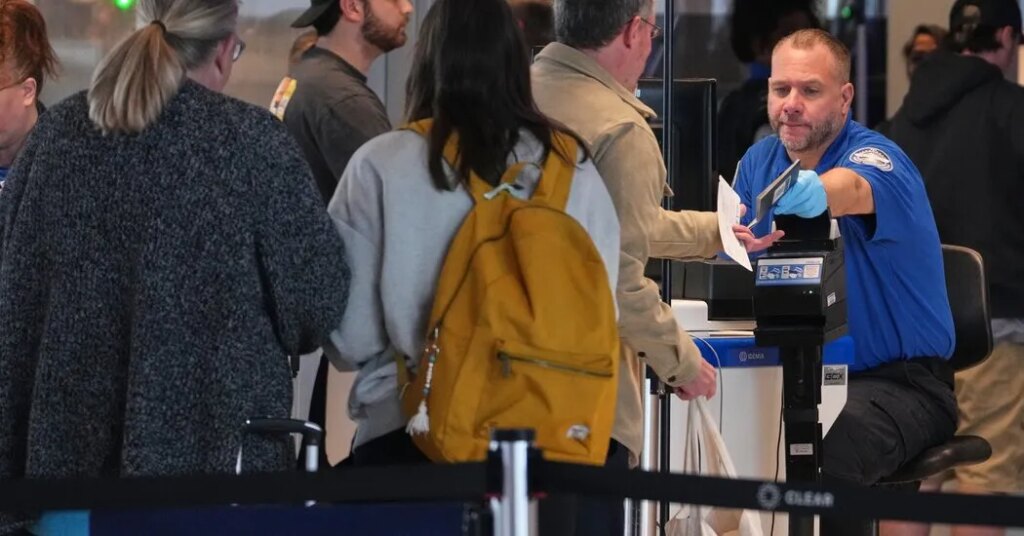
The next time you hand over your Real ID to be checked at the airport, the Transportation Security Administration agent who examines it might be standing rather than sitting.
The T.S.A. ordered that change recently in the hope that it will result in a more attentive and hospitable experience for travelers during the airport screening process. But the agency is receiving resistance from the union that represents more than 45,000 agents.
The T.S.A., which is responsible for screening passengers and baggage at 450 commercial airports across the United States, made the decision last week.
“T.S.A. officers performing the travel document checker role are the first to interact with the traveling public,” the T.S.A. said in a statement on Wednesday. “This welcome change reinforces both our security posture and our commitment to hospitality by having these officers on their feet and alert.”
The agency said officers must meet “fitness for duty requirements to be capable of performing their vital national security function while simultaneously creating a welcoming and professional environment for travelers.”
Council 100 of the American Federation of Government Employees, the union, that represents T.S.A. agents across the country, has pushed back on the move.
It said in a statement this week that it had not been consulted about the decision to “remove all chairs” at the travel document checker positions where agents check passenger IDs.
“These chairs serve as basic ergonomic and safety support for officers that stand and walk on hard surfaces all day,” the union said.
The union said it was “moving aggressively to address this matter,” and urged its members to contact representatives in Congress to express their concern.
Agents have typically been seated during the document checks, which are the first layer of the security screening process. Duties at other stations, such as monitoring and instructing passengers as they place belongings in the bins to be screened, and at the end when they collect them again, require agents to stand.
The order will not affect agents who operate and monitor carry-on baggage scanners who may continue to be seated. Agents also get short rest breaks and meal breaks during their shift.
Typically, T.S.A. agents rotate through a number of stations during an eight-hour shift, including identity document checks, divestiture and collection of belongings, and baggage screening, a T.S.A. spokesman said.
It was not immediately clear whether the new guidelines on standing at identity checkpoints would contribute to the other measures that have been taken to ease the long wait times that plague passengers.
In 2025, the T.S.A. lifted its requirement that travelers remove their shoes. Airports have also been trying to implement changes to passenger and luggage screening with remote check-in points, and a “Touchless ID” program that provides a dedicated line for those allowing their identities to be verified through facial recognition.
Earlier this year, agents worked more than six weeks without pay during the government shutdown. As salaries went unpaid, hundreds of agents quit or called out of work, and long lines throttled the flow of passenger screenings at some of the nation’s busiest airports. By the end of March, most of the T.S.A.’s agents began receiving back pay, easing some of the chaos.
The post T.S.A. Agents Are Told to Get on Their Feet During Airport ID Checks appeared first on New York Times.