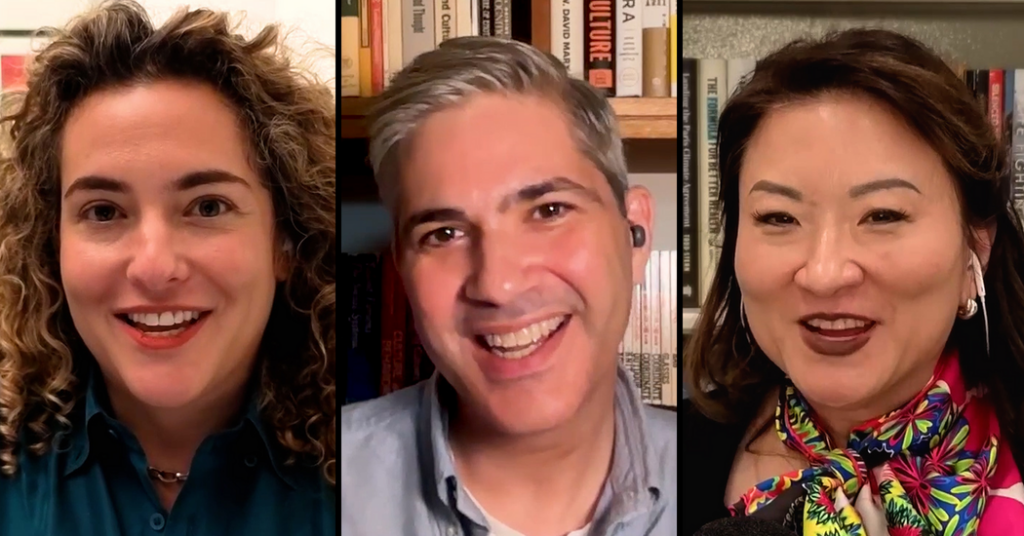
Has America lost its monopoly on cool? The Opinion culture editor Nadja Spiegelman joins the American expats and authors W. David Marx and Euny Hong to discuss how the world views U.S. culture and whether its cultural exports still have the lasting impact they used to.
This episode is part of “The New World Disorder,” a series exploring the disintegration of the postwar international system and how countries are adjusting as America steps aside.
Below is a transcript of an episode of “The Opinions.” We recommend listening to it in its original form for the full effect. You can do so using the player above or on the NYTimes app, Apple, Spotify, Amazon Music, YouTube, iHeartRadio or wherever you get your podcasts.
The transcript has been edited for length and clarity.
Nadja Spiegelman: American culture has been globally dominant for decades: Hollywood, bluejeans, jazz, hip-hop. How is that culture faring in a time of so much global disruption? And how has the rest of the world realigned while we were busy thinking about ourselves? I invited the writers W. David Marx, the author of “Blank Space: A Cultural History of the Twenty-First Century,” and Euny Hong, the author of “The Birth of Korean Cool: How One Nation Is Conquering the World Through Pop Culture,” to talk about American cultural soft power and its impact around the world.
Welcome, Euny and David. Thank you so much for joining me.
Euny Hong: Hi.
W. David Marx: How are you? Thank you for having us.
Spiegelman: I’m so excited to talk to you both about so many different things. The first place I wanted to start is: You’re both Americans, but you’ve both lived in other countries for the past 20 years or more. David, you’ve lived in Tokyo for over 20 years, and Euny, you’ve lived in South Korea, Germany and, currently, you’ve been in Paris for over 20 years.
One thing that I noticed when I moved to Paris in my 20s was that people were really excited to reference American culture to me as this shared culture that we all had, but it was quite different from the culture I had grown up with. Like, everybody was really excited about “Malcolm in the Middle,” which was not a show that anyone I knew in America had ever watched or referenced. And so I’m curious: What surprising elements of American culture do you see around you? Not like Starbucks, Coca-Cola, Marvel films, but surprising ways in which people embrace American culture, maybe differently than they even do in America.
Hong: Well, since you mentioned France, there are two recent innovations that have come over in the past I would say five to 10 years, and these are brunch and pastrami.
Spiegelman: I love that pastrami is really what they’re into. I remember when I lived in Paris, people were really into brunch, but brunch was also something I had never experienced this way before. It was like a 30-course meal with lots of little different pots of food.
Hong: Yeah, I think they first heard about brunch because of “Sex and the City,” believe it or not, but it didn’t travel over. And then when they introduced it, French people do not have breakfast food in the middle of the day.
They just don’t do it. And they’re very picky, as you know, about when a croissant is fresh. You do not get up at 11 o’clock — well, first of all, you don’t get up on Sunday morning. You don’t meet your friends, and you don’t have pastries after noon. It’s already bad by then. So, yeah, they don’t really have this in-between thing, or they didn’t until recently. So that was really surprising for me.
Marx: In the case of Tokyo, the amount of vintage stores that sell American 1980s high-school gym T-shirts and all these other forgotten bits of American culture is very shocking to people when they first come here. And so you’re surrounded by Americana all the time in Japan, but it’s a little bit detached from the real America now. So maybe contemporary pop culture in America is slow or doesn’t really catch on, but this kind of imagined version of America is everywhere. And then there are things like City Bakery and Dean & DeLuca and all these institutions of New York that no longer even exist in New York that are still strong in Tokyo. Tokyo feels, sometimes, like New York when “Sex and the City” was still on the air, but it’s still going here in Tokyo.
Spiegelman: I’m curious how American culture is perceived where you are, and I’m also curious how that’s changed.
Marx: I mean, from the perspective of Japan, obviously, it was occupied by the United States after World War II, and so America, jazz and American consumer goods became the reference for aspiration. So people may have had ill feelings toward the United States — or may not be interested, necessarily, in America as a geopolitical entity — but they loved jazz and they loved American clothing, and they aspired toward that.
And so that kind of continued, and at some point — especially, let’s say, during the Vietnam War, when there was real resistance against American military presence in Asia — then you get a real split where people hate the United States, but they love this Americana that still exists. And so Americana is just a huge part of Japanese life. At this point, it almost feels Japanese. It feels completely detached from America. And so then, when you kind of catch up to now, I think the question is whether the United States is creating these new kinds of culture that are really inspiring people in the same way, that are aspirational in the same way?
And so in many cases, yes, hip-hop culture has been massively influential globally. There’s no question about that. It’s really fun to go to countries around the world and you hear the local music and so much of it has trap beats, as if it’s been directly influenced by Atlanta or something. And so there’s these elements still where America has an advantage, that America can make the coolest music in the world. But oftentimes, other parts of American culture, kind of the way people live today, don’t get as inspiring to people — or it’s the Japanese version of a thing that is maybe more interesting. So the core of these American ideas still seems influential, but America may not always get the credit for the end product.
Spiegelman: That’s interesting. And what about you, Euny? How is our culture being perceived? Do people think America is cool in Paris?
Hong: Well, I would say that there are two separate versions of American soft power, or American pop cultural influence, in France — and this is the influence of Brooklyn versus mainstream America. One is going up: Brooklyn is going up; mainstream American influence, I would say, is going down. And these are on two separate axes that do not cancel each other out. You know, it started in an area of Paris that kind of looks like Williamsburg a little bit — warehouse-y — and then it spread to the rest of Paris.
But the American mainstream soft-power axis, I would say that it has diminished. I started to notice the effects radiating out of the second Gulf war. And my employer, France 24 — my first employer in Paris — exists because of the waning of American soft power, because Jacques Chirac said: Well, America’s invading these places. Fine. That’s just what they do. But why do they also get to tell the story? Why is CNN the narrator? Why can’t we be the storyteller?
And that was sort of the beginning of the end. I’m overstating it because it’s not as if they hate America now. When you think of soft power, I think of Regina George from “Mean Girls.” Like, everything you do is cool if you’re popular, no matter how dumb it is. And if you’re not cool, then everything you do is just, you know — you’re a pariah and nobody wants to do it. Recently, two things have happened that have put America into the pariah category: One is when France voted that abortion would be enshrined in the Constitution. This was a direct consequence of where America was going and France saying: We cannot stand by this.
Now, if it were the case that America still had omnipotent soft power in the world, they would not have done this. Then there was the CPAC, the conservative convention. I forgot where it took place. And the head of the French National Rally, the far-right party, Jordan Bardella, was supposed to speak there. He was invited to speak. And he backed out because he was so embarrassed by what he saw.
And again, if it were the case that America were omnipotent in terms of soft power, any French politician — I can remember a time when any French politician would have jumped at the idea to appear and speak at an American political convention. Things have changed, and now, he’s like: No. I will lose votes; I cannot be seen with this uncool kid with the bad skin or whatever.
And that is very recent. That is very recent.
Spiegelman: I’ve been wondering how much has changed, specifically since the second Trump administration. And I also just want to define some terms, because I feel like soft power is a thing that people can use to mean a lot of different things. David, how do you define the term “soft power”? Where does it come from, and what is the history of this idea?
Marx: So the term “soft power” comes from the scholar Joseph Nye, who really used it in the context of international relations. And so “hard power” is coercion and threat, and “soft power” is countries just liking other countries and doing things for those reasons. And there’s been a long debate whether soft power actually leads to geopolitical outcomes.
If you look at the Cold War, there is a case to be made that people in the Eastern Bloc started aspiring toward American pop culture, and maybe that helped create the feeling of wanting to liberate themselves from the communist regimes. But I think for other countries — let’s say Japan, which has really tried to focus on the soft power question — whether they’ve gotten better geopolitical outcomes because of interest in Japanese pop culture has been a big question that is still unanswered.
I think soft power, colloquially, we definitely now mean it as a country becoming cool, becoming a bigger presence on the map because it’s offering something. But I think, what’s interesting to me, I always think about Persian rugs because people love Persian rugs, and they love, let’s say, Turkish rugs, but it’s not necessarily that Iran’s soft power has increased because of these rugs.
And so there’s something about especially Korea and Japan at the moment, where it’s not just that the pop culture and the products are interesting to people; there’s actually something really aspirational when people around the world see a K-pop group or Japanese street fashion that they want to be inside of that world. They actually are anchoring their identity to the people, not just the products. And over the last year, there’s been this idea of “Chinamaxxing,” — which we had left out of this conversation — has now suddenly become part of it. So anyway, soft power, there’s the technical definition, there’s the colloquial definition, but I think we’re just describing something very interesting, which is the rise of these places as meaningful cultural units on the global map.
Spiegelman: Yeah. And I think that we’re also, for the purposes of this conversation, really interested in the cultural element, because soft power doesn’t have to be about culture. But here we really want to talk about the cultural element of it and focus on this idea of cool, as you were saying. But David, can you briefly walk us through when American media and pop culture really began to dominate in other countries? And then did it reach all parts of the world equally? Were some countries more influenced by America than others? In my lifetime, I’ve only known America as culturally globally dominant.
And so everywhere I go in the world, there’s American music playing out of car stereos. People can reference “Friends” and Marvel movies. When did that start? How did that start?
Marx: Really in the post-World War II period, where most of the world is destroyed and has yet to really create its own cultural industries. America is pumping out all of this culture around the world, and so films are going around the world and being shown in theaters. Before the war, obviously, you had jazz and you had other exports, but really, after World War II is where everything becomes just dominated by the United States.
And I think, especially when you get to the late ’50s and the early ’60s, the thing that was so appealing is that you have this youth consumer. You have teenagers become a big part of culture for the first time. And American culture with Elvis and the films that were coming out, and then obviously it becomes an Anglo-American thing with the Beatles. You have this pop culture that is revolving around the idea that young people could have high status.
So before World War II, that’s still really not part of the equation, and suddenly this culture is speaking to young people: that you’re hip and you’re cool and you know what’s going on, and you have this advantage over adults. And so, obviously, that’s really compelling. That really spreads and it sets up everything. So even, let’s say in Japan or in France, these places where you have youth culture grow, it’s kind of based on that American model, even if the particular styles or sounds or things are different. It’s just still that concept that young people are in charge of everything. If you look at the specific outcomes, like everybody watching “Friends” all the time, the format of the sitcom versus the one I think about a lot is “Jersey Shore.” So “Jersey Shore” is so American. It’s about these New Jersey working-class kids, and maybe “Jersey Shore” is not big, but they made spinoffs of “Jersey Shore” in all these different places.
There was one in Poland called “Warsaw Shore.” And so this format of “let’s do a show like this” goes around the world, and so the American values exist in the format. Even if kids aren’t watching “Jersey Shore,” they’re watching something that was based on that. America has been so dominant for this entire post-World War II period, setting the standard of what pop culture and what youth culture is supposed to feel like. So even when it changes just a little bit, there’s still something very American in the DNA of all of it.
Spiegelman: I think it’s interesting, also, that it starts with World War II, in this moment when America has ended the war and won over the fascists. And we had this really positive, idealistic idea of exporting American culture as an idea — as culture that could contain our values that we hold dear, the value of individualism, of democracy, of equality, of freedom.
Are we asking too much from culture that is mainly entertainment to hope that, when we are exporting something as silly as “Jersey Shore” to have it become “Warsaw Shore,” that contains the values of individualism, democracy, equality and freedom?
Hong: No. I think there are a lot of examples of things like what you’re describing becoming vectors for American values — sort of larger Values, with a V. And one example I can think of is if you look at antigovernment protests in Thailand from about 2014 till approximately 2020, you see a lot of people in the crowd using a symbol of protest from “The Hunger Games.” This is a symbol against the government of Panem, which isn’t even a real country. And yes, it’s a movie, but they’re doing it completely unironically. I mean, because to David’s point, there’s something synonymous with soft power, American soft power, and youth culture, youth empowerment, independence, having a voice. And I think that this is a really good example of that, of embodying all of those things that are arguably America’s best gifts to the world.
Marx: And just to extend to that, what’s so strong about American culture has been this liberal value, at least, that people who are marginalized or oppressed can work hard and struggle and fight off the oppressor. And obviously, something like “Star Wars,” that’s core to that.
You have parallels in “Star Wars” between the U.S. and the British forces and the Revolutionary War are really, really clear. They have all these people in uniforms, and you have this ragtag group of rebels on the side. It always complicates it when you talk about America and American pop culture, because the state and the regime — who’s in power — may not have the same values that are represented in pop culture.
And it’s also very clear that marginalized groups in the United States and the culture they have created has been probably the most effective American pop culture — not the culture that represents, maybe, the values of the dominant group or the group that holds political power. And so obviously, the history of Black music has been massively influential around the globe, with hip-hop being the most recent example. Gay culture has spread around the world, I think, through American pop culture. I think that the value of the good guy in a movie being the underdog — it’s the oppressed person who’s fighting back. I think that value does hold. And so for every movement that is trying to fight and struggle, there’s something in American pop culture they can latch onto, whether it’s a giant propaganda scheme or not.
Spiegelman: Yeah, I really love that point. Here in America, we have this so-called crisis of liberalism. Our government certainly does not have fully liberal values, but dominant American culture that’s exported globally is still largely liberal in its values. And so what values is America selling to the world right now, given that we have this crisis of liberalism in this country?
Hong: I do think that pop culture, the pop culture that spreads, regardless of whether it’s from Japan or the United States or South Korea, does tend to be left-leaning culture. And just simply because that’s where the fresh ideas are. And one example I can think of is “Black Panther,” the movie, which isn’t ideological, but it does promote values that, in my opinion, were very necessary in Korea. And I saw a sort of on-the-street interview with people who had just seen “Black Panther,” and every single one of them said that it had changed their views about Black people in a very positive way. Well, first of all, it’s wonderful, but I can’t imagine a movie taking a racist point of view or a far-right-wing point of view becoming viral or popular. There’s no Marvel movie that I can think of that has a right-wing agenda. I just don’t think it would work.
Marx: In the 21st century, one of the cultural issues has been that, for the 20th century, there was still so much patriarchy, there was so much pro-imperialism, there was so much obvious racism and sexism and homophobia that was in the top echelons of power that it was so clear that pop culture could always find a transgressiveness in left-wing ideas, in liberalism.
And so polite society has much more aligned with liberalism than it used to, say, 50 years before. And so the transgressive power of pop culture becomes more associated with the right wing throughout the 21st century in the United States. And so Vice magazine starts mixing drugs and sex and all of that, with this oblique right-wing politics and being racist and sexist and homophobic as a joke and being ironic. And one of the three founders of that then goes on to found the Proud Boys. And so there’s this direct connection between downtown hipsterism to 4chan and this kind of alt-right that develops later. And so transgressiveness becomes a bit right-wing in the 21st century.
But that culture, as Euny said, is just not as exportable; people around the world were not electrified by it. I think, in the United States, people weren’t even that electrified by it. It just happened to have a small cult of people behind it. And so much American pop culture has not even an oblique political line to it. It’s just an explicit kind of: Our politics are this. And I think that has not necessarily translated particularly well to the rest of the world. And so sometimes, when the specific American political context gets too dominant in the culture itself, it just makes it way less appealing than having these broad values be the thing that it represents.
Spiegelman: As much as it feels like perhaps America is less cool than it used to be in its age of denim and hip-hop and Hollywood at its peak, our culture is still very dominant around the world. U.S. films captured an estimated 52 percent of global cinema admissions in 2025, but still, that’s down from 63 percent in 2019. And Asian films’ shares rose from 27 percent to 36 percent.
So I’m curious how things are shifting, and Euny, in your book “The Birth of Korean Cool,” you talk a bit about this. How are things shifting in the rise of a more globally dominant Asian culture, even if it’s still quite far behind America’s?
Hong: Sure. I mean, to your point about the American box office, if I could just expand on that a little bit. I think Marvel is a really good metaphor for what’s happening with American soft power in general because, yes, Marvel does really well in every single country. But every time a Marvel movie comes out, there’s an op-ed in Le Monde or something about how, oh, this is America making itself into the superheroes of the world. So, Marvel giveth and Marvel taketh away is sort of what’s happening — this push-pull.
In terms of other countries becoming more dominant, I don’t think that America will ever not be No. 1. What’s new is that they’re now sharing, and Koreans did a lot of things right, but Netflix also had a lot to do with the democratization of content. The fact that Gen Z is now used to reading, having, watching everything in subtitles — even if it’s their own language — means that it’s easy for them to watch Korean content, Japanese content without it being this pretentious foreign film or whatever. I think that what we’re seeing with Japan and Korea is something that France has had for hundreds of years, which is a soft power without a hard power.
Spiegelman: Well, because in Korea, it was a very organized government effort to export its global culture, to create a new financial market, which they were seeing as just behind semiconductors in terms of what Korea could export globally. And I think the current government has a target to build a $265 billion K-culture market by 2030, which I am really interested in, because one of the things that we all know about cool in general is that it is really hard to simply decide to be cool and become cool by trying. That’s something that any middle school kid knows. So I’m curious how Korea succeeded, and I’m also curious — secondarily, David, like, Japan in 2013 literally created a Cool Japan Fund to export Japanese culture to the rest of the world. And in 2027 it’s going to wind that down after substantial financial losses. And yet, obviously, Japanese culture is cool. Not only is American tourism to Japan reaching record-breaking levels over the past couple of years, but also most people know about Studio Ghibli, Pokémon, anime, Nintendo. Those are all familiar to Americans. Why in Korea did the state-funded project succeed financially, and why in Japan did it not?
Hong: To speak to the Korean part of that question: Well, necessity is the mother of invention. Bankruptcy was the mother of the Korean pop culture wave. They fell victim to the Asian financial crisis in 1997, and the government realized they were overly reliant on these massive companies, like Samsung and so forth. And they found out in the ’90s what every 20-something knows now, which is that content creation is something that anybody can do cheaply and quickly, with no skills and no money and no infrastructure, and you don’t have to build factories. So that is how South Korea decided to do that. And the open secret about soft power is that you do need hard power, but I don’t mean military power, I mean boring infrastructure. And by boring ——
Spiegelman: Can you define this? What is soft power without hard power? What do you mean by those two different categories?
Hong: Soft power without hard power would be a country like South Korea, which I think in its history has literally never invaded any country — unlike any other country that we’ve just mentioned — and by definition doesn’t have any hard power. It doesn’t have any oil. It doesn’t have any leverage at all. All it has is this image as sort of harmless — handsome men and the smarts to realize that streaming video was going to be very important. It would be hard to exaggerate how important video was in the strategy of pushing South Korean pop culture.
I mean, the reason Korean music videos look the way that they do is that they were preparing for worldwide broadband before most countries had it. And so 100 percent of the people I know who are into K-pop discovered it through video; they did not discover it through the radio or an MP3. That is very intentional. Korea decided to be video-first, and that’s where they led. That’s where they focused all of their energies. And by “they,” I mean the Korean government and private industry working together.
Spiegelman: That’s really interesting. And then, David, how is that different in Japan? Why did they create a Cool Japan Fund a little over 10 years ago that they’re now going to wind down next year?
Marx: Japan is complicated because Japanese artists and creators had a long history of influencing the West way before the government got involved. You have bands like Yellow Magic Orchestra with Ryuichi Sakamoto. Sakamoto goes on to do scores for big, global films. And so you had this cadre of artists who were in no way supported by the government, who were not even that popular, maybe, in their home country. They were real rebels and avant-garde members of the Japanese artistic community who were getting big overseas. And that kind of extends to the ’90s. And I think a lot about the film “Lost in Translation” by Sofia Coppola, because the version of Japan she’s showing, it’s her perspective on it. And so she was spending all this time in Japan and thinking Tokyo was a cool place, and reflected that in the film, and then showed it to a bunch of Americans for the first time. They were like, “Oh, Tokyo seems very cool.”
And obviously, at the same time, you have anime and games that pop up, and those were real market opportunities that companies like Nintendo and all of the anime makers were pursuing. And so the government got involved very, very late, and it then became a somewhat of a boondoggle of, just: Let’s support the projects we have some sort of political connection to.
It wasn’t a particularly rational or well-thought-out plan of: Oh, here’s how Japanese culture got big overseas. Let’s help with it. The problem with pop culture in general is that there can be no planning. I mean, you can try 10 things. Hollywood studios did this for a long time. You make 10 movies; eight of them are going to lose you money, one of them is going to break even and one of them is going to make money for all the other eight. And it’s the same with culture. And so I think the Cool Japan Fund just didn’t really understand these principles, and it wasn’t about starting from scratch, which I think in Korea probably helped.
Hong: That explains why China never succeeded as well — the Chinese government never succeeded in being able to push it because the lesson, as you’re saying, David, is that you actually can’t create virality. It’s not as easy as it seems.
Marx: Yeah. In the case of China, in “Blank Space: A Cultural History of the Twenty-First Century,” I wanted to think about the impact of China on the global market because China has become such an economic power. And normally, in the case of Japan in particular, when you have that economic power, cultural power just kind of comes from that.
And culture in China has really developed. I mean, there’s so much going on. But it was hard, at least at the end of 2024, when I was writing it, to find very clear examples of where Chinese pop culture had spread overseas. And so Douyin, which is the app that became TikTok, that obviously influenced the format of global culture, that TikTok is so big, but TikTok is not the same app. It’s not the same videos. So something can go very big there, but it doesn’t get big globally because TikTok is split from it.
And so China, I think, has had a hard time because the country, as Euny says, isn’t particularly focused on cultural export the way that South Korea and Japan have been. And at the same time, it’s prevented a lot of things from going out, and then it’s also prevented so much from going in. And so when things are being prevented from coming in, it’s hard to create culture that then speaks to the language of global audiences.
Spiegelman: I think something that keeps coming up is the fact that technology and platforms are what’s driving culture and the spread of culture right now. And how are you seeing the mixing of cultures on these social media platforms?
Marx: I’ve been obsessed with this one feature on Instagram, which is that you can pick a place and then see the videos that are created there. And actually, this was fed to me algorithmically, but it was a content creator in Mongolia, and the videos were just identical in format to the same kind of meme format as you would see in an American video or anywhere else.
And just looking at these created videos, they were all created in the same format, with the same jokes and the same framings and everything. It’s just that the dialogue was in Mongolian. And then, obviously, the cultural context of the jokes, the inside jokes, were all Mongolian. I think the other really interesting example, to kind of tie the thread of a lot of things we’ve been talking about, is Labubu, because Labubu has been one of the first moments where China was on the map of, OK, you created a huge global fad.
Spiegelman: What is a Labubu? Like, I know what it is ——
Hong: Yeah. Also don’t know.
Spiegelman: Can you describe a Labubu?
Marx: Little monster, kind of plush monster toys that are sold in blind boxes, so you don’t know what you’re buying when you buy them. And then people put them on their bags. The original creator is from Hong Kong, and the influences on that creator were European lore and also a lot of Japanese anime aesthetics and illustration, but from Hong Kong. The company that produces it is Pop Mart, which is in mainland China, so the capital behind it is mainland China. And the other part is the nexus of cultural production of cool — especially in this online, fast-moving, fad-driven culture that we’re in — it’s very different than a Hollywood, organic, bluejeans, jazz music, rock ’n’ roll kind of a world, is that Asia in ——
Spiegelman: Can you talk quickly a little bit about, as you’re saying that, how different is a Labubu from something like America’s export of denim?
Marx: Well, Labubu in particular is just clearly a fad. I mean, one of the things that’s interesting is they knew how to do the limited edition sales of Labubu, but they didn’t realize that when everyone’s coveting it, what you do is you don’t expand production. And they expanded production, which of course ruined the scarcity, and then the whole thing kind of collapsed.
And the difference between bluejeans and rock ’n’ roll is that these were things that people anchor their identities to, that when they put on a pair of bluejeans, it wasn’t: OK, this year, this fall I’m wearing bluejeans, and who knows what’s going to happen next spring? It’s kind of like: I’m a bluejeans person. I’m a rock ’n’ roll person. I’m a hip-hop person. And so those movements gave people this feeling that they wanted to anchor their entire identity to. And that is different from a fad. I think that if we are in a fad-driven consumer culture — which we seem to be more in now — and last year people wrote a lot about Labubu, and they wrote a lot about Dubai chocolate. And Asia is getting much better at creating these things than maybe the United States is. I think people don’t like fads, and if you read the analysis of Labubu, it’s always people being: I don’t know what this is; I don’t like it. And it’s not celebrating Labubus. And so if there’s a resistance to fads but the world wants fads, I think these more fad-driven cultures that are emerging have a real advantage going forward.
And so the United States isn’t necessarily producing these new organic cultures. And the culture’s shifting from being more interested in these organic cultures to fad-driven culture. And so that’s going to be a big shift just on its own.
Spiegelman: I’m interested in this distinction of a fad that doesn’t have a real ideology behind it, or a way of being behind it. And I’m specifically curious, Euny, if you think of something like K-pop as something that has a strong ideology, way of being behind it, or is it more — as David was painting it — a sort of conglomerative mix of other music styles and things that have come together to hit just at the right moment?
Hong: Actually, one of my most surprising interviews that I did for my book was this Korean cultural critic who said just flat out that Koreans are not creative; they’re good at packaging. Now, I don’t agree with the first part of that, but K-pop is a really good example. The songs, tune-wise, many of them come from Sweden — which, by the way, is also the case for a lot of American pop hits. The dance choreographers are typically American. It’s very much a product, in the way that any kind of multinational corporation would build a product.
Spiegelman: In a world of fad and contents, is it still possible to have the kind of culture that has a deep sense of ideology attached to it, and therefore becomes lasting? The way that rock ’n’ roll or wearing bluejeans once was. Is anywhere in the world able to create that kind of culture right now?
Hong: I think it’s become very confusing for people, because we’re in an era where the right and the left, or extremes, have met in the middle. For example, what do trad wives and queer-friendly cottagecore have in common? They fetishize the countryside. So for that reason, I would say that you can have a cultural export, like cottagecore or trad wives — which unfortunately is another American export, like inceldom, that we would rather not be what soft power in America is known for. But I think it’s too confusing for people to attach culture to ideology in quite the same way because the extremes have met, basically, like a snake fighting. It’s like an Ouroboros.
Spiegelman: And what do you think, David? There’s this thing you write a lot about in “Blank Space,” like, is it still possible to create lasting cultural movements, more than just fads or contents?
Marx: I mean, the truth is also that culture has become so entwined with commerce in a way that — obviously, pop culture always had a commercial side to it, but there was a tension between culture and commerce that powered so much of the transgressiveness and interestingness of 20th century culture, where a band like Pearl Jam could get really big and then freak out and say, well, we’re never going to make a music video again.
And so that was an extreme act in the 1990s, to do that, but it made sense in the logic of the time. Now, I believe last year, a book came out about Taylor Swift being a poetic genius, and a book came out about her being a business genius the same year. And so there’s so much in culture that has a commercial side to it, that the values are more entrepreneurial than they are about democracy or liberalism or fighting the system, or any of those kinds of things.
And so K-pop, too, has this real glamour to it that — I don’t see that much transgressiveness in K-pop. And so I think so much of what’s powering youth culture now is this promise of being an entrepreneur, being a self-started business, to spin your content into economic means — to not have to have a real job, but to be able to do this as your life.
And so from that perspective, it levels the playing field that, again, people from around the world can make this very commerce-dominated culture. But at the same time, I think the culture that has this very clear universal feeling, the political ideology has become much rarer.
Spiegelman: Is there such a thing as American culture for us to export right now? What would it be? And is it bad? Is American culture simply bad now?
Hong: I would say what’s replacing American soft power more than any country — it dovetails with what David just said. Bong Joon Ho, when he was talking about “Parasite” in an interview, he said, “There is no borderline between countries now because we all live in the same country. It’s called capitalism.”
I would say that Silicon Valley — with Google, Apple, Facebook and Amazon, which are a monolith in the E.U. — have much more power than America as a country. So in that sense, I don’t think that American soft power, American culture, spreads in the same way that it used to. But it’s not because of South Korea, and it’s not because of Japan.
Spiegelman: Yeah, I think that quote — there is no borderline between countries now because we all live in the same country; it’s called capitalism — really speaks to also why some of the culture that’s been created in that global country of capitalism is maybe less alive than some of the culture created internationally in the past. David, what do you think? Is there such a thing as American culture, and is American culture bad now?
Marx: I would say that, with Hollywood films and a lot of music, it’s still very technically impressive that not every country can make a Marvel-type movie with all those computer graphics. And so if you want this big spectacle, America still does the spectacle best. The question is more: Is America creating the underground culture, or culture on the fringes, that will go on to inspire people around the world? Is that still being created as much? And in one way, there’s less marginalization, and so more people have more voice and can speak directly to giant audiences on these platforms. And so this kind of idea that a culture is developing in the shadows and then, you know, suddenly pops up, and it’s fully formed and amazing and people are really inspired by it — that’s just harder to do in the 21st century because everything is online.
From that perspective, I think America will still dominate the giant pop-culture spectacle, and the monopoly on cool, on the other hand, I think is probably over, that it is a more kind of multipolar world of cool. And so I guess the question of “is it good or bad” is — I would step back and not try to answer that on behalf of the United States. It’s just more if the United States cares that this is an edge that they need to preserve. It’s to really understand what it was, at the very beginning, that made American culture so powerful, and maybe that era is over. But that being said, I think there’s still music around the world that sounds like trap, and that, to me, is still a sign that you can have a new kind of sound pop up in the United States, and it’s just infectious and people can’t resist changing their production to match the American standards. And as long as that’s happening, America’s still the dominant cultural power.
Spiegelman: David, Euny, thank you so much for being here with me. Thank you so much for taking us through this whole history and present of how culture is spreading around the world. It is really such a pleasure to talk to you both.
Hong: Same. This was really fun. Thank you.
Thoughts? Email us at [email protected].
This episode of “The Opinions” was produced by Vishakha Darbha. It was edited by Kaari Pitkin and Annie Galvin. Mixing by Carole Sabouraud. Video editing by Dani Dillion and Steph Khoury. The postproduction manager is Mike Puretz. Original music by Pat McCusker and Aman Sahota. Fact-checking by Mary Marge Locker. Audience strategy by Shannon Busta, Kristina Samulewski and Ali Baluch. The director of Opinion Video is Jonah M. Kessel. The director of audio engineering is Isaac Jones. The deputy director of Opinion Shows is Alison Bruzek. The director of Opinion Shows is Annie-Rose Strasser.
The Times is committed to publishing a diversity of letters to the editor. We’d like to hear what you think about this or any of our articles. Here are some tips. And here’s our email: [email protected].
Follow the New York Times Opinion section on Facebook, Instagram, TikTok, Bluesky, WhatsApp and Threads.
The post America Used to Be Cool. What Happened? appeared first on New York Times.