The new documentary “NAZA” is tough to watch, and impossible to ignore.
A shattering inquiry into Israel’s military actions in the war in Gaza, it was directed by the Israeli filmmakers Yuval Abraham and Rachel Szor, who also codirected the 2024 documentary “No Other Land,” about military and settler violence in the occupied West Bank. Since the premiere of “NAZA” on Sept. 10 at the Venice Film Festival, their new movie has ignited pushback. A spokesperson for the Israel Defense Forces has rejected claims made in it, and Prime Minister Benjamin Netanyahu has compared it to a ballistic missile attack against Israel. He has also threatened to revoke the directors’ citizenship.
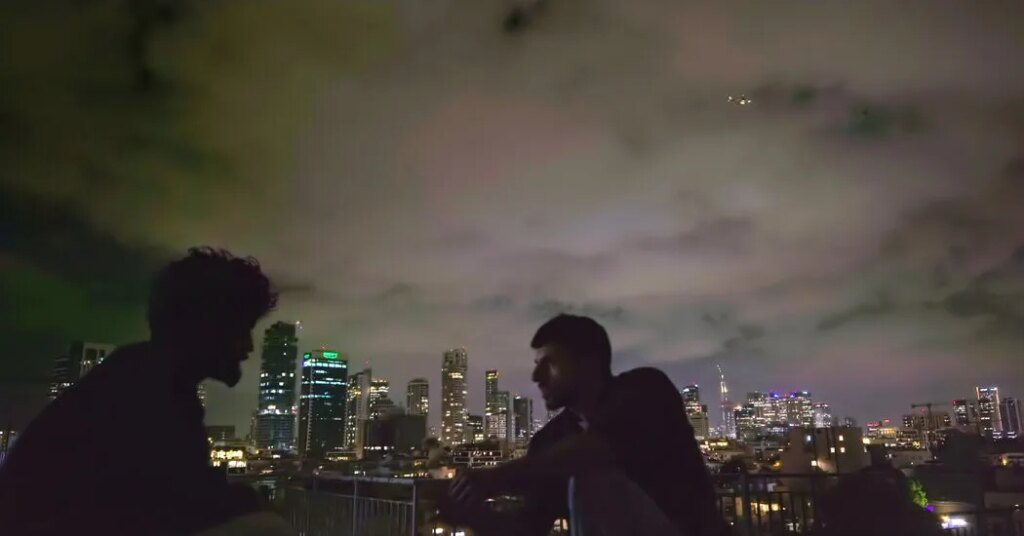
The fulcrums of “NAZA” are 24 one-on-one interviews with Israeli intelligence officers and soldiers. The interviews were conducted at night on rooftops in Tel Aviv with Abraham as the onscreen interlocutor. Szor and an unidentified cinematographer shot the interviews, which often find Abraham and one of the subjects facing each other in silhouetted profile against the cityscape. The interviewees spoke on the condition of anonymity (one says he could be arrested), and their looks and voices have been digitally altered. Their faces at times verge on visibility, while in other instances their heads disappear into the inky dark. Their voices are often matter-of-fact, and rarely waver.
Throughout the 80-minute movie these interviewees describe the military actions in Gaza in the wake of the Hamas-led attack on Oct. 7, 2023. Up to 1,200 people, mostly civilians, were killed; about 250 hostages were seized; and thousands of rockets from Gaza were fired at Israeli cities and towns. By the next day, Netanyahu had announced that Israel was at war, saying, “We will bring the fight to them with a might and scale that the enemy has not yet known.” By Oct. 9, 2023, Israel had ordered a “complete siege” of the Gaza Strip. By July 2026, Gaza health officials said that more than 70,000 people had been killed during the war.
The movie largely focuses on civilian deaths, and its title is shorthand for nezek agavi, which effectively means collateral damage. Early on, an interviewee explains: “We say 15 NAZA. We don’t say 15 people will be killed, and certainly not that 15 children and women will be killed.”
This assertion sets the template for what follows as other interviewees describe decisions and actions — buildings bombed, the number of permissible civilian casualties — that they made on the ground and often remotely. Throughout, Abraham and his subjects speak with relative calm; at times, though, his voice rises in pitch and volume. His affect is tense yet gently insistent, including when the topic turns to military operations that led to mass casualties. No one yells, even when an emergency siren starts blaring during an interview. As the night sky flashes, the filmmakers cut to a rocket from Gaza soaring over nearby buildings. “Is there a shelter here?” a subject asks before explosions sound and the camera shudders.
The intimacy of these interviews is powerful, and creates an unsettling paradox. Even at their most off-puttingly horrific you are drawn into these discussions. That speaks to the power of the filmmaking and of documentary itself and, indeed, while the movie can be shocking, its revelations are similar to what’s been published earlier. In 2024, The New York Times reported that, after the Israel military changed its threshold for noncombatant causalities, civilian deaths in Gaza spiked. Strikes on military targets, The Times reported, were permitted to “cumulatively endanger up to 500 civilians each day,” a number echoed here. Abraham’s 2024 report on the military’s use of A.I. to locate targets was published in several outlets, including The Guardian. Another of his reports was cited in a 2025 Times report.
(The Guardian, which helped produce the movie, will make it free to watch on its website after the theatrical run.)
Although the filmmakers include some larger historical context as well as some archival visuals, “NAZA” is emphatically about the present and not the past, a focus that registers as an ethical choice. The interviewees repeatedly invoke Oct. 7, and snippets of news reports from that day can be seen on TVs in nearby apartments. Again and again, amid the interviews, Abraham and Szor cut to the unidentified inhabitants of these buildings going about their everyday lives: They watch television, exercise, read and look out of their windows. Their presence is at once a reminder of the threat that Israelis face and of the deaths of tens of thousands of Palestinians.
It is the movie’s relentless insistence on the human factor, not policy or politics, that makes it finally so haunting. Every so often, the filmmakers cut to Netanyahu and other public figures speaking on TVs in nearby apartments. Although their faces are visible and their voices sometimes sound inflamed, what they say is often familiar, which can make them seem more anonymous than the interviewees. It is, this movie underscores, one thing for people to speak about war in the abstract. It is another matter entirely when an interviewee discusses eavesdropping on a target while he pulled dead children from the rubble of his home.
Throughout “NAZA,” the interviewees describe the systems — the technologies of war — used in Gaza. In the process, they also speak to the systemic dehumanization of their targets. “After Oct. 7th,” one man tells Abraham, “everyone kept saying: There are no innocent people in Gaza.” As the movie continues, some interviewees express remorse; others do not. One speaks about the need to trust the system, while another talks about doing a job; this too is bureaucratic dehumanization. Abraham and Szor never solicit pity for their subjects who, in serving their country, have helped perpetuate what the United Nations and Israeli human rights organizations have described as genocide. Instead, the filmmakers ask and they listen.
At one point in “NAZA,” the filmmakers cut to the image of Claude Lanzmann playing on TV. One of the giants of cinema, Lanzmann directed “Shoah” (1985), a staggering nine-and-a-half hour history of the Holocaust that largely comprises interviews, including with victims and perpetrators. The “NAZA” filmmakers don’t explain his inclusion here, though it seems that his image is being shown in conjunction with Holocaust Remembrance Day. It’s possible to see Lanzmann’s presence in this documentary as a gesture of solidarity and a homage to another journalist-filmmaker. It’s also a reminder of the singular power of eyewitness testimony and how the act of speaking about our lives is one way we collectively try to make sense of the past, present and future. We speak, and hope that others listen.
NAZA Not rated. In Hebrew and English, with subtitles. Running time: 1 hour 20 minutes. In theaters.
The post ‘NAZA’ Review: Intimate Interviews About War’s Human Costs appeared first on New York Times.