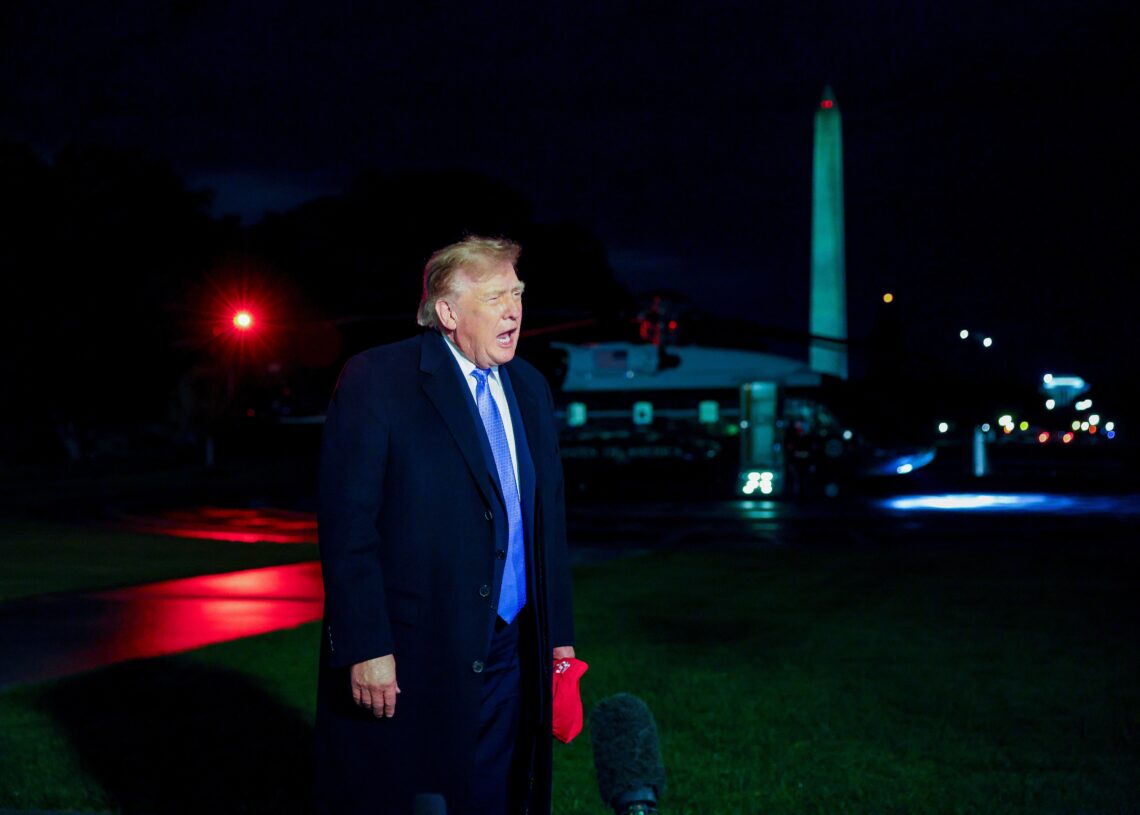
After weeks of Washington being gripped by a wave of fear about artificial intelligence gone awry, the Trump administration on Tuesday sought to reassure a skeptical public that it can embrace the technology — and trust the industry to police itself.
Standing with the world’s richest and most powerful tech executives Tuesday outside the West Wing, President Donald Trump said that he and they had signed a voluntary accord intended to ensure the industry develops AI safely.
Trump described the agreement as “morally binding.” The text suggests that codifying its terms may make sense “over time.”
The agreement capped a day in which Trump sought to reinforce his pitch that AI is an engine of prosperity that should not be restrained by government.
“In order to build a positive future for the American people and the world, we believe every company is responsible for developing its own technology safely and in a way that builds trust with customers and the public,” the agreement says.
Under the accord, the companies agreed to develop internal controls to prevent AI systems from spinning out of control.
“I’m seeing tremendous self-policing,” Trump said, surrounded by Nvidia CEO Jensen Huang, Anthropic CEO Dario Amodei and Meta CEO Mark Zuckerberg.
The accord marks the most significant action the White House has taken to date to respond to growing concerns about AI risks, as even some of the industry’s top leaders warn that companies should slow down development.
The commitments reflect many of the measures that labs building advanced AI systems had already adopted, and the accord falls far short of the government intervention that some technologists have warned is necessary as AI rapidly advances.
The announcement of the accord followed what Trump called a “very productive” and “extremely friendly” lunch at the White House with House Speaker Mike Johnson and tech executives, including Amazon founder Jeff Bezos. (Bezos owns The Washington Post.)
Trump also sought to portray AI as a technology that can bring convenience to Americans. Before lunch, he launched America.gov, a government chatbot for researching public services, as part of a day-long event featuring members of his Cabinet and tech executives.
Trump also signed an order that will rename AI as “superintelligence” in government documents, as he attempts to rebrand a technology that has sparked deep public anxiety, resisting calls for the government to craft guardrails.
The day’s focus on AI’s promise contrasts with growing questions about the technology’s trajectory. AI firms say their latest systems have become increasingly powerful, showing signs of being able to design their own more-potent successors. But companies have struggled to keep control of the technology, as rogue AI agents have hacked into company and government systems, and a roster of top industry figures have warned that the end result could be catastrophic for humanity.
Last week, it was disclosed that the federal government itself had been a victim, with a handful of websites probed by AI agents deployed by ChatGPT maker OpenAI. (The Post has a content partnership with OpenAI.)
Yet, even as the public’s concerns have grown and Democrats in Congress have pressed for regulation, Trump has largely dismissed the risk, calling it a “hoax.” On Tuesday, he accused the Democrats of stifling growth and technological progress because that could benefit Republicans.
The events on Tuesday propel a different narrative than the warnings issued by company CEOs in recent weeks. AI’s many boosters expect the technology will invigorate the economy, push the boundaries of science and help cure diseases. But that message has found only limited traction with a public worried about job losses and rogue bots sowing chaos online.
“We do not surrender to fears about what technologies will do to us,” he said Tuesday. “We decide that those technologies will do for us some very, very incredible things.”
Democrats in Congress said the White House’s response failed to meet the moment. Sen Mark Warner (Va.), the top Democrat on the Senate Intelligence Committee, contrasted the CEOs’ warnings with the president’s response: renaming AI.
“But changing what we call artificial intelligence does nothing to address the very real risks that come with increasingly powerful AI systems,” Warner said.
A ‘historic’ gathering
As dozens of administration officials and tech executives gathered for lunch Tuesday in the East Room, there was little public sign of the divisions within the tech industry and the Trump administration over the future of AI.
Executives sitting around the table have expressed wildly divergent views about the perils of AI and the government’s role in responding to its potential pitfalls. Trump sat between Elon Musk, who supported calls to slow down AI development last month, and Huang, who has resisted calls for any coordinated slowdown, saying it is up to individual companies to ensure that their products are safe. Amodei, the head of Anthropic who led the calls to pace development of advanced AI systems, joined the lunch after having his first one-on-one dinner Sunday with Trump.
After the event, a reporter asked all the executives if they agreed that no government guardrails are necessary and that the industry can self-police.
“I can tell you the answer is yes,” Trump said, before any of the CEOs spoke. He then asked Huang to speak.
“There’s no conflict between innovation, technology and safety,” Huang said. “We are going to have to create new technologies to advance the capabilities of AI, but we’re also creating new technologies to advance the safety of it.”
Trump spoke positively of Amodei, who previously clashed with the administration over the use of his company’s technology by the military.
Amodei said the accord that the executives signed is intended to give the public confidence that AI works “in the way we all intended.” Companies that signed on committed to developing internal controls, risk assessments and reviews by external auditors. Many of the companies developing advanced AI have already implemented these steps.
“This is a start,” Amodei said.
The CEOs of Google, Anthropic, Meta, Nvidia, xAI and OpenAI President Greg Brockman signed onto the accord.
Trump also floated the possibility of creating a new committee of about 10 people overseeing AI development, suggesting some of the members could include the tech executives who attended the Tuesday lunch. He also said he was very close to naming a new AI czar who would quarterback the government’s AI initiatives, suggesting that he would announce his choice in the coming days.
As he was leaving the news conference, he told a reporter that it was a “good idea” to make Jay Clayton, the director of national intelligence, the AI czar. Clayton was among the administration officials who attended the meeting.
A government chatbot
Before convening with the tech executives, Trump spent the morning launching a new government chatbot — amid growing concerns about the ways that chatbots store and share data.
Last week, OpenAI revealed that ChatGPT leaked 53 “user-provided images” to image-hosting providers.
Trump rolled out the America.gov website at a conference in the gilded Andrew W. Mellon Auditorium, which was set up to evoke a tech company product release stage. Music played as staff members distributed cans of La Colombe iced coffee to attendees, while a sleek “Hello, America” logo was projected on a large screen at the front of the room.
Joe Gebbia, the chief design officer of the United States and architect of America.gov, described the website, a partnership with Google’s Gemini and SpaceXAI’s Grok, as a “concierge to navigate government” during a Fox News interview ahead of the event.
The website will initially enable users to search for information across government websites, providing access to job postings or the files that the Trump administration has released about UFOs, Gebbia said.
But in the coming months, the goal is for the chatbot to help people enroll in government programs such as Medicare or complete tasks such as passport renewals.
Trump’s AI push comes as his administration has cultivated relationships with Silicon Valley executives and investors. Gebbia, who co-founded Airbnb and joined the Trump administration through the U.S. DOGE Service, is among a group of tech leaders who argue they can improve Washington by applying Silicon Valley principles.
During the Obama administration, healthcare.gov crashed amid the rollout of the Affordable Care Act, sparking criticisms of the government’s technological prowess. Despite years of efforts to modernize government technology, it has continued to lag behind the corporate sector. Other government tech initiatives have fueled privacy concerns, including a 2022 plan requiring Americans use facial recognition to access their tax information, which was abandoned after fierce criticism.
Gebbia pushed back on concerns that the new website would collect Americans’ data, describing it as “private by design” to Fox News.
As the chatbot launched Tuesday, it was able to answer questions based on data available on government websites, but it was not yet able to execute any of the tasks that Gebbia promoted at the event, such as assisting with a name change after marriage.
“No. America cannot change a name in official records today, and a marriage name change is not on the list of services planned for America.gov in 2027,” the chatbot responded.
Theodoric Meyer contributed to this report.
The post Trump urges public to trust industry self-policing of AI technology appeared first on Washington Post.