Matt Fleming is the communications director and a policy fellow at the Pacific Research Institute.
What did yoga ever do to San Diego?
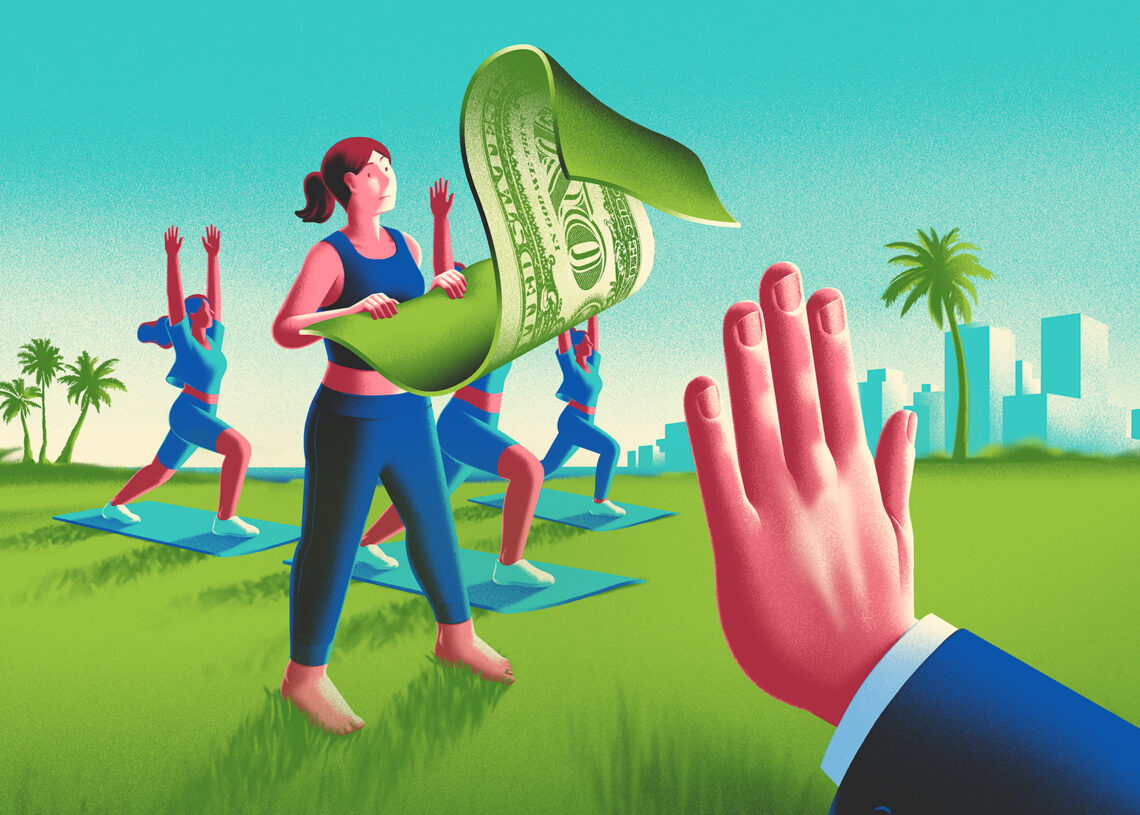
For two years, the city has been waging a protracted legal battle against two yoga instructors. Their alleged transgression? Teaching yoga classes supported by donations in a picturesque public park on a cliff overlooking the Pacific Ocean. You know, the kind of park perfect for a relaxing activity like yoga.
The park is open to the public. Visitors can take a walk and look at the ocean, but they should be careful. Bringing a yoga mat and a few friends (at least four, to be exact) might be construed as an illegal yoga session. It’s probably safe for a group of joggers to stretch before setting out, but if anyone’s wearing yoga pants, that could raise a red flag — hard to tell, because the ordinance is silent and the city wouldn’t comment.
And, yes, there’s litigation. So far, San Diego is losing.
In June of last year, a federal appeals court ruled that the city violated the First Amendment rights of Steve Hubbard, a.k.a. “NamaSteve,” and Amy Baack when it attempted to shut down their yoga classes in 2024 after adopting the ordinance. The court determined that yoga instruction was protected speech and that the yogis did not need a use permit (which would run them about $6 an hour). The classes offered by Hubbard and Baack are free and open to everyone (donations are accepted). Hubbard filed a separate lawsuit this June, claiming that city officials violated his rights again when they cited him three times in May 2025, including giving him a ticket after he filmed a live stream at his home. The ordinance doesn’t regulate private property, but viewers were allegedly following along with the class from a park. The city also subpoenaed Hubbard’s financial history and the GPS records of some of his students, according to his attorney.
The crackdown started in 2022 as the city took action in response to a state law decriminalizing sidewalk vending. At first, city staff recommended charging street vendors $230 annually for a permit. Negotiations ultimately brought it down to a more realistic annual fee of $38. But the city believed that some vendors took advantage of a loophole to claim free-speech exemptions by accepting donations instead of making direct sales. The city sought to close the loophole by targeting vendors allegedly skirting the rule. But San Diego’s aggressive enforcement strategy has sparked a debate over free expression and entangled the city in a legal mess.
The debate ultimately centers on whether these activities fall under the definitions of expressive activities and commercial services, and whether they are protected by the First Amendment protections or require written consent of the city manager.
Cities have a reasonable interest in issuing permits to businesses to collect tax revenue and compel adherence to health and safety standards. San Diego is already dealing with a budget crisis and needs revenue. The city just eliminated dozens of jobs and cut funding for things like recreation centers and public restrooms, all in an effort to close a $118 million budget deficit. Cities also have a responsibility to manage scarce resources, like parks, making them available for everyone and keeping them from being dominated by one vendor or group.
But San Diego lost the plot when it started deploying rangers to keep taxpayers from doing yoga, and possibly playing pickup soccer and volleyball, and considered tracking citizens’ whereabouts just to prove a point.
Maybe the city desperately needed the six bucks it could charge yoga instructors for a permit. That deficit won’t close itself, after all. Then again, maybe the city shouldn’t have risked an extended legal fight, part of which it had already lost, exposing itself to the possibility that it will pay not only its own legal bills but the plaintiffs’ as well. Government attorneys aren’t cheap, but they are probably a bargain compared with the yoga teachers’ defense team.
Is regulating yoga in parks really worth it? This all started because the state wanted to promote street-vending entrepreneurism. San Diego officials apparently interpreted that as a mandate to go after park yoga.
San Diego just settled a lawsuit over single-family trash fees and Balboa Park parking fees, costing the city millions of dollars. If the city can back away from one fee fight, it’s hard to see why a minor dispute over $6-an-hour yoga permits was worth two years and several lawsuits. But such is life in California.
As one of the Golden State’s favorite sons, Ronald Reagan, once said about the government’s view of the economy: “If it moves, tax it. If it keeps moving, regulate it. And if it stops moving, subsidize it.” Unless the lack of movement is the savasana pose at the end of a yoga class.
The post A California city is waging a fight against yoga appeared first on Washington Post.