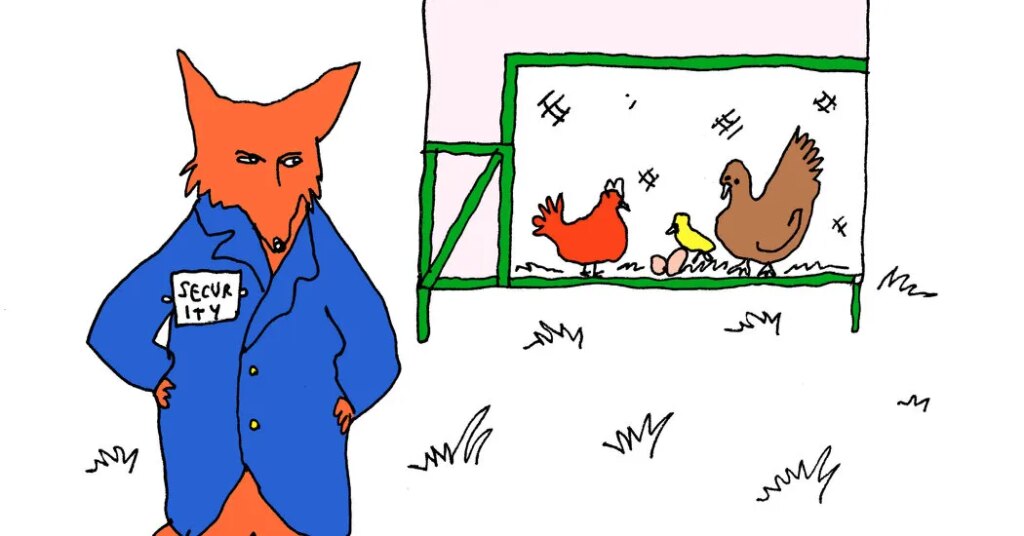
Anthropic’s chief executive, Dario Amodei, has transfixed Washington with apocalyptic warnings that his products could end humanity. To prevent such an outcome, he has proposed letting the artificial intelligence companies police themselves. The government’s role? To issue an antitrust exemption allowing the companies to coordinate on slowing down model development and try to persuade China to adopt a similar approach. And on Tuesday, President Trump sat flanked by top A.I. executives after a private lunch at the White House and promised, “tremendous self-regulation.”
A.I. may differ from products developed during the internet boom, but some parallels are emerging. Starting around 2018, Facebook, now rebranded as Meta, began a series of self-governance initiatives that purported to introduce some oversight of its behavior. In practice, these measures seemed more intended to forestall government scrutiny. Almost a decade on, jury trials have revealed that instead of policing itself to curb destructive practices, Meta was concealing evidence that its products seriously harmed kids and teens.
Implicit in the idea of A.I. self-regulation is that America is incapable of managing risk through our democratic government. But historically we have done just that, successfully building and regulating powerful new technologies, from railroads to nuclear energy. We can bring A.I. companies in line with the public interest and deter dangerous behavior.
First, policymakers should look to laws already on the books, not to the online manifestoes and blog posts written by tech chief executives, for guidance. Much of the commentary from the executives suggests they currently operate in a legal vacuum, as if A.I. has wiped clean the regulatory map. In fact, their business practices — including how they develop and deploy their technologies — are already subject to longstanding laws.
Product liability laws apply when goods are defective or dangerous, while tort law establishes basic duties for companies to not act negligently or recklessly. Consumer protection laws prohibiting unfair or deceptive practices can also kick in when businesses injure others by failing to take adequate precautions.
A host of lawsuits in this vein have already been filed against A.I. companies, with several judges already affirming the viability of these cases at the initial stage. State attorneys general can also act. Even at a time when federal enforcers have ignored all manner of corporate lawbreaking, the states can obtain injunctions and substantial penalties to halt harmful conduct and deter bad behavior, as Florida is now trying to do.
Individual executives at A.I. companies can also be held personally liable for unlawful activity, and we already have criminal laws that address more egregious forms of corporate lawbreaking. Given the automated hack of Hugging Face and a series of similar breaches, enforcers at both the state and federal levels should immediately hold A.I. executives accountable for the dangerous and illegal actions of their systems.
Congress will need to legislate. America has a long history of regulating companies and products that are both transformative and risky, including nationally chartered banks, potentially dangerous pharmaceuticals and lethal nuclear assets. Drawing on this tool kit, lawmakers should consider mandatory testing of advanced A.I. systems; breaking up the A.I. giants to prevent conflicts of interest that can arise when a dominant company controls a critical technology, its inputs and its distribution; and truly independent supervision to monitor risk.
Even where A.I. presents new risks, we have a rich history of what works and what doesn’t that we can mine for lessons on how to design new, effective regulations. Efforts to bolster deterrence of risky or dangerous behavior — such as Senator Bernie Sanders’s and Representative Greg Casar’s proposal to introduce a “corporate death penalty” and heighten criminal liability for executives — are especially apt in today’s environment of rampant corporate lawlessness.
Lastly, tackling the challenge of A.I. will require confronting our broader crisis of governance.
Congress struggles to deliver — a legacy of the Republican takeover of Congress in 1995, when the newly appointed House speaker, Newt Gingrich, slashed committee staffing needed for rigorous policymaking and defunded internal expertise. The flood of money in politics greenlit by the Roberts Supreme Court has also distorted our legislative body, where even popular, bipartisan initiatives now fail to pass, or often fail to even get a vote.
Over this same period, our court system has become increasingly libertarian on economic issues, with judges regularly vetoing policies that would promote economic fairness and protect Americans from corporate abuse while going easy on corporate lawbreaking. Mr. Trump’s executive branch has devolved into naked corruption and stopped enforcing laws against wealthy interests.
Against this backdrop, outsourcing regulation to the A.I. companies may prove tempting. But it would be a clear mistake. Our democracy cannot surrender the trajectory of these powerful technologies to a handful of private actors. We must ensure they ultimately serve public ends. Congress should move diligently to investigate these companies and legislate, and state attorneys general should enforce the laws on the books.
Emerging technologies have always created both opportunity and peril as society and business adjust to rapid change. The public is now awake to the reality of A.I.’s potentially transformational nature. But the most dangerous reaction would be for Washington to panic and hand the steering wheel to the very same companies and executives whose breakneck pace of development and financial conflicts led us here in the first place.
Lina M. Khan is an associate professor of law at Columbia Law School and chair of the Board of Directors of the N.Y.C. Economic Development Corporation, which promotes the city’s economic growth. She was chair of the Federal Trade Commission from 2021 to 2025.
The Times is committed to publishing a diversity of letters to the editor. We’d like to hear what you think about this or any of our articles. Here are some tips. And here’s our email: [email protected].
Follow the New York Times Opinion section on Facebook, Instagram, TikTok, Bluesky, WhatsApp and Threads.
The post Trump Says A.I. Titans Should Police Themselves. What Could Go Wrong? appeared first on New York Times.