Times Insider explains who we are and what we do, and delivers behind-the-scenes insights into how our journalism comes together.
In 2024, the Times reporter Andrea Elliott went to Hudson, N.Y., to witness the rollout of the state’s legal cannabis industry. But Hudson had a bigger story to tell about America.
The battle to corner Hudson’s weed market was shaped by the drug war’s legacy and 21st-century gentrification. There was also a new chapter to be found in the life of the boxer Mike Tyson.
Hudson was, Ms. Elliott wrote in an article published last weekend, “a mirror of the nation’s most ruptured self.”
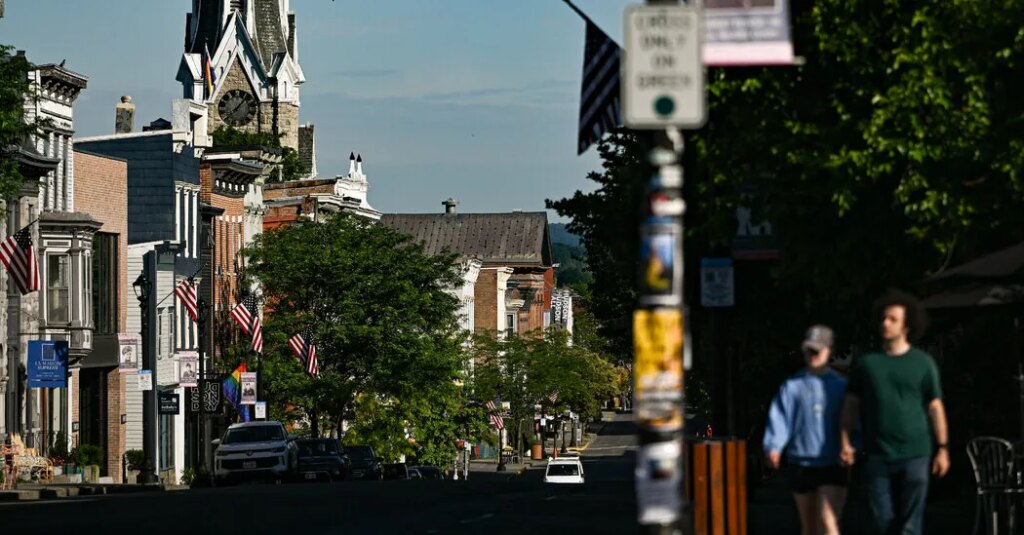
Ms. Elliott conducted more than 150 interviews and followed the lives of her two main subjects, Bill Hughes and Joanne Wilson, for a year and a half. With the help of her colleague, Rob Gebeloff, she analyzed previously unpublished crime and income data. She made 15 trips to Hudson, embedding in a river town that The Times’s Kenny Holston photographed.
In the conversation below, Ms. Elliott told me how she shaped reams of reporting material into a 12,000-word narrative and why the power of showing up never ceases to amaze her.
This conversation has been edited.
Andrea, on the surface this is an article about the legal cannabis industry in New York. But like a Russian nesting doll, it opens up to reveal deeper subjects. Where did your reporting begin?
Every time I thought I’d nailed the reporting, a new layer appeared. Cannabis became a vehicle for exploring a much vaster terrain — income inequality, racial justice, polarized politics, the power of capital. And Hudson turned out to be America writ small.
I never expected this when I first headed upstate, in 2024, to witness the cannabis law’s rollout. I had one source (the mayor of Hudson, who answered the phone at City Hall) and barely a lead: Abby Rockefeller was growing marijuana on her local farm.
But that was enough to pique my curiosity. As a journalist, I had spent years researching the impact of government policies on the lives of Black families. Any student of this history knows that the Rockefeller Drug Laws (passed in 1973 by Abby’s uncle, Gov. Nelson Rockefeller) created a national blueprint for mass incarceration.
The story unfolds in a cinematic fashion, with characters, chapters and other narrative techniques that are uncommon in traditional news stories. Why did you decide to construct the article this way?
There are many ways to tell a story. This one came with so much complexity, and such a fascinating weave of characters, that its narrative style mirrored my reporting. It felt kaleidoscopic.
One moment we are with Bill Hughes, whose childhood intersects with the boxer Mike Tyson, whose own story leads to the “green rush,” linking him to Abby Rockefeller, whose family connects to America’s drug-war history, which becomes a crucial chapter in the story of Hudson, which then leads us to Joanne Wilson, who in turn brings us back to Tyson’s brand, and on it goes.
To keep track of these intersecting narratives, I did what my colleague Ben Weiser taught me many years ago: I kept a timeline. It is color-coded to distinguish between sources — some historical (my Hudson timeline begins in 1609) — along with real-time events.
Soon, I had a detailed outline that my editor, Paul Fishleder, and I worked to hone. This was taped to my wall, along with photos, maps and quotes. But the written word brings its own process. Ultimately, I wanted to write the kind of story that moves readers, which required a deep and continued engagement with my sources.
Those sources shared a lot with you. Mike Tyson told you about parts of his life that books and scripts skipped over. How did you get so much buy-in from so many people?
I never take trust for granted, nor do I see it as a destination. It’s a constant work in progress. The stakes are high when a person lets you in. But as a journalist, my loyalty is to the facts and, by extension, the reader. It works best when a source shares this ethos, or at least believes that the story needs telling.
What I’ve learned over my 27 years as a reporter is that you can make your best case for a story, but nothing compares to the act of showing up. There is no substitute for being there. And people know this, instinctively. They are more inclined to open up when they see how devoted you are to the story.
Just as I am observing my subjects, they are taking note of me — the kinds of questions I ask, or how I talk to my kids when they call, mid-interview, or whether I laugh at a particular joke. It is a deeply human exchange.
For buy-in, it also helps to report from the ground up. Tyson’s P.R. team repeatedly turned me down.
And that’s where Hudson came in.
As Tyson’s boyhood friends got to know me, and saw that I was doing serious work, they helped me strategize. When I got word that Tyson was in Hudson, for a cannabis expo near the train station, I slipped past his bodyguards, went up to his face, and said, “I know Bill Hughes!” And he said “Billy?”
And then — following the instructions of his Hudson friends — I said, “Where’s Kiki?” (his wife). This was like saying a secret password. She rolled down the window of their S.U.V. and listened to my pitch. And she cleared the way.
The utility of on-the-ground reporting never ceases to amaze me.
Bill Hughes and Joanne Wilson are at odds in a number of ways. How did you ensure that you were fair to both of them, and not produce an article that had one sympathetic character and one antagonist?
Any dual narrative runs the risk of becoming a simplistic, hero-villain tale. That’s precisely what I labored against — and not just because it’s uninteresting. It’s not the story I found.
Both Bill and Joanne are highly relatable, and in many ways, similar: They are both self-described “hustlers” who are scrappy, ambitious, and civic minded. They share a deep devotion to their respective spouses, children and lifelong friends. And they each carry childhood wounds that help explain what drives them.
Theirs is not a story of moral equivalency. It’s about two people trying to navigate a nascent industry — and a dysfunctional bureaucracy — using the tools at their disposal. Their plans eventually clash on Hudson’s main drag, Warren Street, now a dividing line between the historic Black community and the city’s gentrifiers.
The ultimate antagonist — both Bill and Joanne would agree — is the state, which has bungled the rollout and is still struggling to meet the law’s social-justice promise.
As a journalist, are you drawn to places that tell bigger stories?
Like my colleagues on investigations, I am always looking for the bigger story. This is an essential part of our job. It’s what my mentor, the revered Times editor Christine Kay, called “taking altitude.” This requires drilling down, deep — while also flying high above the ground, to make sense of it all.
The post In a Small American City, a Story About Weed Reveals Much More appeared first on New York Times.