A few weeks ago the independent movie “Before Sunrise” popped into my mind. A 1990s classic and the first in a trilogy, the film is about two cerebral 20-somethings, Céline and Jesse, who meet cute on a train to Paris. They decide to hop off in Vienna, and spend a day together bantering, interacting with locals, wandering the beautiful city without purpose and falling in love.
They relate in spite of cultural differences (he is American, she is French, they both talk to Austrians) and gendered ones, too. As I was replaying the movie in my mind, I had a thought that made my stomach drop: My children may never get to experience this. By “this” I mean the uninterrupted attention, general serendipity and conversational vulnerability that I got to experience before smartphones.
“Before Sunrise” even somewhat presaged our screen-addled present. In her review of the film in The New York Times, Janet Maslin notes Jesse’s commentary on the “dubious spiritual value of technology,” when he states, “You never hear somebody say, ‘Well, you know, with the time I’ve saved by using my word processor, I’m going to go to a Zen monastery and hang out.’”
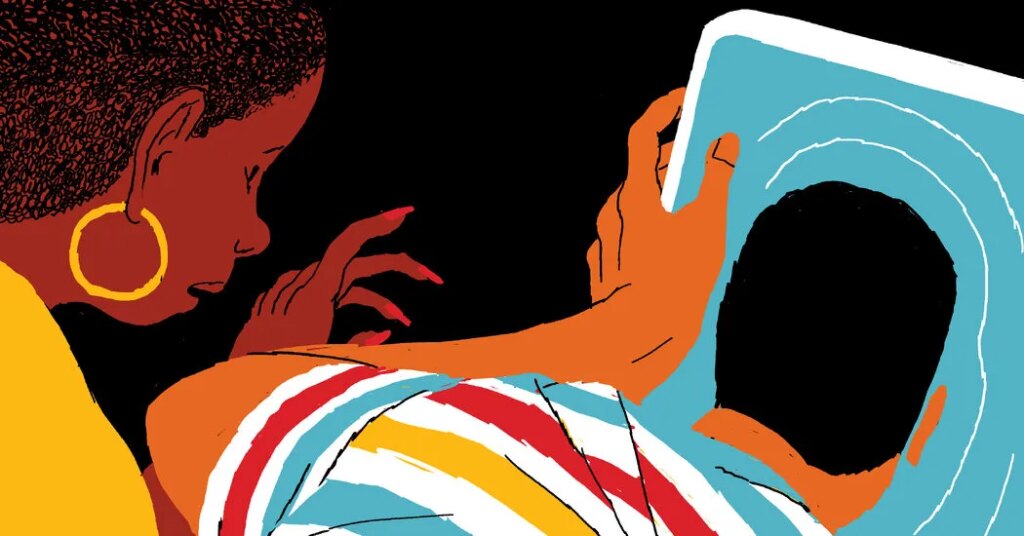
Mine is not a new fear, and I realize it is born out of a kind of nostalgia. From the pollster and public opinion researcher Daniel Cox’s forthcoming book, “Generation Uncoupled: America’s New Gender Divide and the Crisis of Human Connection,” I learned a new term: “attention infidelity.” Cox defines it in a somewhat unusual and expansive way: when a partner’s digital life intrudes on an in-person connection.
This kind of “infidelity” can include looking at sexually explicit material or engaging in suggestive social media interactions, but more often it is just the banal distraction of dead-eyed scrolling. “Instead of reaching for each other,” Cox explains, “we snatch up our digital devices that flood us with an endless stream of hyper-curated content.”
Though couples of any age experience this to some degree — my husband and I try to leave our devices in the kitchen after dinner so we can actually talk to each other — people like us who got together before the smartphone at least had the benefit of cementing our bonds with long stretches of concentrated attention. That kind of sustained focus breeds deeper understanding across differences and more grace.
Some may dismiss this kind of worry about young people’s nascent relationships as a technological moral panic. But Cox, who is the director of the Survey Center on American Life at the right-leaning American Enterprise Institute, has compiled a list of sobering statistics that show that screens are a driving factor in how disconnected teenagers and 20-somethings are from one another.
Gen Z-ers, the first generation that can’t remember a world without smartphones, participate less in “embodied social experiences” than their counterparts in every other generation. They’re less likely to work, go to church, attend parties, date or play sports, Cox notes. About half of teenagers describe themselves as “almost constantly” online. There is no other change that has occurred in the past few decades that would explain this unique decline.
Young people’s very online isolation, which was worsened by the Covid lockdown, means they have much less practice interacting with new people and navigating the usual friction and established norms. This, Cox writes, has left them lonely, unmoored and distrustful of each other.
While dating has always been challenging and provided fodder for complaint, today’s teenagers and 20-somethings have a starting point of greater suspicion, which can be poison for the creation of romantic relationships. Drawing on large surveys, books and qualitative interviews with young people, Cox reveals how fearful they are of being vulnerable, because any misstep can lead to global and permanent humiliation on social media.
The example of “West Elm Caleb” came to mind when I was reading Cox’s book. Caleb was a New Yorker who went viral in 2022 because a few women posted about how he would ghost them instead of breaking up with them properly. What followed in the wake of his virality was “a massive online harassment campaign against a fairly average 25-year-old whose biggest crime so far is being a bad communicator,” as Rolling Stone’s Brittany Spanos put it. The rise of online dating, where relationships start on digital territory, only exacerbates this dynamic.
This kind of technologically driven apprehension particularly affects heterosexual coupling. In a phone call, Cox told me that while there have been gender divides in every era, what is new for Gen Z-ers is the way the algorithms of social media are warping their views of all kinds of interactions and reinforcing “initial biases.” Cox cited a 2025 Washington Post analysis of over 1,000 users, which found that “gender is one of the biggest predictors of what’s in your feed.”
In the worst cases, gender-specific feeds lead to misogynistic manosphere influencers gaining a foothold in young men’s minds, which Cox rightfully condemns as toxic in his book. But our feeds are also creating news silos that may affect our perception of the world in more subtle ways. At minimum, they mirror a lack of a shared reality that might provide a basis for conversation and connection. (I saw this in action when I discovered that my husband knew nothing about the Lindsay Clancy verdict, even as I had been served wall-to-wall content about it for weeks.)
Two things give me hope about the social and romantic lives of young people. One is that at least some Gen Z-ers seem to know what they’re missing. Ethan Hawke, who played Jesse in “Before Sunrise,” told The Times in 2020 that his daughter watched the movie with friends, “and there was a certain envy they had for a time where you didn’t have email. Life insisted that you live in the moment more.” Having seen technology colonize their lives, they refuse to give another inch to A.I.
The other is that Americans in a wide variety of demographics are disgusted by the way screens have come between them and other people, and want to create a better world for our children. Cox is most certainly to the right of me, and while I did have some partisan quibbles with his book, I overwhelmingly agreed with his broad analysis and specific dismay with the status quo. He understands something I also hold to be true: giving another person your full attention is a gift, one we should all be more conscious of giving each other.
End Notes
-
I am sick about the sexual assault allegations at Cornell. Beyond blind rage I don’t have anything particularly coherent to say about it for now, but I have been doing a lot of reading. First, I recommend this article from May in The Times about New York State’s unfair and outdated rape laws, and how they make it “difficult to charge people with rape if the accuser chose to become intoxicated.” I also recommend reading this New York magazine interview with two editors from The Cornell Daily Sun about their reporting on the case.
-
Finally — in a sadly related issue — The 74, a nonprofit newsroom focused on education, recently published an investigation into almost 2,000 child sex abuse claims involving New York State K-12 schools. These claims were made because of a 2019 law that “allowed any living survivor of childhood sexual abuse to bring a civil case during a two-year look-back window and permanently extended the statute of limitations from age 23 to 55 for future civil cases,” explained the reporter, Amanda Geduld. Nearly one-fifth of these claims were made against adults who had access to their victims through schools. “Multiple teachers were credibly accused of sexual abuse in one school, and then permitted to quietly move on to a new one,” Geduld found.
Feel free to drop me a line about anything here.
The post ‘Attention Infidelity’ Is Ruining Romance appeared first on New York Times.