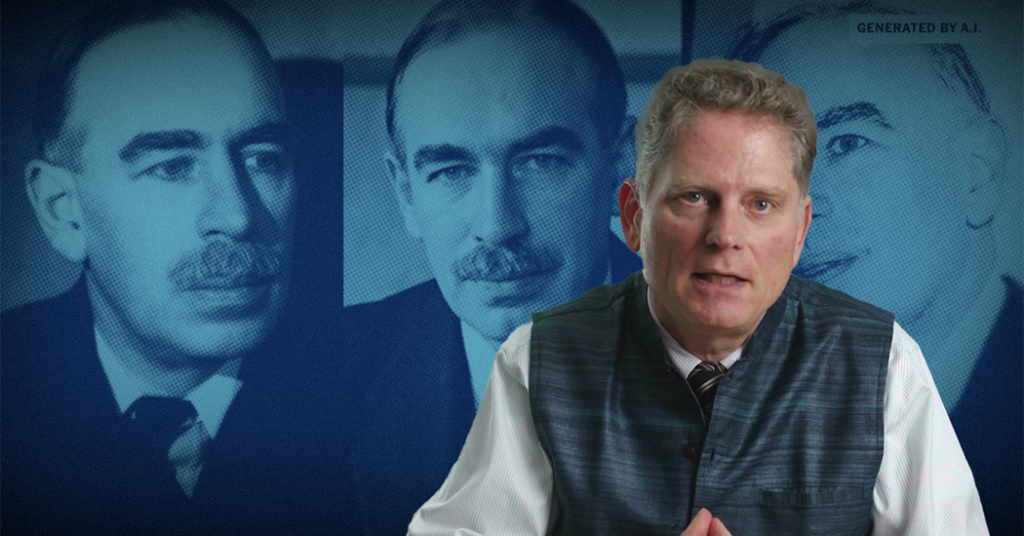
To understand how A.I. will affect our future, we’re looking to the past.
Nearly a century ago, the legendary economist John Maynard Keynes predicted that technology would significantly increase productivity and reshape how we live. Today, as A.I. capabilities accelerate, technologists have similar claims.
But what would Keynes say about this moment?
The Princeton University economist Markus Brunnermeier set out to answer this very question. Using an A.I. agent trained on more than 12,000 pages of Keynes’s writings and transcripts, along with the few available recordings of him, Brunnermeier and his team built a bot designed to answer questions in Keynes’s voice and style. He then had an in-depth conversation with the Keynes bot about the future of work and what happens to society when technology changes what people do for a living. Times Opinion, in collaboration with Brunnermeier, distilled those conversations into a short exchange.
The result is a revealing conversation with a Keynes who never lived to see the A.I. age — and a trenchant warning from his A.I. bot.
(The New York Times has sued OpenAI and Microsoft, claiming copyright infringement. The companies have denied those claims.)
How the Keynes bot Was Created The economist Markus Brunnermeier and the researcher and Ph.D. student Pablo Balsinde built a bot using ChatGPT to create the Keynes A.I. The bot was instructed to draw primarily from Keynes’s seminal essay “Economic Possibilities for Our Grandchildren” (though the model was also provided with his larger body of work) and to answer questions in his style, which the pair described as “first-person, early 20th century British cadence, restrained wit.”
According to the team behind the bot, its initial responses were often long-winded and unclear. To improve them, the researchers “asked the GPT to rephrase, prompted it to reply using famous quotes from Keynes and cut parts of responses.” While the language was generated by the model, the responses were edited by the research team for clarity and brevity.
For the visuals, the team uploaded a public domain image of Keynes and used DeepSeek to alter the environment, placing him behind a desk. To create audio resembling Keynes’s voice, the team used a recording of Keynes from the BBC as a reference.
Below is an edited transcript of this video. We recommend watching it in its original form for the full effect. You can do so using the video player above.
Narrator: This is John Maynard Keynes, one of the most famous economists who ever lived.
He died in 1946. Yet in the last century, we have looked to his teachings many times. And if you stick around for the next five minutes, maybe he’ll have something to teach you about how A.I. might change our lives. But first, a little background.
According to the Encyclopaedia Britannica, John Maynard Keynes revolutionized economic theories. He is widely considered the founder of modern macroeconomics.
Archival clip of John Maynard Keynes: It is a wonderful thing for our businessmen to taste hope.
Narrator: There are numerous biographies on Keynes. But Lord Robert Skidelsky is considered to have written the definitive account of Keynes’s life and work — in three volumes.
Keynes’s essays and books have been cited in numerous articles. There’s a Keynes rap.
Clip of “Fear the Boom and Bust: Keynes vs. Hayek”: John Maynard Keynes wrote the book on modern macro. The man you need ——
Narrator: There are many groups dedicated to Keynes’s philosophy around the world. Harald Hagemann is the honorary chairman of the German-speaking society.
Archival clip of Harald Hagemann: Welcome to all of you.
Narrator: John Maynard Keynes was Charles Darwin’s granddaughter’s brother-in-law. And Keynes’s great-great-nephew starred in the 2005 smash hit movie “The Lion, the Witch and the Wardrobe.”
Tilda Swinton as the White Witch: I would very much like to meet the rest of your family.
Skandar Keynes as Edmund Pevensie: Why? They’re nothing special.
Narrator: In 1930, Keynes published a paper that predicted that technology would dramatically increase productivity in what he called “progressive countries” over the next century. At the time, people were skeptical of his argument. Sound familiar?
It’s 2026, and again, there is a fierce debate raging as to where technology is taking us.
Archival news clip: The people building A.I. earnestly believe it could kill us all ——
Narrator: Uh — not that debate.
Archival news clip: A.I. is rapidly reshaping the workplace.
Clip of Allie K. Miller on “The Mel Robbins Podcast”: You are going to expand your capabilities and your superpowers.
Clip of Gael Breton on “Authority Hacker Podcast”: The models got so good that the gain in productivity is undeniable at this point.
Narrator: So what would Keynes say about what A.I. means for our economy?
Up in the north tower of the Bendheim Center for Finance at Princeton University, the economist Markus Brunnermeier has been trying to answer this very question. And he’s taken an unorthodox approach to finding out what Keynes might think.
Markus Brunnermeier: So with the help of A.I., I built an avatar of him. I used his writings, along with an archival photo and interviews with him. Welcome, Lord Keynes.
A.I.-generated bot of John Maynard Keynes: Well, thank you, Professor Brunnermeier. For someone born in 1883 to be reanimated as an artificial intelligence is, I confess, an unexpected form of life after death.
Narrator: So you may not all approve of this. We don’t know for certain that Keynes would approve. But we did run it by his family. Remember Edmund?
Clip of Skandar Keynes: They’re nothing special.
Narrator: Well, he, along with his sister, great-aunt and great-uncle, gave us the go-ahead.
Keynes: Today I have the curious privilege of speaking with you, those very grandchildren I was speculating about 100 years ago.
Narrator: Sorry, sorry — last interruption, we promise. Keynes was British and spoke and wrote more formally than we speak today, so we’ve updated some of the language to more contemporary English and modified the conversation for brevity and clarity. You’re welcome.
Brunnermeier: Professor Keynes, when you wrote your essay “Economic Possibilities for Our Grandchildren,” it was the start of the Great Depression. A majority of Americans were poor. Education was a luxury. Yet a handful of folks were so rich, they didn’t need to work at all.
Keynes: Indeed. I predicted that by 2030, the United States could be as much as eight times richer per head. America beat that prediction: Your society is already eight times richer, and it’s only 2026.
Brunnermeier: Our lives are not perfect, but overall, we are much better off than we used to be. Technological advancements lifted more than one billion people out of poverty, even as the world’s population quadrupled.
Keynes: Absolutely. I also predicted that in four years, you would be living lives of such material abundance that everyone would need to work far less, perhaps 15 hours a week. From what I can tell, that has not come to pass.
Brunnermeier: Correct. But now we have artificial intelligence. Do you think A.I. could fulfill your prediction of a 15-hour workweek? And in four years our lives could be predominantly ones of leisure?
Keynes: Unfortunately, I see the emergence of A.I. introducing new challenges. I fear you may end up with skilled and overworked professionals with money but no time, and the rest of society with time but no money.
Brunnermeier: Why?
Keynes: Due to the concentration of A.I.’s potential, as A.I. takes over tasks that are more and more qualified and sophisticated, it will bring an increased concentration of expertise into the hands of a limited few. Those people might, in the future, be managing the whole economy by themselves.
Narrator: At this point in the video ——
Clip of “Once in a Lifetime” by Talking Heads: You may ask yourself.
Narrator: Which group will I belong to? Well, tighten your seatbelts, because the Keynes Bot is about to get darker.
Brunnermeier: There’s something else in your 1930s essay that haunts me. You warned that humanity might suffer a “nervous breakdown.” That we have been bred to struggle against scarcity and when that struggle is removed, we won’t know what to do with ourselves. Does that still hold?
Keynes: Yes, though it might split the population into two groups, each suffering differently.
The first — those still employed and dominating the new technology — burn out. They make work their whole identity, and so when A.I. absorbs more of what they do, they do not step back. They grind harder at whatever the machine cannot yet handle, trying to prove they are still essential.
The second group troubles me more. The displaced lose something money cannot replace: the quiet daily reassurance that someone needs them to show up. They may question their own worth. And it can take a very long time — perhaps a generation — to find a new purpose. If the gains are not shared, they will also suffer materially. So the struggle against scarcity would not end for them. It would just be exacerbated by a lack of purpose.
In any case, there might be not only widespread unemployment, but a deeper risk: the strain on democracies, and the fraying of the bonds that hold a society together.
Narrator: According to the Keynes Bot, the haves and have-nots both could have serious nervous breakdowns. Are you wondering if there’s an overlooked Option C? Markus?
Brunnermeier: Is this terrible future inevitable?
Keynes: Not at all. Whether A.I. ends up as a source of broadly shared prosperity and purpose or a machine for manufacturing a new dominant class of wealthy and powerful is not preordained by the technology itself. It will be determined by your government and whether it has the political courage to use its laws and its tax systems to ensure that A.I. will work to the benefit of all of society’s citizens.
Brunnermeier: Thanks a lot for your insights, Lord Keynes.
Keynes: Thank you, Markus. The central question remains the same: What shall be done with the growing powers of production and invention? The outcome is up to you to decide.
Narrator: OK, so what have we learned? Well, if we’re going to thrive, let alone survive, the power of A.I. can’t end up in the hands of the few.
It’s obvious: We need ongoing regulation and government intervention. Even an A.I.-reincarnated economist can see what’s on the line: Our livelihood. Our sanity. Our future.
This video was produced by Sarah Kramer. It was edited by Mehron Abdi. The associate producer is Rebecca Shaid. Additional production by Suein Hwang. Additional editing by Stephanie Shen. Fact-checking by Julie Beer. Cinematography by Nick Midwig. A.I. production and engineering by Pablo Balsinde. Mixing by Isaac Jones. The postproduction manager is Mike Puretz. Audience strategy by Kristina Samulewski and Shannon Busta. The executive producer of Opinion Video is Erica Berenstein. The director of Opinion Video is Jonah M. Kessel. The director of audio engineering is Isaac Jones. The deputy director of Opinion Shows is Alison Bruzek. The director of Opinion Shows is Annie-Rose Strasser. The head of Times Opinion is Kathleen Kingsbury. Special thanks to Soumaya Keynes.
Opinion Video combines original reporting with creative storytelling to produce visually transformative commentary. Pitch a video guest essay here.
The Times is committed to publishing a diversity of letters to the editor. We’d like to hear what you think about this or any of our articles. Here are some tips. And here’s our email: [email protected].
Follow the New York Times Opinion section on Facebook, Instagram, TikTok, Bluesky, WhatsApp and Threads.
The post What Would John Maynard Keynes Say About A.I.? The Keynes Bot Told Us. appeared first on New York Times.