The Israeli flag hanging outside a New York town hall disappeared just weeks after it was raised in solidarity with the victims of the 2023 Hamas-led attacks on Israel. Shortly after, two men were accused of stealing the flag during an anti-Israel protest.
The suspects were anti-Zionist Hasidic Jews who oppose Israel. Under their interpretation of religious law, they believe that establishing a Jewish state before the Messiah’s arrival is forbidden. Both men were initially charged with hate crimes, but the case ended quietly after they paid a fine and pleaded guilty to a lesser charge of disorderly conduct in early 2024.
Now, one of those men is facing deportation.
Federal immigration officers in August detained Yehonatan Ovadia, a 35-year-old Israeli citizen, after revoking his legal status because of the flag incident. Mr. Ovadia — a religious teacher who says that he participated in the protest but did not tear down the flag — has been in the United States since 2022 on a visa for religious workers.
His lawyers, who filed a 27-page lawsuit in Manhattan Federal District Court on Aug. 29 requesting his release, argued that the Trump administration was retaliating against his protected religious and political speech. Federal immigration officials have targeted noncitizens who engage in behavior the government regards as antisemitic.
Though federal officials did not cite antisemitism in revoking Mr. Ovadia’s legal status, his lawyers have accused the Trump administration of conflating their client’s anti-Israel activism with antisemitism.
“He’s against the Israeli government and the existence of the state of Israel for religious reasons, but to claim that he’s an antisemite is the peak of absurdity,” Eric Lee, one of his lawyers, said.
Immigration and Customs Enforcement agents arrested Mr. Ovadia after he had been summoned to immigration court in Manhattan on Aug. 28. He is being held at the Metropolitan Detention Center in Brooklyn, a federal prison where ICE also holds some detainees.
In a statement, the Department of Homeland Security, which oversees ICE, said that Mr. Ovadia had “overstayed his welcome and refused to depart” after his legal status was revoked.
“It is a privilege to be granted a visa or green card to live in the United States of America,” the statement said. “The Trump administration acted well within its statutory and constitutional authority, as it does with any alien who advocates for violence, glorifies and supports terrorists, harasses Jews and steals property.”
Mr. Ovadia, a husband and father of five, is part of a large enclave of ultra-Orthodox Jewish people in Rockland County, about an hour north of New York City. The area is heavily populated by Hasidic groups who commit to a traditional, insular lifestyle, and has many yeshivas.
While there is significant support for Israel among Orthodox Jews, Mr. Ovadia belongs to an ultra-Orthodox Hasidic branch known as Satmar. It is the largest Hasidic group in New York and is opposed to Zionism and the state of Israel on theological, not political, grounds.
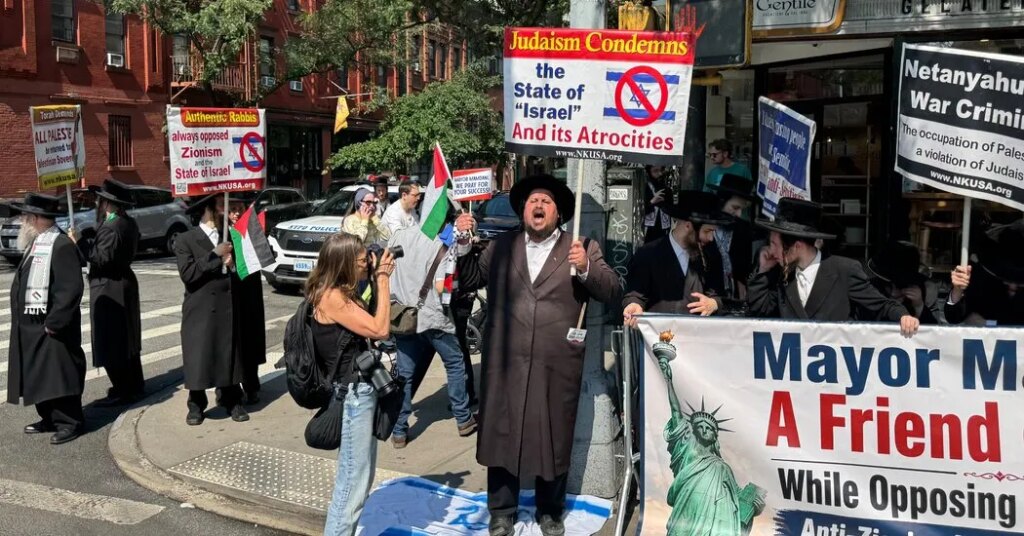
Mr. Ovadia appeared to belong to a smaller grouping of politically active Satmars who not only oppose Israel, but have aligned themselves with the Palestinian cause. Mr. Ovadia frequently attended anti-Israel marches with other Satmar Jews wearing black coats and hats, and often flew the Palestinian flag.
“We demonstrated for Gaza, for the liberation of Gaza, for the rights of the Palestinians and to show to the world that the Jews, real Judaism, want to have peace,” Mr. Ovadia said in a brief phone interview from detention.
The flag controversy began on Oct. 12, 2023, when the supervisor of Ramapo, a town in Rockland County, mounted a large Israeli flag on its town hall, five days after Hamas fighters killed an estimated 1,200 Israelis and took dozens of hostages.
“We have people in Ramapo who have friends and relatives in Israel, and we stand with them as well,” the supervisor, Michael Specht, a Democrat, told a crowd of about 60 people at the time. (Mr. Specht did not respond to a request for comment.)
About a month later, as Israel’s retaliatory strikes killed and displaced thousands in Gaza, residents who were opposed to the display of the Israeli flag on a government building held a demonstration.
Mr. Ovadia and other Satmar Jews saw the flag’s display as an endorsement by their town of a state “whose existence their religion holds to be forbidden,” his lawsuit said. A state law prohibits municipal buildings from displaying a foreign flag except under limited circumstances.
Mr. Ovadia said that he drove several people in his van to protest the flag on Nov. 13, 2023, helping gather about 20 Jewish people outside the town hall. Also present, Mr. Ovadia said, were people affiliated with the anti-Zionist Neturei Karta, a fringe, ultra-Orthodox organization whose political activism has been condemned by mainstream Satmars.
“We wanted to express our opinion legally, peacefully,” Mr. Ovadia said.
Surveillance cameras captured four or five men in traditional Hasidic clothing ripping the flag from the town hall before two men destroyed it with scissors, according to police records reviewed by The New York Times.
Mr. Ovadia said that a friend had torn down the flag, and that he had opposed the action and tried to leave the demonstration immediately, an account that he later shared in writing with the federal government.
Two days after observing Mr. Ovadia’s van on the surveillance footage, police officers pulled him over and questioned him. He told the officers that while he had driven people to the demonstration, he did not know where the flag was, according to police records.
Mr. Ovadia was arrested and charged with criminal mischief, petit larceny and conspiracy — all as hate crimes. He was released without bail.
The criminal complaint, which accused him of stealing the flag, said that Mr. Ovadia and others “were motivated to participate in this act because of their hatred of the existence of the Israeli state.” The police arrested a second Jewish man in connection with the episode.
The hate crime charges were dropped.
In February 2024, Mr. Ovadia pleaded guilty to disorderly conduct, a violation under New York law, but not a crime. He paid a $200 fine and an additional $125, according to his lawsuit.
“I said, ‘You know, I don’t have power, I’m out of money, I have no time, I am a teacher, I need to teach students every day,’” he recalled. “‘Let’s end this with disorderly conduct.’”
The following year, President Trump returned to power and issued an executive order that instructed the Department of Homeland Security to target noncitizens who had participated in actions the administration deemed antisemitic. Several international students, including Mahmoud Khalil, a Columbia University graduate, were detained.
When Mr. Ovadia’s congregation applied for an extension of his religious worker visa in September 2025, U.S. Citizenship and Immigration Services demanded police records and court documents related to the demonstration.
The agency issued a rare split decision in May that highlights the quirks of U.S. immigration law. It agreed that Mr. Ovadia was qualified to continue working in the country, but refused to let him remain in the United States to do so, a move that stripped his lawful status and left him vulnerable to arrest.
In its denial letter, the agency said that while it had found no “conviction or commission of a crime involving moral turpitude,” it had used its discretion to deny his stay after considering “adverse factors.” Those factors included the dropped charges; the disorderly conduct violation; and police records showing that Mr. Ovadia had declined to identify other participants in the demonstration.
The immigration agency’s letter does not mention Mr. Ovadia’s activism or Mr. Trump’s executive order on antisemitism.
Federal officials charged Mr. Ovadia with remaining in the country without legal status, summoned him to immigration court in Manhattan and arrested him there last month.
“He’s very, very devoted, and he is strong-minded,” said Rabbi Leibish Iliovits, who lives in the same neighborhood in Rockland County as Mr. Ovadia and helped him settle in the United States. “He would stand up for what he believe is right, and he wouldn’t back down, but he would not harm anyone.”
Mr. Ovadia’s lawyers plan to request his release during a bond hearing on Wednesday morning in Manhattan.
Eliza Shapiro contributed reporting. Georgia Gee contributed research.
The post A Hasidic Jew Protested Against an Israeli Flag. He May Be Deported. appeared first on New York Times.