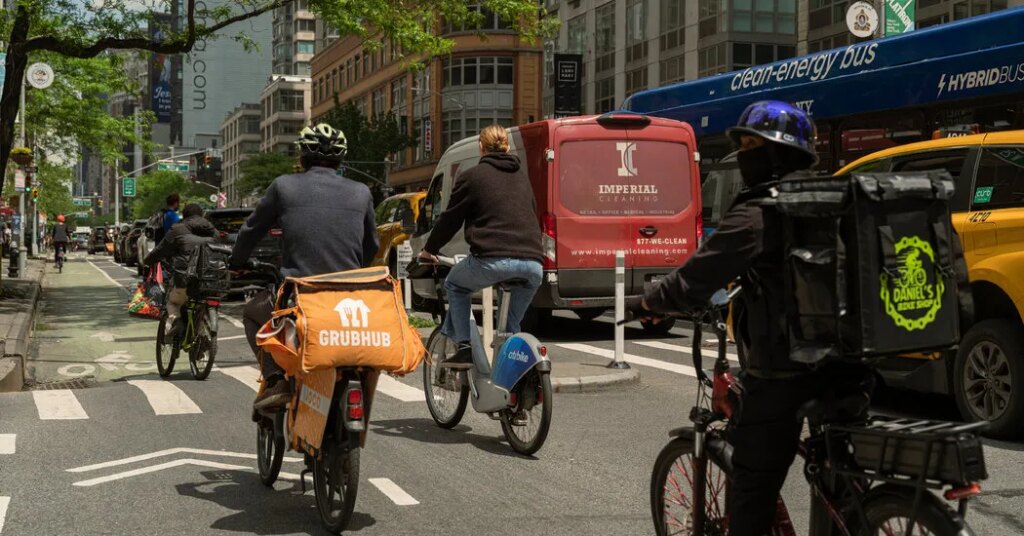
New York City lawmakers on Wednesday are set to discuss more than 20 proposals that would regulate electric bikes and scooters, after a series of fatal collisions.
The wide-ranging package — one of the largest assortment of bills ever proposed on a single topic, with measures from more than 10 council members — aims to crack down on the proliferation of devices that can far exceed the speed limit, while maintaining the rights of cyclists who are increasingly the victims of serious collisions.
The proposals include a plan to ban the sale of a subset of e-bikes called “class 3,” which can travel much faster than the 15 mile-per-hour speed limit for such devices, with the goal of eventually making them illegal to ride.
Other bills would force food-delivery companies to obtain licenses, carry liability insurance and more closely monitor its workers; require the users of ride-share services like CitiBike to confirm they’ve reviewed the rules of the road; mandate new speed-reducing features in a number of bike lanes; and create a free- or low-cost trade-in program for cyclists who own dangerously fast bikes and scooters.
But various street safety advocates say the proposals have fallen short of their expectations: Some feel the package does not go far enough to enforce traffic laws, while others fear that some of the rules will discourage cycling and expose delivery workers, a largely immigrant work force, to more interactions with the police.
Those in the first camp include street-safety groups who are frustrated with the council’s lack of support for the proposed Priscilla’s Law, named after Priscilla Loke, an educator who was killed in 2023 by the rider of an electric Citi Bike. The state bill would require all electric bikes and scooters in New York to be registered and display license plates.
Janet Schroeder, the director of the NYC E-Vehicle Safety Alliance, a street-safety group that supports the law, said the council’s current plan was mostly “fluff,” if it does not create a registry to track cyclists who break the law.
“None of those 23 bills calls for personal accountability for the rider,” Ms. Schroeder said.
But some cycling advocates believe the proposals don’t focus enough on the safety of bike and scooter riders, who have been seriously injured or killed in a growing number of crashes. A vast majority of fatal crashes in the city involve cars and trucks, not cyclists.
Kate Slevin, the executive vice president at Regional Plan Association, an urban planning think tank, said the new measures should take into account the growing number of commuters and workers who use the devices.
“Cars and trucks are still the most dangerous, in terms of street safety,” she said. “We don’t want to discourage people from using bikes and e-bikes.”
Ben Furnas, the executive director of Transportation Alternatives, a street safety and cycling advocacy group, said he supported the effort to end the sale of dangerously fast e-bikes and scooters, but not Priscilla’s Law, because a license plate requirement would put an undue burden on riders, especially lower-income delivery workers who rely on e-bikes.
This year, New Jersey passed a licensing and registration requirement similar to the one proposed by state lawmakers, and critics have said it has led to falling sales of e-bikes in the state.
Even as lawmakers look to revise e-bike enforcement, the city has already made several street safety improvements.
Traffic deaths are down about 30 percent since 2014, after New York adopted a far-reaching set of street safety policies called Vision Zero, according to the Department of Transportation.
The city is on pace to have one of its safest years for street traffic since 1910, when record keeping began. Through Sunday, there were 149 recorded traffic fatalities, fewer than in any comparable period since 2018.
But a series of recent traffic collisions, several of which have killed e-bike riders, have raised concerns that the city has not accounted for the mix of cars, pedestrians, cyclists and users of other so-called micromobility devices, like scooters, that now share the road.
On Monday, a dump truck driver struck and killed a 50-year-old woman who was riding an e-bike on 34th Street, a congested commercial thoroughfare in Midtown Manhattan. The woman, who has not been identified, was the 20th cyclist killed this year, up from 15 in the same period last year. All but three of the cyclists killed this year were riding an e-bike.
Eleven people were also killed while riding stand-up scooters this year, up from five in the same period in 2025.
The use of electric bikes and scooters soared in New York City after 2020, when the state legalized a range of the devices for street use.
But there is still confusion among consumers about which class of vehicles is safe — and legal — to operate.
Stand-up electric scooters are permitted if they are under 100 pounds and have a maximum speed of 20 m.p.h. Electric bikes that can exceed 25 m.p.h. are illegal. The speed limit for all electric bikes and scooters is 15 m.p.h.
The post After Fatal Crashes, N.Y.C. Lawmakers Seek to Regulate E-Bikes appeared first on New York Times.