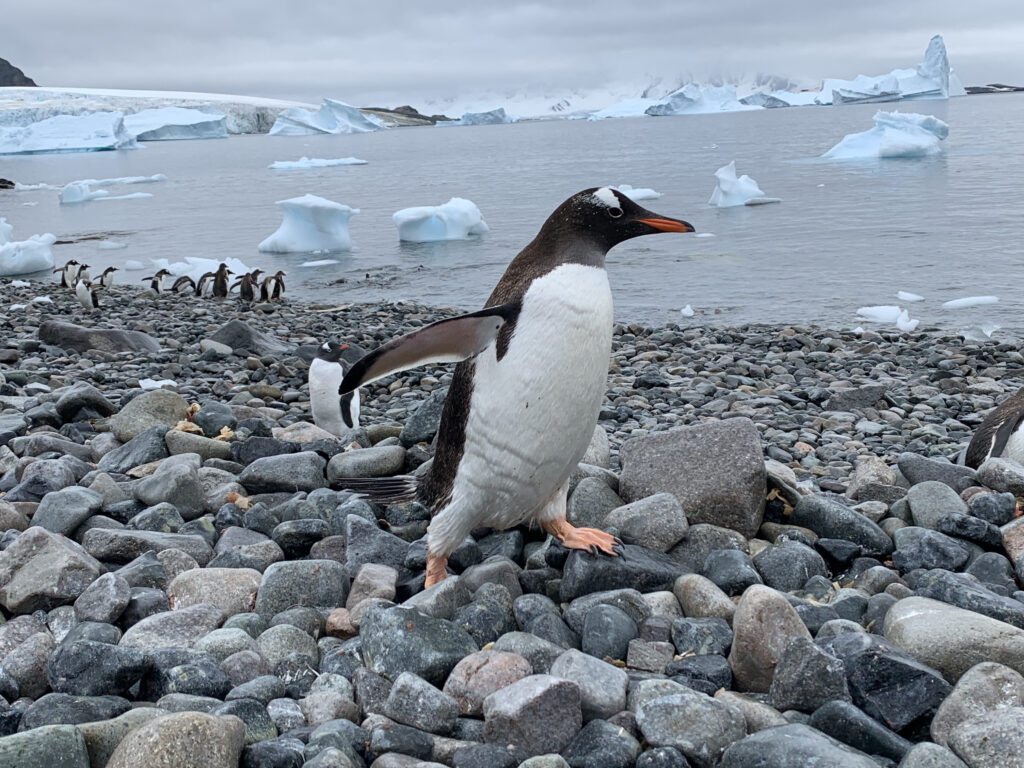
Scientists have for the first time in more than 100 years identified a new species of penguin thanks to DNA analysis.
The gentoo penguin found in the Antarctic and on remote islands in the Indian Ocean had historically been treated as a single species. But researchers were able to show that over hundreds of thousands of years, the gentoo has diverged into four distinct evolutionary lineages, each of which the researchers say should be its own species.
Of the northern gentoo, southern gentoo, southeastern gentoo and eastern gentoo, the southeastern was previously unknown.
The group of 22 researchers — scientists, conservationists and penguin experts spanning five continents — published their findings in April in Communications Biology, a biological sciences research journal.
The southeastern gentoo hadn’t been identified before because its differences become apparent only through analysis of its genetic code.
“One of these was previously unrecognized because … it looks like every other gentoo,” the University of California at Berkeley said in a news release. “Yet it is clearly genetically different — what scientists refer to as a cryptic species.”
UC-Berkeley researchers led the multiyear study with researchers from Universidad de Los Lagos in Chile.
“Bringing together researchers across continents allowed us to uncover a remarkable new penguin species — and revealed just how urgently these fragile ecosystems need our protection,” Rauri C. K. Bowie, one of the researchers, told The Washington Post in an email Tuesday.
Catch up quickly every weekday morning with a rundown of the 7 most important and interesting stories. Sign up for The 7 newsletter.
The post Scientists identify new species of penguin, first in more than a century appeared first on Washington Post.