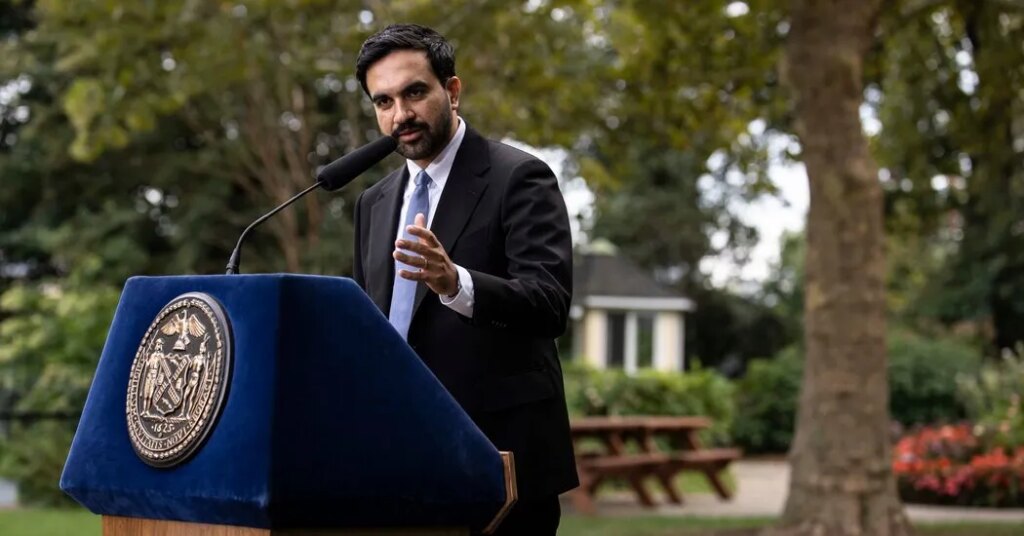
After months of tension with some Jewish leaders in New York, Mayor Zohran Mamdani on Tuesday released a report on antisemitism in New York City, laying out ways to combat hate crimes against Jews while sidestepping any politically fraught discussion of Israel.
Throughout the 35-page report, Mr. Mamdani’s administration details how it intends to take on antisemitism, including with tens of millions of dollars it has already allocated for hate crime prevention, as well as programs to continue celebrating Jewish traditions.
Mr. Mamdani, a longtime critic of Israel, has spoken less about the issue in recent weeks, after acknowledging in a widely watched video in July that he lacked the authority to arrest the Israeli prime minister, Benjamin Netanyahu, as he had promised to do. In August, a group of rabbis beseeched the mayor to pay greater attention to the effects his criticisms could have on the city, which is home to the largest Jewish population outside Israel and where concerns about antisemitism remain high.
The report’s omission of any discussion of the Israeli-Palestinian conflict reflects the sensitive and fraught politics around the issue. Prominent Jewish leaders say the growing opposition to Israel and the war in Gaza has at times spilled over into antisemitic rhetoric. Supporters of the Palestinian cause, including some progressive Jewish groups, say they should be free to critique Israel’s conduct without being accused of antisemitism.
The report recommends continuing and expanding many existing city policies, such as teaching public school students about the Holocaust and providing training to city workers on “understanding Jewish experiences.”
There are also new ideas, if modest, including highlighting the contributions of Jewish New Yorkers on the thousands of LinkNYC kiosks that provide Wi-Fi coverage on city streets, and a pledge to demand more federal support for educational centers and museums about the Holocaust in the city.
The report comes at a moment of particular significance for Jews around the world, who are celebrating the High Holy Days amid increased fears of antisemitic violence.
City Hall released the report less than a week after Mr. Netanyahu called Mr. Mamdani antisemitic while addressing a global audience at the United Nations. Mr. Mamdani said Mr. Netanyahu, who is facing re-election next month, had “used his speech to repeat baseless lies meant to sanitize his genocide of Palestinians.”
An independent United Nations commission, as well as some international and Israeli human rights groups, have also accused Israel of committing genocide in Gaza; Mr. Netanyahu and his government have vigorously denied the accusations, as have some independent scholars.
During a briefing held via video call on Monday night, several elected officials pressed staff members from the Mayor’s Office to Combat Antisemitism, which produced the report, about its omission of the controversy surrounding Israel, noting the mayor’s stance on the issue.
Michael Novakhov, a Republican assemblyman, told Phylisa Wisdom, who leads the office, that “the main source of antisemitism in our city at the moment is Mayor Mamdani,” according to a recording of the call obtained by The New York Times.
Ms. Wisdom said at the briefing that all Jewish New Yorkers deserved protection, including those “who disagree with the mayor on all manner of things and whom the mayor may disagree with as well.”
Mr. Novakhov, whose district includes several largely Jewish areas of Brooklyn, pointed out that Mr. Mamdani had repeatedly called Mr. Netanyahu a war criminal. The mayor has called for the arrest of Mr. Netanyahu; the prime minister was accused of war crimes in 2024 by the International Criminal Court, which has issued a warrant for his arrest. He has denied the charges.
During the call, Jeffrey Dinowitz, a Democratic assemblyman from the Bronx, called attention to the mayor’s use of the term “genocide” to refer to Israel’s treatment of Palestinians, saying that such language “kind of gives permission to some people to engage in antisemitic action.” The term is not used in the report, but it is one that the mayor uses frequently, including during an interview Tuesday morning on WNYC.
The report highlights the increased resources Mr. Mamdani has directed to hate crime prevention — $29 million annually, up from $3 million — and his administration’s relaunching of a working group to support security for synagogues and other Jewish cultural centers.
“For generations, Jewish New Yorkers have sustained our city,” Mamdani said in a two-and-a-half-minute video accompanying the report. He ticked off accomplishments by famed Jews and Jewish institutions, like the composer Leonard Bernstein and Katz’s Delicatessen in Manhattan.
“Today, we hold a responsibility to sustain and protect our Jewish neighbors,” he said, “a responsibility that belongs to each of us.”
Amy Spitalnick, chief executive of the Jewish Council for Public Affairs, applauded the report for outlining policies that rely on an array of government agencies, but she questioned what she considered its limited description of antisemitism.
An introduction to a section entitled “Statistics and polling on antisemitism” notes that American Jews have reported a marked rise in antisemitism in the past decade, pointing to the 2017 white nationalist march in Charlottesville, Va., and the 2018 Tree of Life Synagogue massacre in Pittsburgh, which was perpetrated by an man active in far-right extremist online communities. It also notes that antisemitism, and acts of antisemitic violence, have only grown in recent years. It makes no mention of acts motivated by anti-Israel sentiment since the war in Gaza began.
“Obviously there is a very real threat of right-wing antisemitism,” Ms. Spitalnick said. “The report should also recognize that in the last few years, we’ve seen increasing violence targeting Jews under the guise of protesting Israel.”
Hate crimes against Jews and Muslims increased in New York City after the deadly Hamas-led attack on Israel on Oct. 7, 2023, to which Israel responded with a bombing campaign in Gaza that is responsible for more than 70,000 deaths of Palestinians, according to Gaza’s health ministry, a count that does not distinguish between civilians and combatants but includes thousands of children.
During the first eight months of this year, confirmed hate crimes in the city rose 16 percent overall, and antisemitic incidents rose 9 percent, Police Commissioner Jessica S. Tisch announced earlier this month. While Jews represent only 12 percent of New York City’s population, they comprise roughly half of all victims of reported hate crimes, according to the mayor’s report.
Several politicians celebrated the report, with Liz Krueger, a state senator from Manhattan, thanking City Hall for outlining “concrete strategies the city intends to pursue to address the growth of antisemitism.”
“It is crucial that our mayor, as the leader of our government, continues to make clear through words and actions that Jews in New York can express their religious and political beliefs safely, including those who express support for Zionism, without fear of threats, harassment or violence,” she continued.
Mr. Mamdani chose to retain the Mayor’s Office to Combat Antisemitism, a late-tenure creation of his predecessor Eric Adams, at the same time that he revoked an executive order signed by Mr. Adams that designated some criticism of Israel as antisemitic.
Criticism of Israel, and the championing of Palestinian rights, have been central to Mr. Mamdani’s political identity. As a student at Bowdoin College, he founded a chapter of Students for Justice in Palestine. As a state legislator, he sponsored legislation that would have stripped tax-exempt status from charities with ties to settler groups in the occupied West Bank.
The report released on Tuesday pointedly avoids defining antisemitism.
“New York City can and will leverage all of the tools at its disposal to combat antisemitism effectively without needing to adopt a definition for this specific form of hate,” the report reads.
But it does describe as “a useful framework” a description contained in former President Joseph R. Biden Jr.’s U.S. National Strategy to Counter Antisemitism, released in May 2023.
It describes antisemitism as: “a stereotypical and negative perception of Jews, which may be expressed as hatred of Jews. It is prejudice, bias, hostility, discrimination or violence against Jews for being Jews or Jewish institutions or property for being Jewish or perceived as Jewish.”
It added that antisemitism could take the form of discrimination based on race, religion, national origin or ethnic identity.
“However, antisemitism is not simply a form of prejudice or hate,” it said. “It is also a pernicious conspiracy theory that often features myths about Jewish power and control.”
The post Mamdani Announces Plan to Fight Antisemitism, Without Discussing Israel appeared first on New York Times.