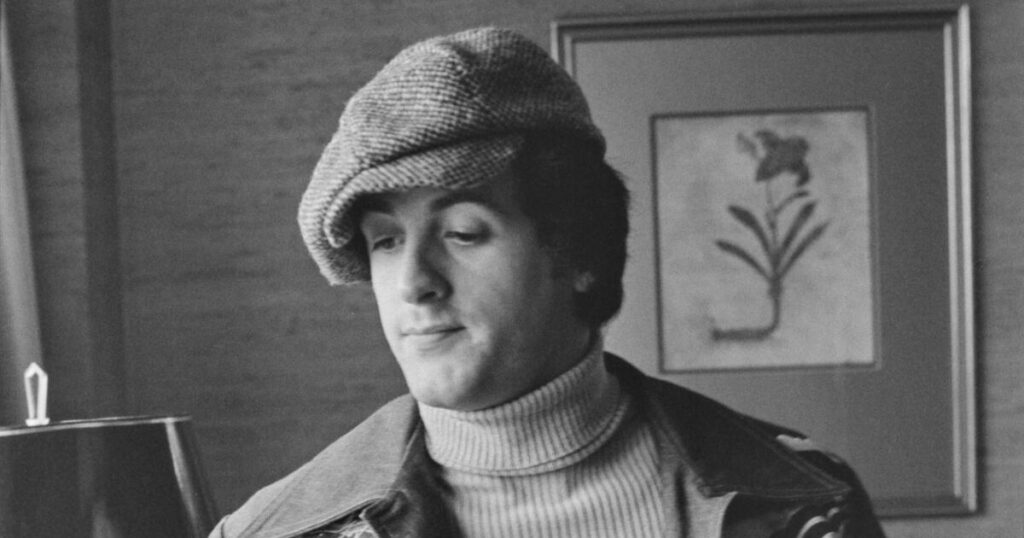
One thing is obvious upon reading Sylvester Stallone’s memoir “The Steps”: He’s no nepo baby. No one ever gave him a leg up, or pulled favors on his behalf. This breezy and insightful book, which takes the movie icon from the slums of New York to the Dorothy Chandler Pavilion, triumphant on Oscar night, is a sobering reminder of just how far Stallone had to go to make it. It’s also a primer on perseverance and tenacity, both of which the movie icon needed in abundance to find his way.
Young Sly was a prime candidate for a life of thuggery, reared by parents who had no business raising kids. Sly and his parents lived in a tiny cold water flat in New York’s Hell’s Kitchen, at a time when that neighborhood was a breeding ground for gangs and prostitution. “You learned to mind your own business, and to never walk down the sidewalk, but rather in the street, to avoid being pulled into an alleyway and robbed,” Stallone writes. The bath was a dining table; a piece of plywood was laid over it for meals. Frank Senior was a barber who dreamed of being a singer, a nasty cur who beat his two sons and verbally whittled them down to a nub. (Sly’s brother Frank Jr., four years younger, was born in Maryland and the boys grew up primarily in Philadelphia). Their mother, meanwhile, was a beautiful narcissist who was convinced she had missed her chance at a Hollywood career by marrying Stallone’s father and being saddled with two kids to raise. For Stallone, this was the scar that never healed.
Despite his parents’ showbiz failures, Stallone was convinced that he was destined for success as an actor. He managed to bum his way to Europe, where he hoped to get a proper education at an institution in Switzerland called the American College, a sanatorium that had been converted into a junior college. But he left without graduating and attended the University of Miami for two years studying drama before dropping out “a few credits short of graduating.” Stallone backpacked some more across Europe, then moved back to New York, where he lived on $34 a week in a flophouse apartment “smaller than the minimum size for jail cells recommended by the Bureau of Prisons today.”
Suffice it to say, Stallone didn’t land a cushy white-collar gig upon his return to the city. Instead, he shoveled lion poo at the zoo and worked in a deli, where he was arrested for a physical altercation and briefly found himself in “The Tombs,” New York’s notoriously violent house of detention. With no contacts or resources in entertainment, he looked for acting work in the hardest possible way: flipping through the yellow pages, finding talent agents, and knocking on their doors with his headshot in hand.
In order to feed himself, Stallone took a job as an usher at the Baronet and Coronet Theatre, a movie house on Third Avenue and 59th Street. It turned out to be the valuable education he didn’t get in Switzerland. “Whichever movies were showing, I decided to really study them,” he writes. “I wouldn’t grab a nap between shows or grab a smoke in the alley, like other ushers. I would use the time constructively and start to break down why the good films were good and bad films were bad.” Soon, he was sneaking a tape recorder into the theater, so he could study the dialogue. It was a fortuitous time to pay close attention to film: Among the movies that Stallone deconstructed were “MASH,” “Love Story,” “Billy Jack,” “The French Connection” and “Patton.”
Meanwhile, Stallone endured an avalanche of rejections from agents who felt his slurry speech and asymmetrical mouth were liabilities — the very traits, of course, that would mark him as an original in a few short years. Taking the blows like a champ, Stallone used his informal film education to write screenplays, “using a frayed record album cover as a lap desk.” If acting wouldn’t pry the door open, maybe writing would. He writes one script after another. None of them free him from the flophouse.
Then, a break. Stallone lands a small but crucial speaking role in the 1974 film “The Lords of Flatbush” alongside an unknown Henry Winkler. Emboldened, with a small mountain of spec scripts in the trunk of a junker car his father sold him, Stallone and his future wife Sasha Czack make their way out West to try their fortunes in L.A. He finds work in a few Roger Corman films, most notably “Death Race 2000” alongside David Carradine. On the set of the movie “Capone,” a drunk Ben Gazzara implores Stallone to “drive your own cab” and be the boss of your own destiny. Stallone would take that advice to heart, but it almost cost him his career.
The story of how “Rocky” got made has been oft-told, but let Stallone’s riveting retelling of the saga here stand as the definitive version. Broke and blocked in the winter of 1975, his spec scripts having failed to be produced as films, Stallone, during one of his many dark nights of the soul, decides to transmute his struggles into a compelling filmic narrative featuring a down-and-out boxer. “After all, my story is just the story of any person who has ever dreamed of doing something special or unexpected with their lives but was never given a chance,” he writes. “I thought of life as a boxing ring. When you decide to get in there, ‘life’ will hurt you if you don’t fight.”
He goes all-in on his idea, pounding out the script “like a maniac.” He writes the first draft of “Rocky” in three days. It’s all wrong. Rocky’s nobility, his goodness, is absent. He also has no goals in life, so Stallone makes him a “third-rate fighter who never really applied himself” and wants a second chance.
What follows is the most famous game of brinkmanship in Hollywood history, grippingly recounted here by Stallone. Producers Irwin Winkler and Robert Chartoff are interested in Stallone’s script, and thus a shaft of light shines on his film writing for the first time. But he has a big caveat: The script can’t be sold without Stallone in the lead role. Winkler and Chartoff refuse and offer Stallone $60,000 for the script. “In LA County,” Stallone notes, “$40,000 was the average price of a home in 1975.” Still, he turns them down, despite having $106 in the bank. The offer jumps: $75,000. $160,000. $300,000. There is a come-to-Jesus meeting in the conference room of Winkler and Chartoff’s office. $360,000 for the script and for Stallone not to act. Stallone walks out.
If the rest is history — Winkler and Chartoff relent, “Rocky” is the highest-grossing film of 1976 and wins the Oscar for best picture — it’s only because Stallone willed it so. Grit made the man; “The Steps” shows us how he did it.
Weingarten is the author of “Thirsty: William Mulholland, California Water and the Real Chinatown.”
The post Sylvester Stallone was never supposed to make it appeared first on Los Angeles Times.