“Abstract Expressionism is overrated,” snapped a veteran art world friend of mine not long ago, speaking of the maverick, heroizing American art movement that has long been a high-ranking auction-block monument. The ranking game, to which we’re addicted, can have that effect, inspiring resentment for even the most praiseworthy candidates.
And Abstract Expressionism was, and is, such a candidate. Proof? The loosely defined movement produced some of the most entrancing images in 20th-century art, as the blockbuster exhibition “Krasner and Pollock: Past Continuous,” which opens on Sunday at the Metropolitan Museum of Art, demonstrates. And it continues to be honored as a formal and conceptual model by artists in the present, as contemporary painters like Mark Bradford, Jadé Fadojutimi, Laura Owens and Amy Sillman attest in the exhibition’s catalog.
The basic format of the show is biographical, focused on the lives and careers of an artist-couple, Lee Krasner (1908-1984) and Jackson Pollock (1912-1956). (It includes more than 120 paintings from 80 lenders, slanted toward Krasner, if you’re counting, with 74 artworks, and 48 by Pollock.)
And it opens with a lyrical introductory video combining vintage photographs of them, with new footage of the still-existing house they shared as a married couple in Springs, on rural Long Island, at a time when Pollock was on his way to stardom, and Krasner was about to be overshadowed by it.
Then, right off the bat, inside the first gallery, the show does an interesting thing. It flips this historical script, and in a challengingly high-stakes way, opens with a big solo blast of Krasner: a kind of wall-of-sound lineup of a half dozen of her large abstract collage paintings from the mid-1950s, all made with cutup drawings and fragments of canvas from her own earlier paintings. With their long, thin vertical forms the pictures look, collectively, like a lineup of ghostly raised arms, but also like a garden grown wild.
Pollock is present here too, but half-hidden, and at a distance. Look to your left and you’ll see through an opening in the gallery wall one of his fantastic, mythmaking “drip paintings,” this one titled “Convergence: Number 10, 1952,” hanging, as if in midair, several rooms away.
And look closely at one of the Krasner collage pictures — the vividly colored “Bald Eagle” — and you’ll be seeing (though you wouldn’t know this unless you were told) fragments of discarded drawings by Pollock that Krasner had salvaged, cut up and painted over.
After this curatorial exercise of art-historical reset — courtesy of the Met’s adventurous organizers, David Breslin, curator in charge of the department of modern and contemporary art, and Brinda Kumar, associate curator — the show takes a more straightforward biographical tack. In a second gallery we get a small, 1930s-ish pencil-and-crayon self-portrait of the Brooklyn-born Krasner, along with some early paintings and drawings demonstrating her studio training in traditional genres (nudes, still life) filtered through a European modernist lens (Matisse, Mondrian, varieties of Cubism).
Nearby we also find a little sepia-colored, early-1930’s oil self-portrait by Pollock, here looking like a fiercely haunted E.T., along with drawings and paintings demonstrating his very different art apprenticeship under the multifarious sway of the American regionalist Thomas Hart Benton, Picasso the Surrealist and Mexican muralism, with Jungian therapy stirred in.
All these elements are apparent in a micro-re-creation of an influential 1942 New York gallery show called “American and French Paintings,” assembled by the émigré artist John Graham. Here Graham, ever alert to fresh American talent, included the up-and-comers Krasner and Pollock among the likes of Modigliani, Willem de Kooning and Stuart Davis. And it was through this show that the two met.
Krasner, an expert art-world networker, was at this point the more visible presence in that world. In fact, she’d never heard of Pollock, so tracked down the recessive, hard-drinking artist in his studio and introduced herself. Soon, they were dating. In 1945, they married and moved — in part to get Pollock away from the pull of city bars — to the isolated rural setting seen in the opening video.
At this transition point the exhibition becomes largely a Pollock showcase. In the mid-1940s his painting had begun a powerful forward trajectory, as he wrestled figure painting toward abstraction. As for Krasner, she hit a wall, creatively. She could barely work at a time when Pollock’s career was beginning to accelerate, gain notice.
It was in these early years that Krasner began to be cast, in the public eye, not as the ambitious artist she was but as the supportive spouse (and, at times, caretaker) of one, a status privately reflected in the initial assignment of studio space in the Springs house: Pollock got an upstairs bedroom to work in; Krasner got the cramped kitchen.
This spatial arrangement is succinctly embodied in two nested galleries at the Met. On the walls of the larger hang some of Pollock’s earliest purely gestural abstract works such as “The Key” (1946) and “Number 1, 1949,” forerunners of the radical, floor-worked drip paintings to come, pictures that brought a merging of paint, choreography and gravity to the point of explosion
In a small-walled gallery within that gallery is a cluster of Krasner’s paintings from the same period, produced after her fallow stretch. Most of them are tabletop-size. Some are composed as tight-weave fields of dabbed paint, others as rows of paint-drawn shapes suggesting tesserae (a mosaic table Krasner made from found materials is on display here), or Hebrew characters remembered from the artist’s Orthodox Jewish childhood. These “Little Images,” as she called them, are about focus, containment. The space feels like a meditation room, and a scriptorium.
Inevitably, and justifiably, the fully activated explosions that are Pollock’s mammoth canvases of the late-1940s and early-1950s — the ones that caused a sensation when photographs of them, and him, ran in LIFE magazine under the crazy headline “Jackson Pollock: Is He the Greatest Living Painter in the United States?” — are installed in a big open, high-ceilinged gallery at the center of the Met show, some on free-standing walls and bathed in natural light from uncovered gallery windows, all features of a stunning exhibition design by Linsen Chai.
It’s an entrancing sight, and with it a concentration on Pollock effectively ends, because sharing this central gallery with him is Krasner.
Pollock in the 1950s, like Krasner in the 1940s, suffered a bout of creative near-paralysis. But unlike her, he couldn’t overcome it. He felt he had taken the “drip” technique as far as it could go. It had been a tremendous leap, for him and for painting, but once made, it had no potential for development. It was over. And, for that reason, despite all the popular hoopla, it was, you might say, overrated. At least Pollock seemed to feel that. Alcoholism, kept at bay for some years, grabbed him hard, and in 1956 he died, drunk, in a car crash.
Just a year earlier, Krasner had had a gallery solo — her second ever — in Manhattan. It was a critical success. Eight paintings from that exhibition — all related to the grassy, sky-reaching collage pieces in the Met’s first gallery — are gathered in a circle in the big central space, rubbing shoulders with Pollock’s valedictory art. And from this point on the show belongs mostly to Krasner.
Pollock reappears in a dark-walled, chapel-like space. A handful of condolence messages to Krasner from art world figures mourning his death are on display, along with a movingly atypical late Pollock painting, “The Deep” (1953) — an image of what looks like a black fissure half-hidden behind a bank of white clouds — and a flesh-pink, weeping-eyed 1956 Krasner picture titled “Embrace.”
The succeeding galleries form a kind of telescoped survey of the subsequent two decades and more of Krasner’s career.
There was emotional darkness in that time. Aftershocks of grief over Pollock’s death, and later her mother’s, brought depression and insomnia. And the painting career that she tenaciously pursued — it was her life — remained a struggle. The art world continued to regard her — both as a woman and as Pollock’s mate — as at best second-tier, a view that persists, for the same reasons, to this day
Yet what we get, right out of the gate, from her post-Pollock work is a distinctive impression of personal joy. You find a version of such elation in Pollock’s 1950s drip painting too, but their joys are different. Pollock’s feels spacey, galactic; Krasner’s feels concretely, lovingly of this earth.
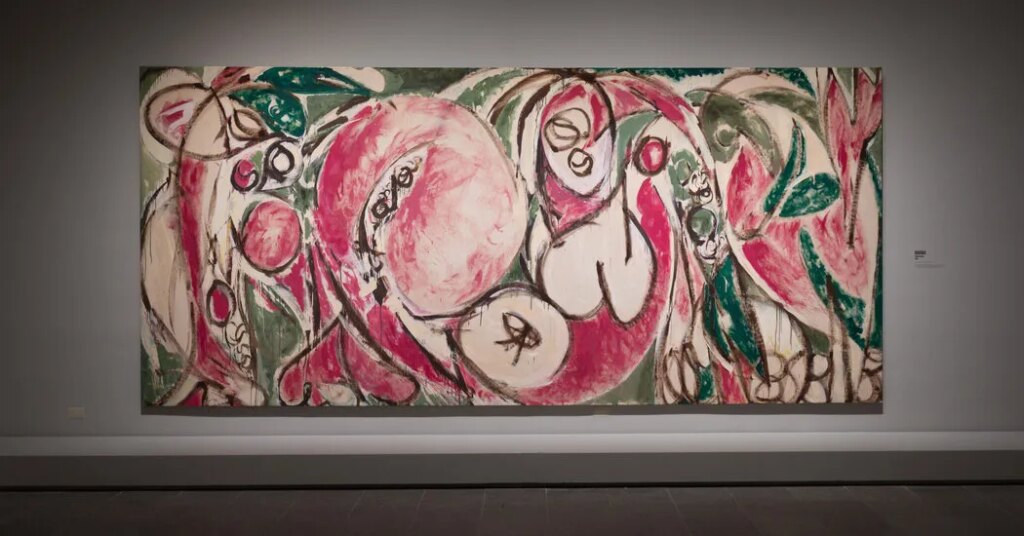
You sense it right away in her 17-foot-long magnum opus “The Seasons” from 1957 which, with its bulbous pink and green forms, exudes the visual fragrance of a Cézanne still life, and in other paintings that undisguisedly incorporate images of birds and flowers.
Darkness is certainly present in her art. The monumental 1965 “Combat” is a classic Abstract Expressionist tangle of gestural agitation, but done in un-Pollockesque shades of magenta and tangerine.
Krasner never adopted a signature style, as artists aiming to stake out marketable turf in the Abstract Expressionist camp tended to do. How does a work like her 1972 “Rising Green,” for example, with its hard-edge, solid-color forms straight from Matisse, qualify as Ab-Ex? It doesn’t. That’s all.
Ab-Ex itself, like all radical art impulses that quickly pass into textbook orthodoxy, now has to work hard to look interesting as a continuing practice. This seems even to have been the view of Krasner herself, as it appears to be for the many contemporary artists who reference the movement today.
She honored its history, of which she was an essential creator, but also took her art in diverse directions, including into her own deep past, as she does, literally, in the late work that gives the Met show its name.
In 1974 she came across a long-buried trove of her own youthful Cubist-inspired studio drawings, mostly of nudes, from the 1930s. She selected a handful, made some folds and trims, pasted them onto Ab-Ex-size canvas, and titled the result “Past Continuous.” It concludes the Met show, and brings her vital. expansive spirit, and freshly rank-maxxed art, into the now.
Krasner and Pollock: Past Continuous
Oct. 4 through Jan. 31, 2027, the Metropolitan Museum of Art, 1000 Fifth Ave., 212-535-7710; metmuseum.org.
The post A Knockout Show Resets the Record With ‘Krasner and Pollock’ appeared first on New York Times.