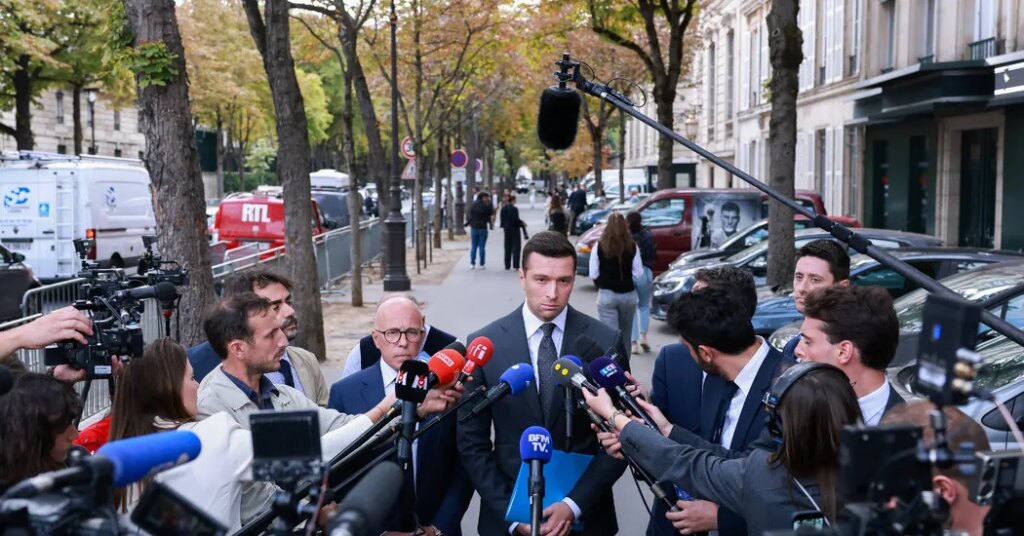
Jordan Bardella, a star of the French far right, faced condemnation and scattered calls to resign on Tuesday after an investigative news site published antisemitic messages that it said he had sent as a 17-year-old.
Mr. Bardella, now 31 and the president of France’s main far-right party, National Rally, denied making the remarks. “They are not mine, nor are they those of the 17-year-old teenager I was at the time,” he said in a television interview. He and a spokesman said his lawyer had filed a defamation suit against the outlet that published the report, Mediapart.
Among the private messages attributed to Mr. Bardella was one said to be from 2013 that accuses Jews of owning the world’s banks and seeking to dominate and rob non-Jews. Mr. Bardella was already a member of the National Rally at that time.
Mediapart did not disclose to whom Mr. Bardella sent the messages, nor on which platform they were sent. The New York Times was not able to confirm the messages’ authenticity because Mediapart is seeking to protect its source’s identity by limiting access to all the source material. But Mediapart allowed The Times to visit its offices and view some of the material.
Rival political figures quickly condemned the messages, with the head of France’s Green Party, Marine Tondelier, calling on Mr. Bardella to resign from his positions as a party chief and as a member of the European Parliament.
“The man who today presents himself as the greatest defender of Jewish men and women in France is, in reality, an obsessive antisemite,” Ms. Tondelier said on social media.
The leader of the Socialist Party, Olivier Faure, and the far-left presidential candidate Jean-Luc Mélenchon both condemned the messages. Mr. Mélenchon’s party, France Unbowed, has itself faced accusations of using antisemitic rhetoric, which it denies. France’s foreign minister, Jean-Noël Barrot, said on social media that the messages attributed to Mr. Bardella represented the “true face of the far right.”
Mr. Bardella dismissed the accusations against him as a politically motivated effort to torpedo the presidential campaign of his mentor, Marine Le Pen, whose late father founded the far-right National Front in 1972 on a mix of racism, nativism and antisemitism. Ms. Le Pen has worked to decontaminate the party, rebranding it as the National Rally and expelling her father, Jean-Marie Le Pen.
Mr. Bardella, whose parents are of Italian descent and who grew up in a working-class Paris suburb, is a conspicuous part of that effort. Last year, he visited Israel, at the invitation of Prime Minister Benjamin Netanyahu’s government. During that visit, he paid homage at Yad Vashem, the memorial to Jews murdered in the Holocaust, and took part in a conference on antisemitism.
Ms. Le Pen, 58, dismissed the reports about the messages as “madness,” in brief comments as she left a trade show on Monday. “It seems so crazy to me that it must be a fake,” she said, adding that she had “absolute trust” in Mr. Bardella. On Tuesday, she echoed Mr. Bardella’s contention that he was a victim of a conspiracy, and said she had “absolute trust” in him, but did not address the specific accusations.
The allegations come at a delicate moment for the National Rally. Ms. Le Pen has held a steady lead over all rivals in polls for the presidential election, which will be held next April. She has long cultivated Mr. Bardella as a protégé, promising that he will serve as prime minister if she succeeds President Emmanuel Macron and her party wins control of the National Assembly.
But their partnership has shown signs of strain since July, when a court ruling emboldened Ms. Le Pen to officially declare her candidacy. Although the court upheld criminal financial charges against her, it did not forbid her from running for office. Mr. Bardella, who had been preparing to run in Ms. Le Pen’s place if she were banned, was pushed back into a supporting role.
Since then, the two have diverged on some issues, including lowering France’s retirement age. Ms. Le Pen brought her niece, Marion Maréchal, into her campaign — prompting reports of friction with Mr. Bardella that both he and Ms. Le Pen dismissed.
Political analysts said it was too early to gauge how damaging the reports would be to Ms. Le Pen’s electoral prospects. But they said it laid bare the hurdles that the National Rally faced in banishing the racist legacy of its founder, Mr. Le Pen, who was convicted multiple times of inciting racial hatred.
Philippe Marlière, an expert on the French far right at University College London, said the reports undercut Ms. Le Pen’s strategy of “presenting the party as having broken with the traditional antisemitism of the French far right.”
“Bardella is not a secondary figure. He is president of the R.N. and is presented by Le Pen as her future prime minister,” he added, using the French initials for the party. “The affair therefore indirectly affects Le Pen herself.”
The critical question, Professor Marlière said, was whether the issue would spread from political and media circles into the wider population. Ms. Le Pen, who has run for the presidency unsuccessfully three times, needs to appeal to more moderate voters to prevail in the election.
In its report, Mediapart said another party member had emailed Mr. Bardella in 2013 with recommendations for books by antisemitic writers, among them Alain Soral, a French far-right figure. Mr. Bardella’s response was not published, but Mediapart said that Mr. Bardella, in a separate private exchange, praised Mr. Soral. The Times viewed the emails but was not able to verify their authenticity.
Mr. Bardella has not faced charges of antisemitism before. Having joined the party when he was 16, he rose quickly through its ranks, becoming a regional councilor at 20 and a member of the European Parliament at 25. By the time he was 30, Mr. Bardella was party president, Ms. Le Pen’s wingman and a national figure in his own right.
With Ms. Le Pen fighting charges of embezzlement, Mr. Bardella briefly became the far-right’s standard-bearer and the National Rally’s likeliest candidate for president, exposing him to prolonged scrutiny for the first time in his meteoric career.
Mediapart is an independent online service co-founded in 2008 by a former editor from the French newspaper Le Monde. It has published investigations of other prominent French politicians, among them a former president, Nicolas Sarkozy, and a former minister, Jérôme Cahuzac. Both were later convicted in court of charges related to what Mediapart reported.
Mr. Bardella, however, accused Mediapart of pursuing a left-wing agenda. He noted that its co-founder Edwy Plenel once expressed sympathy for the Palestinian militant group Black September, which killed 11 Israeli athletes and officials at the 1972 Olympic Games in Munich. Mr. Plenel has since disavowed his statements about the group, which he said he had written at the age of 20.
Mr. Bardella said he expected Mediapart to publish additional documentary evidence, which he declared would be forged. The head of Mediapart’s investigative desk, Fabrice Arfi, said the site was “ready to vouch for the accuracy” of its reporting, including in court.
Further publications could pose a further threat to Ms. Le Pen, Professor Marlière said. “Her categorical defense of Bardella carries a risk for her if the documents are subsequently established to be authentic,” he said.
The post Accusations of Antisemitism Hit a Star of the French Far Right appeared first on New York Times.