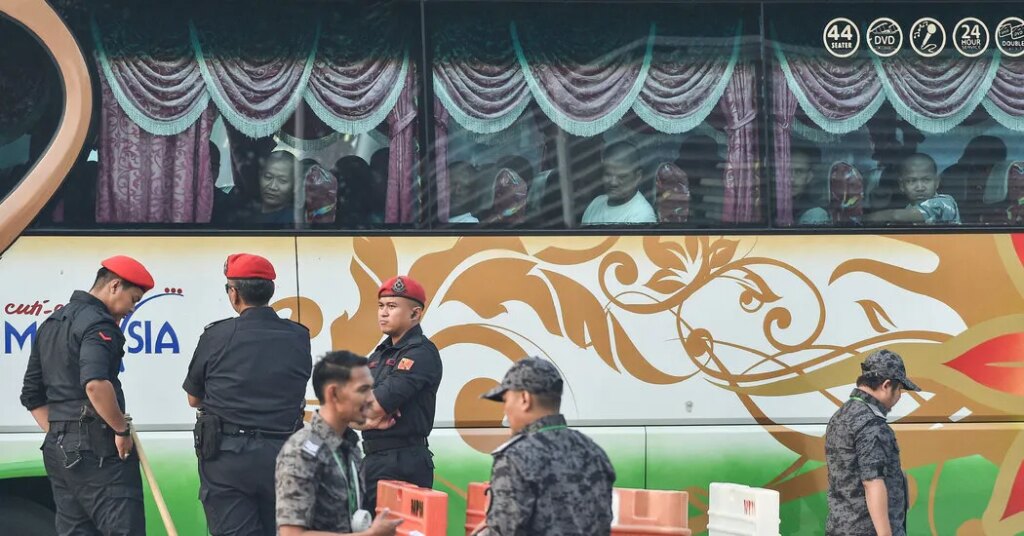
The tour buses arrived at a stadium near Malaysia’s biggest navy base well before dawn on Tuesday, carrying hundreds of migrants from Myanmar who the Malaysian authorities said had agreed to get on a ship home.
But that was not the case for Maung Kyaw, who was scheduled to be on one of those vessels, according to his sister Thida Mon.
“He did not volunteer to go back,” she said, adding that she received a call from her brother last month. “He told me that they asked him to sign a paper and told him he would be sent back by ship.”
On Tuesday, Malaysia began a multiphase repatriation of thousands of undocumented migrants from Myanmar, in a move that the migrants, their families and rights groups say endangers many lives.
Many fear that Myanmar’s military government will conscript them — men and women — on their return and force them to fight in the country’s civil war. The Rohingya Muslims who make up a large number of the migrants have a particular plight: They are stateless in their own country and have suffered what the United Nations and the United States have determined was a genocide conducted by the Myanmar military.
After the sun rose on Tuesday, more than 40 buses headed four miles northwest from Manjung Stadium to the Lumut Naval Base, where three Myanmar Navy vessels, two warships and a hospital ship were docked. A military helicopter circled above as the buses entered the base. About a thousand people then proceeded to get on the boats, while Malaysian soldiers and police stood guard.
Hundreds of thousands of people from Myanmar have fled to Malaysia over the past decade to escape a combination of civil war, ethnic persecution and a cratering economy. Many, including Rohingya refugees who have been driven into Bangladesh, try to get there by boat, taking an especially perilous journey.
Last month Malaysia announced plans to send back the first batch of undocumented migrants from Myanmar — about 1,500 people — who were being held in detention centers, saying they were a “major financial burden” and a “security threat.” Overall, Malaysia has more than 10,000 of these migrants in custody.
The Home Ministry said on Tuesday that 5,000 Myanmar nationals were slated for return because they had consented to go voluntarily and Myanmar’s government had agreed to receive them.
Malaysia does not grant political asylum to migrants. But if they are given refugee status by the United Nations High Commissioner for Refugees, it allows them to stay. The U.N. agency has granted this status to tens of thousands of Myanmar nationals in Malaysia but Malaysia is now starting its own registration system for refugees in a bid to replace the U.N. process.
Prime Minister Anwar Ibrahim of Malaysia has said he wants to repatriate about 200,000 refugees from Myanmar, including Rohingyas. Earlier this month, he said that he would hold talks with Myanmar’s leader, U Min Aung Hlaing. A former general, Mr. Min Aung Hlaing was the leader of the junta that ousted an elected government in a coup in 2021, eventually throwing the country into civil war.
Malaysia’s Home Ministry said that 1,476 individuals had boarded the Myanmar ships on Tuesday but neither the Malaysian nor the Myanmar authorities released the names of the travelers.
“The rule of law and national security will continue to be upheld, while security, welfare and interests of Malaysians will remain the priority,” the Malaysian ministry said in a statement.
If refugees were told that they would be sent back and were then made to sign a document acknowledging that decision, the signature should not be presented as proof of voluntary return, said Nickey Diamond, who is originally from Myanmar and serves on the board of Fortify Rights, a nonprofit.
“Voluntariness requires a genuine ability to say no. Without that choice, the paperwork risks turning coercion into the appearance of consent,” he said.
Min Nyan Tun, 34, an undocumented migrant, was also scheduled to be sent back on Tuesday, according to his sister Pa Pa Win, who lives in Mon State in Myanmar. He was arrested in April 2025 for living in Malaysia illegally and was held in a detention center in Kedah State, she said. She fears that once he returns home, he will be conscripted and send to the front lines of the civil war.
“Nowhere is safe for Myanmar people anymore, wherever they go,” Ms. Pa Pa Win said.
The post ‘Nowhere Is Safe’: The Migrants Being Shipped Back to a War Zone appeared first on New York Times.